Representative Charles Gerard Conn
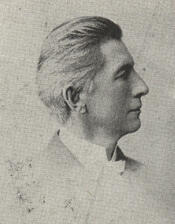
Here you will find contact information for Representative Charles Gerard Conn, including email address, phone number, and mailing address.
| Name | Charles Gerard Conn |
| Position | Representative |
| State | Indiana |
| District | 13 |
| Party | Democratic |
| Status | Former Representative |
| Term Start | August 7, 1893 |
| Term End | March 3, 1895 |
| Terms Served | 1 |
| Born | January 29, 1844 |
| Gender | Male |
| Bioguide ID | C000683 |
About Representative Charles Gerard Conn
Charles Gerard Conn (January 29, 1844 – January 5, 1931) was an American entrepreneur, band instrument manufacturer, newspaper publisher, Civil War veteran, and Democratic U.S. Representative from Indiana who served one term in Congress from 1893 to 1895. Over the course of his varied career he became a prominent figure in Elkhart, Indiana, as a civic leader, industrial innovator, and publisher, while also briefly playing a role in the political and journalistic life of Washington, D.C.
Conn was born in Phelps, Ontario County, New York, on January 29, 1844. In 1850 he moved with his family to Three Rivers, Michigan, and the following year to Elkhart, Indiana, which would remain the principal center of his business and political life. Little is documented about his early childhood and youth, but he learned to play the cornet at a young age, a skill that would later shape his career as a band leader and instrument manufacturer.
With the outbreak of the American Civil War, Conn enlisted in the United States Army on May 18, 1861, at the age of seventeen, despite the objections of his parents. On June 14, 1861, he became a private in Company B, 15th Regiment Indiana Infantry and was soon assigned to a regimental band. After the expiration of this enlistment he returned to Elkhart, but on December 12, 1863, he re-enlisted at Niles, Michigan, in Company G, 1st Michigan Sharpshooters. At the age of nineteen, on August 8, 1863, he was elevated to the rank of captain. During the Overland Campaign and the Second Battle of Petersburg, he briefly commanded the sharpshooters after they suffered heavy casualties. On July 30, 1864, at the Battle of the Crater, Conn was wounded and taken prisoner. He made two imaginative and determined attempts to escape captivity but was recaptured and spent the remainder of the war in prison, ultimately being held at a camp in Columbia, South Carolina. At the end of hostilities he was released and honorably discharged on July 28, 1865. For his gallantry in action he was later recognized as one of only six Union soldiers to be retroactively awarded the Silver Citation Star on the Civil War Campaign Medal.
After the war Conn entered civilian life in Elkhart and the surrounding region, engaging first in the grocery and bakery business. In 1871, while serving as a band leader in Buchanan, Michigan, he badly injured his hand while working at a local zinc horse collar-pad factory, an accident that forced him to abandon the violin and concentrate on the cornet. In 1877 Conn and his wife, Catherine (Kate), returned to Elkhart, where he worked a variety of jobs over the next two years. During this period he sold health care products under the tradename “Konn’s Kurative Kream,” invented parts for sewing machines, plated and engraved silverware, and manufactured rubber stamps. Drawing on the technical skills developed in these trades, he invented a cornet mouthpiece with a rubber rim, an innovation that launched his career in the manufacture of band instruments. Conn went on to found the C.G. Conn Company in Elkhart, becoming an important innovator in the development of modern wind instruments and helping to establish the city as a major center of band instrument production.
Conn’s growing prominence in Elkhart led him into public life and state military and fraternal organizations. In 1880 he was elected mayor of Elkhart on the Democratic ticket and was re-elected in 1882, although he did not complete his second term. In 1884 he organized the 1st Regiment of Artillery in the Indiana Legion and became its first colonel, a title by which he was widely known thereafter. He was also the first commander of the Elkhart Commandery of the Knights Templar, served as lieutenant colonel of the 2nd Regiment of Uniform Rank, Knights of Pythias, and was repeatedly re-elected commander of the local Grand Army of the Republic post. Ten days before the general election of 1888 he was drafted as an emergency Democratic candidate for the Indiana House of Representatives and won, further solidifying his political standing. Conn also entered the newspaper field, founding the Elkhart Daily Truth on October 15, 1889, a paper that continues as The Elkhart Truth. He published the monthly Trumpet Notes for his employees and dealers, and he issued a scandal sheet, The Gossip, which mixed local news with sharp attacks on competitors and personal adversaries.
Building on his local and state political experience, Conn was elected as a Democrat to the Fifty-third Congress and served as a U.S. Representative from Indiana from March 4, 1893, to March 3, 1895. During this single term in the House of Representatives he participated in the legislative process at a time of significant economic and political change in the United States, representing the interests of his Indiana constituents. He was not a candidate for renomination in 1894. While serving in Congress in 1894, he purchased the newly established Washington Times in the nation’s capital and used it to conduct a sensational campaign against alleged vice in Washington, D.C. His aggressive editorial stance led to a major damage suit in which he was named as a defendant; Conn ultimately prevailed in the case and later disposed of the newspaper.
After leaving Congress, Conn returned to Elkhart and resumed the manufacture of band instruments while investing heavily in other enterprises. In 1904 he constructed a powerhouse and began providing electrical service in competition with the Indiana and Michigan Electric Company. The larger utility later bought out his service, but the venture proved financially disastrous for Conn. The failure of this enterprise, the construction and subsequent destruction by fire of his third instrument factory, and the loss of an expensive lawsuit brought by a former company manager combined to place him under severe financial strain. In 1911, in an effort to consolidate his debts and obtain working capital, Conn and his wife executed a trust deed for $200,000 covering virtually all of their possessions. The deed included the horn factory, the Angledile Scale Company, The Elkhart Truth, some sixty parcels of real estate in and around Elkhart, various real estate mortgages, 125 shares of stock in the Simplex Motor Car Company of Mishawaka, Indiana, a seagoing yacht, a lake motor launch, and other valuable personal property. During this period he also suffered reputational damage when a court ordered him to publicly apologize for inflammatory and knowingly false published statements about competitor J. W. Pepper. The Musical Courier reported on the case, and in his printed apology Conn attributed his conduct to an addiction to tobacco.
Conn’s mounting debts forced him in 1915 to seek a buyer for his holdings. That year a group of investors led by Carl Dimond Greenleaf, whom Conn had met during his years in Washington, D.C., purchased all of his major assets, including the C.G. Conn Company and related properties. Conn had previously invested in grain mills in Ohio owned by Greenleaf, and Greenleaf would go on to guide the instrument company through a new era of growth. Initially Conn retained ownership of The Elkhart Truth, but a few months after selling his other holdings he sold the newspaper as well to Greenleaf and local entrepreneur Andrew Hubble Beardsley. The loss of his business empire contributed to the breakdown of his marriage, and he and his wife Kate divorced. Mrs. Conn was permitted to remain in the family residence, the Charles Gerard Conn Mansion in Elkhart, where she lived until her death in 1924; the mansion was later added to the National Register of Historic Places in 2007.
In 1916 Conn retired from active business and moved to Los Angeles, California. There he married Suzanne Cohn, and the couple had a son, Charles Gerard Conn III, born in 1918. In retirement Conn turned to writing, authoring several books that reflected his interest in psychology, religion, and self-improvement, including The Sixth Sense, Prayer: Brain Cell Reformation (1916), For the Good of the World. Finding the Real God (1919), and The Wonder Book: How to Achieve Success (1923). Once a very wealthy and influential industrialist and public figure, Conn spent his final years with greatly diminished financial resources. He died in Los Angeles on January 5, 1931, and was interred in Grace Lawn Cemetery in Elkhart, Indiana. His estate was so depleted that it lacked sufficient funds to purchase a grave marker, and employees at the horn factory passed a hat to collect enough money to provide one.