Representative Charles Frederick Crisp
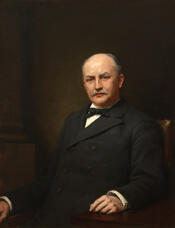
Here you will find contact information for Representative Charles Frederick Crisp, including email address, phone number, and mailing address.
| Name | Charles Frederick Crisp |
| Position | Representative |
| State | Georgia |
| District | 3 |
| Party | Democratic |
| Status | Former Representative |
| Term Start | December 3, 1883 |
| Term End | March 3, 1897 |
| Terms Served | 7 |
| Born | January 29, 1845 |
| Gender | Male |
| Bioguide ID | C000908 |
About Representative Charles Frederick Crisp
Charles Frederick Crisp (January 29, 1845 – October 23, 1896) was a British-American politician, Confederate Army officer, jurist, and long-serving Democratic Representative from Georgia. Elected to the United States House of Representatives in 1882, he served from March 4, 1883, until his death in 1896, completing seven consecutive terms in Congress. From 1890 to 1895 he led the Democratic Party in the House of Representatives, serving either as Speaker of the House or as House minority leader. He was the father of Charles R. Crisp, who also later served in Congress, and he represented his Georgia constituents during a significant period in American political and economic history.
Crisp was born in Sheffield, England, on January 29, 1845. Later that same year his parents immigrated to the United States and settled in Georgia. He was educated in the common schools of Savannah and Macon, Georgia, reflecting the family’s early and permanent establishment in the state he would later represent in Congress. His parents were engaged in the theater, and at the outbreak of the American Civil War they were on a Shakespearean play tour, temporarily residing with their son in Luray, Virginia. This itinerant theatrical background contrasted with the settled, agrarian communities of Georgia in which Crisp spent much of his youth and to which he would return after the war.
With the onset of the Civil War, Crisp entered Confederate service while living in Virginia. He enlisted in a local unit, the “Page Volunteers” of Company K, 10th Virginia Infantry, and was commissioned a lieutenant. He served with that regiment in the Army of Northern Virginia until May 12, 1864, when he was captured at the Battle of Spotsylvania Court House. As a prisoner of war he was held among the group later known as the “Immortal Six Hundred,” Confederate officers confined under harsh conditions, first at Fort Pulaski, Georgia, and later at Fort Delaware. He remained in Union custody until his release in June 1865, after which he rejoined his parents in Ellaville, Georgia, and began the transition from military to civilian and professional life.
After the war, Crisp pursued a legal career in southwest Georgia. He studied law in Americus, Georgia, and was admitted to the bar in 1866. He commenced the practice of law in Ellaville, where he quickly became a prominent figure in local legal and political circles. In 1872 he was appointed solicitor general of the southwestern judicial circuit of Georgia and was reappointed in 1873 for a four-year term, underscoring his growing reputation as a capable prosecutor. In June 1877 he was appointed judge of the superior court of the same circuit. The Georgia General Assembly elected him to that judgeship in 1878, and he was reelected in 1880 for another four-year term. He resigned the judgeship in September 1882 to accept the Democratic nomination for the United States Congress, marking his shift from the judiciary to national legislative service.
Crisp’s personal life was closely tied to Ellaville and the surrounding region. He courted Clara Bell Burton, who was born in Ellaville to Robert Burton, a slave-owning cotton planter before the Civil War, and his wife, both of whom were wealthy, religious, and ambitious for their daughters. Initially, Clara Bell’s parents disapproved of the match to Crisp, then a relatively poor lawyer from a theatrical family, and refused his formal written request to marry their youngest daughter or to allow the wedding in their home. With the assistance of Clara Bell’s sister Ella, the couple made alternate plans, and one Sunday morning, while Clara Bell was visiting her brother near Ellaville, Crisp drove her by buggy to his boarding place. There, in the parlor and in the presence of a few friends, they were married. The following Sunday, they both joined the Methodist Church of Ellaville. Over time, her parents reconciled with the couple, and Crisp became the mainstay of their old age. The couple lived for fifty-one years in the same house, and Clara Bell later recalled on her deathbed that her parents came to love him deeply and that he had been a devoted husband.
Crisp’s formal political career accelerated in the early 1880s. In April 1883 he served as president of the Democratic gubernatorial convention in Atlanta, Georgia, a role that highlighted his influence within the state party. He was elected as a Democrat to the Forty-eighth Congress and to the six succeeding Congresses, serving from March 4, 1883, until his death on October 23, 1896. During his seven terms in office, he represented Georgia during a period marked by Reconstruction’s aftermath, the rise of the New South, and intense national debates over tariffs, currency, and federal power. He contributed actively to the legislative process and to the internal organization of the House, becoming one of the most prominent Southern Democrats of his generation.
Within the House of Representatives, Crisp quickly rose to positions of leadership. He served as chairman of the Committee on Elections in the Fiftieth Congress, where he played a central role in adjudicating contested election cases. In the Fifty-second and Fifty-third Congresses he chaired the powerful Committee on Rules, which controlled the flow and structure of legislation on the House floor. He was elected Speaker of the House of Representatives for the Fifty-second and Fifty-third Congresses, serving from 1891 to 1895, and during this period he effectively led the Democratic Party in the House. When the Democrats lost their majority, he continued to lead his party as House minority leader, maintaining his status as a key strategist and spokesman. His tenure as Speaker placed him at the forefront of national legislative battles of the 1890s and cemented his reputation as a skilled parliamentarian.
In 1896, as his congressional career neared its fourteenth year, Crisp sought higher office. He was nominated in the Georgia Democratic primary for the United States Senate, reflecting the esteem in which he was held in his home state and within the national party. Before he could take that office, however, he died in Atlanta, Georgia, on October 23, 1896, while still serving in the House of Representatives. He was interred in Oak Grove Cemetery in Americus, Georgia, the community that had long been his home and political base. In recognition of his service, Crisp County, Georgia, was later named in his honor. As a former Speaker of the House, his portrait was displayed in the U.S. Capitol’s Speaker’s Lobby outside the House Chamber, but it was removed from public display on June 18, 2020, by order of Speaker Nancy Pelosi due to his service in the Confederate States Army.