Representative Charles Aubrey Eaton
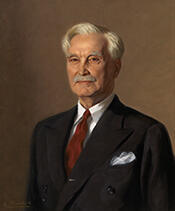
Here you will find contact information for Representative Charles Aubrey Eaton, including email address, phone number, and mailing address.
| Name | Charles Aubrey Eaton |
| Position | Representative |
| State | New Jersey |
| District | 5 |
| Party | Republican |
| Status | Former Representative |
| Term Start | December 7, 1925 |
| Term End | January 3, 1953 |
| Terms Served | 14 |
| Born | March 29, 1868 |
| Gender | Male |
| Bioguide ID | E000023 |
About Representative Charles Aubrey Eaton
Charles Aubrey Eaton (March 29, 1868 – January 23, 1953) was a Canadian-born American Baptist clergyman, journalist, and Republican politician who represented New Jersey in the United States House of Representatives from 1925 to 1953. Over the course of 14 consecutive terms, he served as a leading voice in the Republican Party on foreign policy, chairing both the House Committee on Foreign Affairs and the Herter Committee, and he was one of the signers of the original United Nations Charter. His congressional district, centered on Somerset County, was designated New Jersey’s 4th district from 1925 to 1933 and the 5th district from 1933 to 1953.
Eaton was born on a farm near Pugwash, Nova Scotia, on March 29, 1868, the son of Stephen Eaton, a shipbuilder and farmer, and Mary Desiah (Parker) Eaton. He attended local schools while working on his father’s farm and later studied in Amherst, Nova Scotia, from 1884 to 1886. During his time in Amherst he was baptized and decided to become a Baptist minister, a commitment that shaped the first decades of his professional life. He earned a B.A. from Acadia University in Wolfville, Nova Scotia, in 1890. Pursuing theological training in the United States, he received a Bachelor of Divinity from Newton Theological Institution in 1893, the same year he was ordained a Baptist minister. Eaton continued to advance his education throughout his career, receiving an M.A. from McMaster University in Toronto in 1896, honorary Doctor of Divinity degrees from Baylor University in 1899 and Acadia University in 1907, and an LL.D. from McMaster University in 1916.
After graduating from Newton Theological Institution, Eaton began his pastoral career at the First Baptist Church of Natick, Massachusetts, where he served from 1893 to 1895. While in Natick he met Mary Winifred Parlin (May 11, 1874 – November 12, 1948), daughter of local merchant and Civil War veteran William D. Parlin and Mary Brown. They were married on June 26, 1895, and became the parents of six children. In 1895, Eaton became a citizen of the United States and accepted a call to a Baptist congregation on Bloor Street in Toronto, where he served as pastor from 1895 to 1901. During this period he also began a parallel career in journalism, serving as sociological editor of the Toronto Globe from 1896 to 1901, associate editor of Westminster from 1899 to 1901, and acting as a special correspondent for The Times of London, the New-York Tribune, and the Boston Transcript.
Eaton moved to the Euclid Avenue Baptist Church in Cleveland, Ohio, in 1901, serving there until 1909. The church, located on Cleveland’s “millionaire’s row,” brought him into contact with prominent industrialists, including John D. Rockefeller, who attended services there as a summer resident. Eaton’s commitment to evangelism extended beyond the pulpit; in 1904 he was arrested in Cleveland for persistently violating local by-laws against street preaching, reflecting his desire to reach those who did not attend church. His friendship with Rockefeller became a lifelong association and significantly influenced his own career and that of his nephew, Cyrus S. Eaton. Charles Eaton introduced Cyrus, then a university student, to Rockefeller in 1901; Cyrus later worked for Rockefeller and became a leading Cleveland businessman and one of America’s prominent industrialists.
In 1909, Eaton relocated to New Jersey, settling in what was then North Plainfield, where he started a dairy farm while simultaneously serving as pastor of the Madison Avenue Baptist Church in New York City from 1909 to 1916. The area of his residence later separated from North Plainfield, and in 1926 became the Borough of Watchung, New Jersey, where Eaton lived for the remainder of his life. After leaving the Madison Avenue pastorate, he devoted more time to journalism and industrial relations. He served as editor of Leslie’s Weekly in 1919 and 1920 and later worked for General Electric’s National Lamp Works as director of labor relations, during which time he edited the company publication Light from 1923 to 1924. These roles broadened his experience in public communication and labor issues, providing a foundation for his subsequent political career.
Eaton entered electoral politics as a Republican and, in 1924, was elected from New Jersey to the 69th Congress. He was subsequently reelected to thirteen succeeding Congresses, serving continuously from March 4, 1925, until 1953. As a member of the House of Representatives, he participated actively in the legislative process and represented the interests of his constituents in a period that spanned the late 1920s, the Great Depression, World War II, and the early Cold War. A steadfast opponent of President Franklin D. Roosevelt’s New Deal domestic program, Eaton nonetheless developed a reputation for working effectively with both Republicans and Democrats. His bipartisan approach and foreign policy expertise led Presidents Roosevelt and Harry S. Truman to invite “Doc” Eaton, as he was sometimes known, to the White House as an informal adviser.
Eaton’s most influential work in Congress centered on foreign affairs. Appointed by President Roosevelt, he served as a member of the United States delegation to the United Nations Conference on International Organization in San Francisco, and on June 26, 1945, he was one of the signers of the original United Nations Charter, the foundational treaty of the new international organization. In 1947, with a Democratic president and a Republican-controlled Congress, Eaton became chairman of the House Committee on Foreign Affairs and of the special House Select Committee on Foreign Aid, commonly known as the Herter Committee. At a time when economic assistance had become a central instrument of U.S. foreign policy, these posts were especially powerful. Eaton’s leadership was frequently challenged by a neo-isolationist bloc in the House, but he succeeded in securing passage of every major foreign-aid measure he sponsored, including the continuation of the United Nations Relief and Rehabilitation Administration (UNRRA), aid to Greece and Turkey under the Truman Doctrine, and the European Recovery Program, widely known as the Marshall Plan. The successful enactment of the Marshall Plan marked a high point in his political career, and President Truman later credited Eaton in his memoirs for his bipartisan support of American foreign policy.
Charles Aubrey Eaton retired from Congress at the close of his fourteenth term in early January 1953. Twenty days after leaving office, he died in Washington, D.C., on January 23, 1953. He was interred in Hillside Cemetery in Scotch Plains, New Jersey. Throughout his life, Eaton’s work as a clergyman, journalist, and legislator reflected a consistent engagement with moral, social, and international questions, and his long tenure in the House of Representatives coincided with, and helped to shape, some of the most consequential developments in twentieth-century American foreign policy.