Senator Charles Ellsworth Goodell
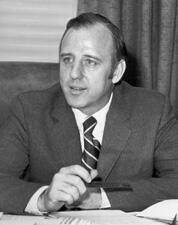
Here you will find contact information for Senator Charles Ellsworth Goodell, including email address, phone number, and mailing address.
| Name | Charles Ellsworth Goodell |
| Position | Senator |
| State | New York |
| Party | Republican |
| Status | Former Representative |
| Term Start | January 7, 1959 |
| Term End | January 3, 1971 |
| Terms Served | 5 |
| Born | March 16, 1926 |
| Gender | Male |
| Bioguide ID | G000282 |
About Senator Charles Ellsworth Goodell
Charles Ellsworth Goodell Jr. (March 16, 1926 – January 21, 1987) was an American lawyer and Republican politician who represented New York in the United States House of Representatives from 1959 to 1968 and in the United States Senate from 1968 to 1971. In both chambers of Congress he first took office following the deaths of his predecessors, entering the House in a special election and the Senate as a temporary appointee succeeding Robert F. Kennedy. Over the course of his congressional career, he was elected to four full terms in the House after winning his first race in 1959, and he played a visible role in the legislative debates of a transformative era in American politics. He was the father of National Football League (NFL) Commissioner Roger Goodell.
Goodell was born in Jamestown, New York, the son of Francesca (née Bartlett) and Charles Ellsworth Goodell. He was a great-grandson of William Goodell, an abolitionist, and grew up in the public schools of Jamestown. During World War II, he served in the United States Navy as a seaman second class from 1944 to 1946. After the war, he attended Williams College, where he was elected to Phi Beta Kappa and graduated in 1948. He continued his education at Yale University, receiving an LL.B. from Yale Law School in 1951 and an M.A. in government from Yale in 1952. He was admitted to the Connecticut bar in 1951 and briefly taught at Quinnipiac College in 1952 before being admitted to the New York bar in 1954. He also served in the United States Air Force as a first lieutenant during the Korean War from 1952 to 1953.
Following his admission to the bar, Goodell began the practice of law in his hometown of Jamestown, New York. Early in his career he worked in Washington as a congressional liaison assistant for the U.S. Department of Justice from 1954 to 1955, gaining experience in federal legislative affairs. Returning to New York, he remained active in Republican politics while maintaining his law practice. His combination of legal training, military service, and experience in the executive branch positioned him for a bid for Congress when a vacancy arose in his home district.
Goodell entered the United States House of Representatives through a special election held on May 26, 1959, to fill the vacancy in New York’s 43rd congressional district caused by the death of Representative Daniel A. Reed. Running as a Republican, he received 27,454 votes (65 percent), defeating Democrat Robert E. McCaffery, who received 14,250 votes (33.8 percent). He was subsequently reelected in November 1960 to the 87th Congress and reelected three more times, serving in the House from 1959 until his resignation in 1968. During his House tenure he participated actively in major civil rights legislation, voting in favor of the Civil Rights Acts of 1960, 1964, and 1968, and the Voting Rights Act of 1965. He voted against the 24th Amendment to the U.S. Constitution, which banned poll taxes in federal elections, but did so reluctantly, arguing on the House floor that the amendment was deficient because it was limited to federal, and not state, elections. His service in Congress during this period placed him at the center of the legislative response to the civil rights movement and other defining issues of the 1960s.
On September 9, 1968, Goodell resigned his House seat to accept an appointment by New York Governor Nelson Rockefeller to the United States Senate, filling the vacancy caused by the assassination of Senator Robert F. Kennedy on June 5–6, 1968. Because a special election to fill the Senate vacancy would not be held for more than two years, the length of his appointed term prompted public controversy and a legal challenge to the governor’s power to appoint senators in the event of a vacancy, a challenge that failed in the case of Valenti v. Rockefeller. In the Senate, Goodell’s political profile shifted: although he had been regarded as a moderate to conservative Republican in the House, he emerged as one of the more liberal Republicans in the Senate, aligning ideologically with New York’s other Republican senator, Jacob Javits. He authored and sponsored a large number of bills, including legislation to provide conservation and development aid to small towns and rural areas. Many small upstate New York communities without municipal sewage systems were able to construct them with the aid of federal matching funds made available through his initiatives. During the Vietnam War, he became, along with Senator Mark Hatfield of Oregon, one of the most prominent antiwar voices within the Republican Party, advocating withdrawal from Vietnam and earning praise from antiwar protesters and activists.
Goodell sought election to a full Senate term in 1970 at a time when the New York Republican Party was deeply divided between a growing conservative grassroots base and a more liberal party leadership associated with Governor Rockefeller. Rockefeller’s influence within the party organization ensured that Goodell received the Republican nomination, and he also secured the endorsement of the Liberal Party of New York, an example of electoral fusion permitted under state law. His liberal positions, particularly on the war, drew sharp criticism from conservatives; Vice President Spiro Agnew derided him as the “Christine Jorgensen of the Republican Party,” likening his ideological shift to Jorgensen’s widely publicized sex-change operation. Goodell campaigned under the slogan “Senator Goodell—He’s too good to lose,” and his television advertising contrasted him with his opponents, Democratic Representative Richard Ottinger and Conservative Party candidate James L. Buckley, as “the lightweight, the heavyweight and the dead weight.” In the three-way race in November 1970, however, Goodell and Ottinger split much of the liberal and moderate vote, and Buckley prevailed. Goodell finished third with 24.3 percent of the vote despite the backing of both the Republican and Liberal parties. His Senate service concluded in 1971, and he would be the last appointed senator from New York until 2009, when Kirsten Gillibrand was selected to replace Hillary Clinton following her appointment as Secretary of State.
After leaving Congress, Goodell resumed the practice of law, dividing his time between Washington, D.C., and New York. In the mid-1970s he returned to national service when President Gerald Ford appointed him vice chairman of a presidential committee, chaired by former Pennsylvania Governor William Scranton, to draft rules for granting amnesty to Vietnam War–era draft evaders and deserters. He also remained engaged in public affairs as a writer and commentator, publishing “Political Prisoners in America” with Random House in 1973, a work reflecting his continuing interest in civil liberties and the treatment of dissent in the United States.
Goodell married Jean Rice (1930–1984), a former registered nurse, in 1954. The couple had five children: Bill, who became a hedge fund executive; Tim, who became a senior vice president for the Hess Corporation; Roger, who became commissioner of the National Football League; Michael, a Pilates instructor; and Jeff, who served as head of the Upper School of Saint Mary’s Hall in San Antonio. Jean Rice Goodell briefly ran for Congress in New York’s 39th district in 1976. The couple divorced in 1978, and later that year Goodell married Patricia Goldman (1942–2023), a congressional caucus director who later served as a member of the National Transportation Safety Board. Charles Ellsworth Goodell Jr. was a resident of Washington, D.C., and Bronxville, New York, in his later years. He died on January 21, 1987, of complications following a heart attack and was interred at Lake View Cemetery in Jamestown, New York.