Representative Charles Abraham Halleck
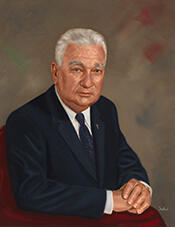
Here you will find contact information for Representative Charles Abraham Halleck, including email address, phone number, and mailing address.
| Name | Charles Abraham Halleck |
| Position | Representative |
| State | Indiana |
| District | 2 |
| Party | Republican |
| Status | Former Representative |
| Term Start | January 3, 1935 |
| Term End | January 3, 1969 |
| Terms Served | 17 |
| Born | August 22, 1900 |
| Gender | Male |
| Bioguide ID | H000081 |
About Representative Charles Abraham Halleck
Charles Abraham Halleck (August 22, 1900 – March 3, 1986) was an American politician who represented Indiana’s 2nd Congressional District in the United States House of Representatives from 1935 to 1969. A member of the Republican Party, he served 17 consecutive terms and rose to become one of the most prominent Republican leaders in Congress in the mid‑twentieth century, including service as House Majority Leader and House Minority Leader.
Halleck was born near DeMotte, in Jasper County, Indiana, the son of Abraham and Lura (née Luce) Halleck. He grew up in rural northwestern Indiana and came of age during World War I. During that conflict he served in the infantry of the United States Army, an experience that preceded and helped shape his later public career. After his military service, Halleck attended Indiana University at Bloomington, where he studied law. He completed his legal education and, in 1924, was admitted to the bar.
Following his admission to the bar, Halleck began practicing law in Rensselaer, Indiana. That same year he became prosecuting attorney for the 13th district court of Indiana, a position he held from 1924 to 1934. His decade as a local prosecutor established his reputation as a capable lawyer and public official in his home region. In 1927 he married Blanche Annetta White; the couple had two children, Charles W. and Patricia. Their son, Charles W. Halleck, later became an attorney in Washington, D.C., and served as a judge of the Superior Court of the District of Columbia.
Halleck entered national politics in 1935, when he was elected to the U.S. House of Representatives to fill the vacancy created by the death of Congressman‑elect Frederick Landis. He would remain in the House until 1969, participating in the legislative process during a period that spanned the Great Depression, World War II, the early Cold War, and the civil rights era. As a member of the House of Representatives, Halleck represented the interests of his Indiana constituents while becoming a prominent figure in the broader national debate, particularly as a leading member of the conservative coalition that often opposed expansive New Deal and later Great Society programs.
Within a few years of his arrival in Congress, Halleck gained national attention. He regarded as a highlight of his early career his role at the 1940 Republican National Convention, where he nominated fellow Hoosier Wendell Willkie for president. Reflecting on the mixed reaction to his nominating speech, Halleck later remarked, “I got more brickbats and more bouquets over that speech than any other I’ve ever made.” In 1944, as the new chairman of the National Republican Congressional Committee, he addressed a major party gathering in Chicago even before Thomas E. Dewey was formally named the Republican presidential nominee. Rejecting the Democratic slogan “don’t change horses while crossing the stream,” he argued that a Republican administration would retain key military leaders—George C. Marshall, Dwight D. Eisenhower, Douglas MacArthur, and William F. Halsey—while attacking what he called New Deal “snooping into our ice boxes,” a reference to the Office of Price Administration and wartime rationing. He declared that Americans should “live again as God meant us to live and not as some bureaucrat in Washington… would like us to live.” Halleck was also rumored to be Dewey’s potential vice‑presidential running mate in the 1948 campaign if he could secure the Indiana delegation’s support at the Republican National Convention, though Dewey ultimately chose California Governor Earl Warren; the Dewey–Warren ticket narrowly lost to the Democratic Truman–Barkley ticket in November 1948.
Halleck’s influence in the House grew steadily. After the Republican victories in the 1946 and 1952 elections, he served as House Majority Leader, helping to manage the party’s legislative agenda. In 1959, amid Democratic control of the House and the waning popularity of President Dwight D. Eisenhower, Halleck leveraged his strong following among House Republicans and the public support of Eisenhower and Vice President Richard Nixon to successfully challenge Joseph W. Martin Jr., ending Martin’s two‑decade tenure as House Republican leader. Halleck then began a three‑term stint as House Minority Leader, serving from 1959 to 1964 and effectively becoming, in that role, the official leader of House Republicans. During the 1960s he was, along with Senate Republican Leader Everett Dirksen, one of the most visible faces of the Republican Party, frequently appearing on television news and talk programs; the press dubbed their joint appearances “The Ev & Charlie Show.”
Ideologically, Halleck was a strong opponent of the liberal social and economic proposals advanced by Democratic Presidents John F. Kennedy and Lyndon B. Johnson, and he was a firm supporter of the Vietnam War. At the same time, he played a notable role in the passage of key civil rights measures. He voted in favor of the Civil Rights Acts of 1957, 1960, and 1964, supported the 24th Amendment to the U.S. Constitution abolishing the poll tax in federal elections, and backed the Voting Rights Act of 1965. He voted in favor of the initial House resolution for the Civil Rights Act of 1968 on August 16, 1967, but opposed the Senate amendment to that bill on April 10, 1968. After the Republican Party suffered heavy losses in the 1964 elections, Halleck was challenged for his leadership position by a younger generation of Republicans. In 1965 he was defeated in his bid to remain Minority Leader by Representative Gerald R. Ford of Michigan, the candidate of the so‑called “Young Turks” within the House Republican Conference. Halleck continued to serve in Congress until the end of his 17th term in 1969, concluding a 34‑year tenure.
In his later years, Halleck remained a respected elder statesman of his party. His wife, Blanche, died in 1973, and he continued to live in Indiana. His long public service was recognized in 1983 when President Ronald Reagan signed legislation renaming the federal district court building in Lafayette, Indiana, as the Charles A. Halleck Federal Building. The Charles Halleck Student Center at Saint Joseph’s College in Indiana was also named in his honor; it was later listed on the National Register of Historic Places in 2016. Halleck’s role in national affairs during the Kennedy administration was memorialized in popular culture when actor Arthur Franz portrayed him in the 1974 made‑for‑television film “The Missiles of October,” a dramatization of President John F. Kennedy and the Cuban Missile Crisis.
Charles Abraham Halleck died in Lafayette, Indiana, on March 3, 1986. He was buried next to his wife in Rensselaer, Indiana, closing the life of a central Republican congressional leader whose career spanned from the New Deal era through the height of the Cold War.