Representative Charles Bernard Hoeven
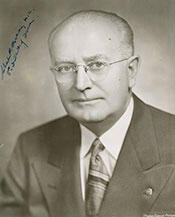
Here you will find contact information for Representative Charles Bernard Hoeven, including email address, phone number, and mailing address.
| Name | Charles Bernard Hoeven |
| Position | Representative |
| State | Iowa |
| District | 6 |
| Party | Republican |
| Status | Former Representative |
| Term Start | January 6, 1943 |
| Term End | January 3, 1965 |
| Terms Served | 11 |
| Born | March 30, 1895 |
| Gender | Male |
| Bioguide ID | H000678 |
About Representative Charles Bernard Hoeven
Charles Bernard Hoeven (March 30, 1895 – November 9, 1980) was an American politician and Republican member of the United States House of Representatives from Iowa, who served eleven consecutive terms in Congress from 1943 to 1965. Over the course of his career, he represented districts in northern Iowa from the Seventy-eighth through the Eighty-eighth Congresses and, in all, held elective office for forty consecutive years. His long tenure in public life spanned the New Deal era, World War II, the early Cold War, and the civil rights movement.
Hoeven was born in Hospers, Sioux County, Iowa, on March 30, 1895. His paternal grandparents were Dutch immigrants, and his maternal grandparents were German immigrants, reflecting the strong northwestern Iowa tradition of Dutch and German settlement. He attended the public schools of the area and Alton High School in Alton, Iowa. Growing up in a rural, immigrant community in northwestern Iowa, he was shaped by the agricultural economy and the civic culture of small Midwestern towns that would later inform his public service.
During World War I, Hoeven served in the United States Army, seeing duty in England and France. He rose to the rank of sergeant in Company D, 350th Infantry, 88th Division, and also served with the Intelligence Service of the First Battalion. His wartime experience in Europe during a major global conflict preceded and likely influenced his later engagement with national and international issues as a legislator. After returning from military service, he pursued higher education under the auspices of the expanding opportunities available to veterans of the era.
Hoeven received a bachelor’s degree from the University of Iowa at Iowa City in 1920 and went on to earn a law degree from the University of Iowa College of Law in 1922. That same year he was admitted to the bar and commenced the practice of law in Alton, Iowa. Establishing himself as an attorney in Sioux County, he quickly entered public life. In 1924 he was elected county attorney of Sioux County, Iowa, a position he held from 1925 to 1937. His twelve-year tenure as county attorney gave him extensive experience in local government and law enforcement during a period that included Prohibition and the Great Depression.
In 1936, Hoeven was elected to the Iowa Senate, where he served from 1937 to 1941. During his time in the state legislature he rose to a leadership role, serving as president pro tempore of the Iowa Senate for the last two years of his term. He was also deeply involved in Republican Party affairs. From 1925 to 1970 he was a delegate to each Iowa State Republican Convention, and he served as chairman of the 1940 state convention. In 1942 he acted as both temporary and permanent chairman of the Iowa Republican State Judicial Convention, further solidifying his standing within the party. Outside of elective office, he also served as vice president of a savings bank, reflecting his engagement with local business and finance.
Hoeven first sought a seat in the United States House of Representatives in 1940, when he ran for the Republican nomination in Iowa’s 9th congressional district, then represented by Democrat Vincent Harrington of Sioux City. In a closely contested primary, he finished a narrow second to Albert Swanson, who subsequently lost to Harrington in the general election by fewer than 2,500 votes out of more than 130,000 cast. Contemporary newspapers and observers speculated that, had Hoeven secured the nomination, he might have defeated Harrington. Following reapportionment, most of the old 9th District was shifted into Iowa’s 8th congressional district, and Hoeven emerged as an early front-runner for the 1942 Republican primary to challenge Harrington in the new configuration. He won the Republican nomination and received an additional boost when Harrington resigned both his House seat and his Democratic nomination two months before the 1942 general election to serve full-time in the U.S. Army Air Corps in England. Although Democrats quickly named new candidates to complete Harrington’s 9th District term and to oppose Hoeven in the 8th District, Hoeven won the 8th District seat by more than 19,000 votes.
Charles Bernard Hoeven entered Congress in January 1943 as a Republican Representative from Iowa and would serve continuously until January 1965. He was re-elected to the House from the 8th District nine additional times, the last time in 1960, when he defeated future United States District Court Judge Donald E. O’Brien. Following the 1960 census, Iowa lost a congressional district, and much of Hoeven’s existing territory was reconfigured as the 6th District. He successfully sought election from that district as well, extending his service through the Eighty-eighth Congress. During his eleven terms in the House of Representatives, Hoeven participated in the legislative process on issues ranging from wartime mobilization and postwar recovery to agricultural policy and domestic economic development, consistently representing the interests of his northern Iowa constituents. Serving during a significant period in American history, he took part in debates over the Cold War, federal infrastructure investment, and the expansion of civil rights.
Hoeven’s voting record placed him among those Republicans who supported key civil rights measures of the mid-twentieth century. He voted in favor of the Civil Rights Acts of 1957, 1960, and 1964, as well as the Twenty-fourth Amendment to the United States Constitution, which prohibited the use of poll taxes in federal elections. His support for these measures aligned him with a bipartisan coalition that advanced federal civil rights protections during a period of intense national debate. In 1964, after more than two decades in Congress, he chose not to seek re-election. That year, Republicans lost 48 House seats nationwide, including Iowa’s Sixth District, underscoring the challenging political environment he opted to leave.
After retiring from Congress in January 1965, Hoeven returned to private life in northwestern Iowa. He resided in Orange City, Iowa, remaining connected to the communities he had long represented and served. He continued to be regarded as a senior figure in Iowa Republican circles, having attended state party conventions regularly for nearly half a century and having served as a delegate to the 1964 Republican National Convention. Charles Bernard Hoeven died in Orange City on November 9, 1980. He was interred in Nassau Township Cemetery in Alton, Iowa, near the community where he had begun his legal career and first entered public service.