Representative Charles Beary Landis
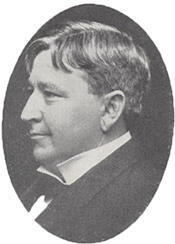
Here you will find contact information for Representative Charles Beary Landis, including email address, phone number, and mailing address.
| Name | Charles Beary Landis |
| Position | Representative |
| State | Indiana |
| District | 9 |
| Party | Republican |
| Status | Former Representative |
| Term Start | March 15, 1897 |
| Term End | March 3, 1909 |
| Terms Served | 6 |
| Born | July 9, 1858 |
| Gender | Male |
| Bioguide ID | L000050 |
About Representative Charles Beary Landis
Charles Beary Landis (July 9, 1858 – April 24, 1922) was an American newspaperman and Republican politician who served six terms as a U.S. Representative from Indiana from 1897 to 1909. He was born in Millville, Butler County, Ohio, and later moved with his family to Indiana, where he was raised and educated. He was part of a politically prominent family: his brother Frederick Landis also served in Congress, and another brother, Kenesaw Mountain Landis, later became the first Commissioner of Baseball and a noted federal judge.
Landis attended the public schools of Logansport, Indiana, reflecting the family’s relocation to that community during his youth. He pursued higher education at Wabash College in Crawfordsville, Indiana, from which he graduated in 1883. While at Wabash he was a member of the Tau chapter of the Beta Theta Pi fraternity, an affiliation that connected him with a network of future professionals and public figures in the state and region.
Immediately after his graduation in 1883, Landis embarked on a career in journalism. He became editor of the Logansport Journal, a position he held from 1883 to 1887. Under his editorship, the paper served as an influential voice in local and state affairs; the Journal would later become part of what is known as the Pharos-Tribune. After leaving the Logansport Journal, Landis continued his work in the newspaper field and, by the time of his nomination for Congress, he was serving as editor of the Delphi Journal in Delphi, Indiana. His prominence in Republican journalism led to his election as president of the Indiana Republican Editorial Association in 1894 and 1895, a role that placed him at the center of party communications and strategy in the state.
Landis’s journalistic and party leadership experience provided a springboard to elective office. A member of the Republican Party, he was elected to the U.S. House of Representatives as a Republican to the Fifty-fifth Congress and was subsequently reelected to the five succeeding Congresses, serving from March 4, 1897, to March 3, 1909. During these six consecutive terms, he represented his Indiana constituents in the House of Representatives and contributed to the legislative process in a period marked by industrial expansion, the Spanish–American War, and the early Progressive Era. As a member of the House, Landis participated in the democratic process and worked to represent the interests of his district within the broader national debates of the time.
Landis’s congressional service came to an end when he was an unsuccessful candidate for reelection in 1908, concluding twelve years in the national legislature. After leaving Congress in March 1909, he returned to Indiana and resumed his newspaper work in Delphi, continuing the profession that had first brought him public prominence. His post-congressional years were spent largely in this journalistic sphere, maintaining his engagement with public affairs through the press rather than elective office.
In his later years, Landis’s health declined, and he traveled to Asheville, North Carolina, a destination known at the time for its climate and health resorts, in an effort to recover from impaired health. He died there on April 24, 1922, at the age of 63. His body was returned to Indiana, and he was interred in Mount Hope Cemetery in Logansport, Indiana, the community where he had been educated and first established himself as a newspaperman.