Representative Charles Edmund Nash
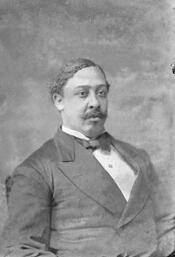
Here you will find contact information for Representative Charles Edmund Nash, including email address, phone number, and mailing address.
| Name | Charles Edmund Nash |
| Position | Representative |
| State | Louisiana |
| District | 6 |
| Party | Republican |
| Status | Former Representative |
| Term Start | December 6, 1875 |
| Term End | March 3, 1877 |
| Terms Served | 1 |
| Born | May 23, 1844 |
| Gender | Male |
| Bioguide ID | N000008 |
About Representative Charles Edmund Nash
Charles Edmund Nash (May 23, 1844 – June 21, 1913) was an American politician, Civil War veteran, and businessman who served a single two-year term as a Republican member of the United States House of Representatives from Louisiana. Elected to the Forty-fourth Congress, he represented Louisiana from March 4, 1875, to March 3, 1877, becoming the first African American from the state to serve in Congress. His tenure came during the tumultuous Reconstruction era, and he would remain Louisiana’s only Black U.S. Representative for more than a century, until the election of William J. Jefferson in the 2nd Congressional District in 1991.
Nash was born in Opelousas, the seat of St. Landry Parish in southern Louisiana. He attended the common schools available to him in the region and learned the trade of bricklaying, which became his principal occupation before and after the Civil War. Growing up in the antebellum South, his early life unfolded against the backdrop of slavery and mounting sectional tensions that would culminate in the Civil War.
During the American Civil War, Nash enlisted in 1863 as a private in the Eighty-second Regiment, United States Volunteers, a unit of the United States Colored Troops. Demonstrating ability and leadership, he was promoted to the rank of sergeant major. His regiment took part in the Mobile Campaign, and Nash saw heavy combat. Near the end of the war, in April 1865, he was severely wounded at the Battle of Fort Blakeley in Alabama, one of the last major engagements of the conflict, and he lost part of his leg as a result of his injuries. After the war, he returned to Louisiana, where he resumed civilian life as a businessman and continued to work in his trade.
In the early Reconstruction period, Nash entered public service and was appointed night inspector of United States customs, a federal position that reflected the growing, though contested, role of African Americans in government during that era. His involvement in Republican politics in Louisiana developed as the party sought to secure civil and political rights for formerly enslaved people and their descendants. Building on his wartime record and community standing, Nash emerged as a political figure in St. Landry Parish and the broader region.
Nash was elected as a Republican to the Forty-fourth Congress and served from March 4, 1875, to March 3, 1877. As a member of the House of Representatives, he participated in the legislative process during a significant period in American history, representing the interests of his Louisiana constituents while the federal government was still engaged in enforcing Reconstruction policies in the South. His service in Congress occurred at a time of intense political struggle over civil rights, federal authority, and the reintegration of former Confederate states. Although specific details of his committee assignments and sponsored legislation are sparse, his very presence in Congress as an African-American representative from Louisiana was a notable milestone. He was unsuccessful in his bid for reelection in 1876, as “Redeemer” Democrats, committed to restoring white Democratic control and rolling back Reconstruction reforms, regained dominance in Louisiana politics.
After leaving Congress, Nash remained involved in public affairs on a more limited scale. During the administration of President Chester A. Arthur, he was appointed postmaster at Washington in St. Landry Parish, Louisiana. His tenure in that office was brief, lasting from February 15 to May 1, 1882, but it reflected the continued, if constrained, participation of African Americans in federal patronage positions in the post-Reconstruction South. Outside of public office, he continued his work as a businessman and maintained his connections to the communities in which he had long lived and served.
Charles Edmund Nash died in New Orleans, Louisiana, on June 21, 1913, at the age of sixty-nine. He was interred in Saint Louis Cemetery No. 3 in New Orleans. Remembered as Louisiana’s first African-American congressman and a Civil War veteran who rose from private to sergeant major in the United States Colored Troops, his life spanned slavery, civil war, Reconstruction, and the onset of the Jim Crow era, and his brief congressional service marked an early and significant chapter in the history of African-American representation in the United States Congress.