Representative Charles Gibb Oakman
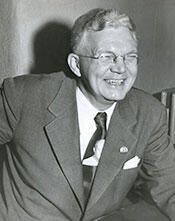
Here you will find contact information for Representative Charles Gibb Oakman, including email address, phone number, and mailing address.
| Name | Charles Gibb Oakman |
| Position | Representative |
| State | Michigan |
| District | 17 |
| Party | Republican |
| Status | Former Representative |
| Term Start | January 3, 1953 |
| Term End | January 3, 1955 |
| Terms Served | 1 |
| Born | September 4, 1903 |
| Gender | Male |
| Bioguide ID | O000004 |
About Representative Charles Gibb Oakman
Charles Gibb Oakman (September 4, 1903 – October 28, 1973) was a Republican politician from the U.S. state of Michigan who served one term as a Representative from Michigan in the United States Congress from 1953 to 1955. He was born in Detroit, Michigan, where he attended the public schools before pursuing higher education locally. Oakman studied at Wayne State University and then enrolled at the University of Michigan in Ann Arbor, from which he graduated in 1926. His early life and education in Detroit and Ann Arbor rooted him firmly in southeastern Michigan, a region he would later represent and serve in multiple public capacities.
Following his graduation, Oakman entered private business, engaging in the real estate and transportation fields from 1927 to 1940. This period in business coincided with the late 1920s economic expansion, the Great Depression, and the early years of recovery, giving him practical experience in economic and urban issues that would later inform his public service. His work in real estate and transportation connected him to the growth and infrastructure needs of metropolitan Detroit, which was then emerging as a major industrial and automotive center.
Oakman began his formal political and governmental career in the early 1940s. He served as a member of the Wayne County Board of Supervisors from 1941 to 1952, participating in county-level governance for more than a decade. At the same time, he held several key positions in the city government of Detroit. He was executive secretary to the mayor of Detroit in 1941 and 1942, a role that placed him close to the city’s chief executive during the early years of World War II. From 1942 to 1945 he served as city controller, overseeing important aspects of the city’s financial administration during a period of wartime mobilization and rapid population and industrial growth.
In addition to these executive responsibilities, Oakman built a substantial record in municipal legislative service. He was elected to the Detroit City Council and served four terms as a city councilman from 1947 to 1952, participating in the governance of one of the nation’s largest cities in the postwar era. Concurrently, he played a central role in regional infrastructure development as secretary of the Detroit-Wayne Joint Building Authority from 1948 to 1954. This authority was responsible for planning and constructing major public buildings, most notably the City-County Building (later known as the Coleman A. Young Municipal Center), which symbolized the modernization of Detroit’s civic center.
Oakman’s long tenure in local and county government led to his election to national office. In 1952, he defeated Democrat Martha W. Griffiths to be elected as a Republican from Michigan’s 17th congressional district to the 83rd Congress. He served in the U.S. House of Representatives from January 3, 1953, to January 3, 1955. His service in Congress occurred during a significant period in American history, marked by the early Cold War, the administration of President Dwight D. Eisenhower, and heightened concerns about national security and American identity. As a member of the House of Representatives, Oakman participated in the legislative process, represented the interests of his constituents in the Detroit area, and contributed to debates on domestic and international issues of the era.
Oakman is most widely remembered for his role in changing the Pledge of Allegiance. On February 8, 1954, he introduced a bill in the U.S. House of Representatives to add the words “under God” to the Pledge of Allegiance. A companion measure was introduced in the U.S. Senate by Senator Homer S. Ferguson of Michigan. Reflecting the religious and patriotic sentiments of the time, as well as the ideological contest with atheistic communism during the Cold War, the legislation gained broad support. The bill was enacted into law on Flag Day, June 14, 1954, permanently altering the wording of the Pledge and leaving a lasting imprint on American civic ritual. Despite this notable legislative achievement, Oakman was an unsuccessful candidate for reelection in 1954 to the 84th Congress, losing to Martha W. Griffiths in a rematch.
After leaving Congress, Oakman returned to his work with the Detroit-Wayne Joint Building Authority, serving as its general manager from 1955 until his death in 1973. In this capacity, he continued to influence the physical and administrative development of Detroit’s governmental infrastructure, overseeing the management and operation of key public facilities. His post-congressional career thus remained closely tied to the civic life of the Detroit metropolitan area, reflecting a long-standing commitment to local and regional public service.
In his personal life, Oakman was a Presbyterian and active in a number of fraternal and civic organizations. He was a member of the Freemasons, Knights Templar, Shriners, Elks, and the Alpha Sigma Phi fraternity, affiliations that connected him to broad networks of community and professional leaders. Charles Gibb Oakman died in Dearborn, Michigan, on October 28, 1973. He was interred at Roseland Park Cemetery in Berkley, Michigan, closing a career that spanned private enterprise, municipal and county government, and service in the United States Congress.