Representative Charles Chester Reid
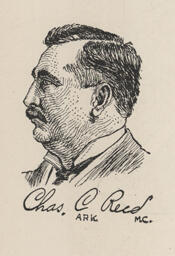
Here you will find contact information for Representative Charles Chester Reid, including email address, phone number, and mailing address.
| Name | Charles Chester Reid |
| Position | Representative |
| State | Arkansas |
| District | 5 |
| Party | Democratic |
| Status | Former Representative |
| Term Start | December 2, 1901 |
| Term End | March 3, 1911 |
| Terms Served | 5 |
| Born | June 15, 1868 |
| Gender | Male |
| Bioguide ID | R000142 |
About Representative Charles Chester Reid
Charles Chester Reid (June 15, 1868 – May 20, 1922) was an American lawyer and Democratic politician who served five consecutive terms as a U.S. Representative from Arkansas from 1901 to 1911. Over the course of a decade in the House of Representatives, he participated actively in the legislative process and represented the interests of his Arkansas constituents during a period of significant economic and political change in the United States.
Reid was born on June 15, 1868, in Clark County, Arkansas, where he spent his early years in the post–Civil War South. Growing up in Reconstruction-era Arkansas, he was exposed to the social and political upheavals that shaped the region’s development and the reestablishment of state and local institutions. These formative experiences in a largely rural, agrarian environment influenced his later legal and political career, particularly his attention to the needs of local communities and the evolving structures of state governance.
After receiving his early education in the public schools of Arkansas, Reid pursued the study of law, a common path for ambitious young men seeking entry into public life in the late nineteenth century. He read law, as was customary at the time, and was admitted to the bar, beginning the practice of law in Arkansas. His legal work brought him into close contact with the practical concerns of citizens and local governments, and it provided the professional foundation for his subsequent public service. Through his practice, he developed a reputation as a capable attorney, which helped propel him into elective office.
Reid’s political career advanced within the Democratic Party, which dominated Arkansas politics in the decades following Reconstruction. Before his election to Congress, he was active in state and local affairs, aligning himself with the party’s efforts to shape economic and legal policy in a period marked by debates over railroad regulation, agricultural interests, and the modernization of state institutions. His standing in the party and his professional background as a lawyer positioned him as a credible and effective candidate for national office.
In 1900, Reid was elected as a Democrat to the United States House of Representatives, taking his seat in the Fifty-seventh Congress on March 4, 1901. He was subsequently reelected to the Fifty-eighth, Fifty-ninth, Sixtieth, and Sixty-first Congresses, serving continuously until March 3, 1911. During these five terms in office, he contributed to the legislative process at a time when the nation confronted issues such as industrial expansion, regulation of commerce, and the early stirrings of the Progressive Era. As a member of the House, he participated in debates, committee work, and votes that affected both his home state and the broader country, consistently representing the interests of his Arkansas constituents within the framework of Democratic Party priorities.
Reid’s decade in Congress coincided with a significant period in American history, encompassing the presidencies of William McKinley, Theodore Roosevelt, and William Howard Taft. During these years, Congress addressed questions of trust-busting, tariff policy, and federal authority over economic life, as well as matters related to America’s growing international presence following the Spanish–American War. Within this context, Reid’s role as a Democratic representative from a Southern, largely agricultural state meant that he was engaged with legislation affecting rural economies, transportation, and federal–state relations, and he worked to ensure that Arkansas’s perspectives were reflected in national policy discussions.
After leaving Congress in 1911, Reid returned to private life and the practice of law in Arkansas. Drawing on his decade of congressional experience, he resumed his legal career with an enhanced understanding of federal law and national policy, remaining a figure of stature in his community. He continued to be identified with the Democratic Party and with the generation of Southern lawmakers who had helped guide their states through the transition from the nineteenth to the twentieth century.
Charles Chester Reid died on May 20, 1922. His career as an attorney and legislator, particularly his ten years of service in the U.S. House of Representatives from 1901 to 1911, placed him among the notable Arkansas political figures of his era, remembered for his participation in the democratic process and his representation of his constituents during a transformative period in American public life.