Senator Charles S. Robb
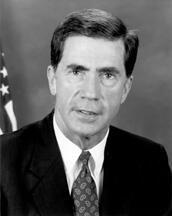
Here you will find contact information for Senator Charles S. Robb, including email address, phone number, and mailing address.
| Name | Charles S. Robb |
| Position | Senator |
| State | Virginia |
| Party | Democratic |
| Status | Former Representative |
| Term Start | January 3, 1989 |
| Term End | January 3, 2001 |
| Terms Served | 6 |
| Born | June 26, 1939 |
| Gender | Male |
| Bioguide ID | R000295 |
About Senator Charles S. Robb
Charles Spittal Robb (born June 26, 1939) is an American former U.S. Marine Corps officer and Democratic politician who served as the 64th governor of Virginia from 1982 to 1986 and as a United States senator from Virginia from January 3, 1989, to January 3, 2001. Over two terms in the Senate, he represented Virginia during a significant period in American political history, participating actively in the legislative process and often positioning himself as a centrist bridge between the parties. In 2000 he sought a third Senate term but was defeated by Republican George Allen, a former governor of Virginia.
Robb was born in Phoenix, Arizona, the son of Frances Howard (née Woolley) and James Spittal Robb. His family later settled in the Mount Vernon area of Fairfax County, Virginia, where he grew up and attended public schools. He graduated from Mount Vernon High School and went on to attend Cornell University before transferring to the University of Wisconsin–Madison. At Wisconsin he was a member of the Chi Phi fraternity and earned a Bachelor of Arts degree in 1961, laying the academic foundation for his later legal and political career.
Following college, Robb entered the United States Marine Corps, beginning a period of service that would shape his public persona and political outlook. An honor graduate of the Marine Corps Officer Candidates School at Quantico, Virginia, he was selected to serve as a White House social aide, a position that brought him into close proximity with national political figures. During this assignment he met Lynda Bird Johnson, daughter of President Lyndon B. Johnson and First Lady Lady Bird Johnson. The couple married in a White House ceremony in 1967, the first wedding held there since 1942, in a service celebrated by the Right Reverend Gerald Nicholas McAllister. Robb subsequently served a combat tour in Vietnam, commanding Company I, 3rd Battalion, 7th Marines. For his service he was awarded the Bronze Star and the Vietnam Gallantry Cross with Star. After his promotion to major, he was assigned to the Logistics section (G-4) of the 1st Marine Division, further broadening his experience in military operations and planning.
After leaving active duty, Robb pursued legal training, earning a Juris Doctor degree from the University of Virginia School of Law in 1973. He clerked for Judge John D. Butzner Jr. of the U.S. Court of Appeals for the Fourth Circuit, then entered private practice with the Washington law firm Williams & Connolly. Settling in McLean, Virginia, he became increasingly active in Democratic politics, serving on the Fairfax County Democratic Committee and the Virginia Democratic State Central Committee. His organizational work and growing prominence within the party set the stage for his rapid rise in statewide politics.
In 1977 Robb was elected lieutenant governor of Virginia, the only Democrat to win statewide office that year and thus the de facto leader of a party that had not captured the governorship in twelve years. He served as lieutenant governor from 1978 to 1982. In 1981 he led the Democratic ticket as its nominee for governor and was elected the 64th governor of Virginia, defeating Republican J. Marshall Coleman. His victory, along with those of the Democratic candidates for lieutenant governor and attorney general, marked a resurgence of the state party. As governor from 1982 to 1986, Robb governed as a moderate who was fiscally conservative, strongly pro–national security, and comparatively progressive on social issues. He balanced the state budget without raising taxes while dedicating an additional $1 billion to education, and he appointed a record number of women and minorities to state positions, including the first African American justice on the Supreme Court of Virginia. He was the first Virginia governor in 25 years to authorize use of the death penalty. Nationally, he helped found the Democratic Governors Association in 1983, was instrumental in the creation of the Southern “Super Tuesday” presidential primary, and was a co-founder of the Democratic Leadership Council, contributing to the modernization of the Democratic Party’s image. His electoral strength and centrist profile led some observers to view him as a potential presidential or vice-presidential contender.
Robb entered the United States Senate after winning the 1988 election with 71 percent of the vote against Republican Maurice Dawkins. Serving from January 3, 1989, to January 3, 2001, he quickly developed a reputation as one of the chamber’s most ideologically centrist members, preferring behind-the-scenes negotiation to public confrontation. His insistence on deeper cuts in federal spending led fellow Democrats to remove him from the Senate Budget Committee, underscoring his fiscal conservatism. In foreign and defense policy, he consistently supported a strong national defense; in 1991 he was among a small group of Democratic senators who voted to authorize the use of force to expel Iraqi forces from Kuwait. That same year he was one of eleven Democrats who voted to confirm Clarence Thomas to the U.S. Supreme Court, in a 52–48 vote that was the narrowest margin for a successful nominee in more than a century. As chairman of the Democratic Senatorial Campaign Committee in 1992, he oversaw record fundraising and the election of seven new Democratic senators, including four new women and the re-election of a fifth, in what became known as the “Year of the Woman.”
On social issues, Robb’s record in the Senate was notably more liberal than that of many of his Southern colleagues. He supported the Federal Assault Weapons Ban, opposed the execution of minors, and voted against a proposed constitutional amendment to ban flag burning. In 1993 he backed President Bill Clinton’s “don’t ask, don’t tell” policy regarding gay and lesbian service members. In 1996 he was the only senator from a Southern state to vote against the Defense of Marriage Act, arguing that the measure was discriminatory and unnecessary and stating that “the fact that our hearts don’t speak in the same way is not cause or justification to discriminate.” His positions on gay rights, abortion, and other contentious social questions are believed by some analysts to have alienated conservative voters in Virginia and contributed to his eventual defeat. Nonetheless, he remained a strong advocate of fiscal restraint and national security; after his re-election in 1994 he was the only Senate Democrat to vote for all items in the Republican “Contract with America” that came to the floor, including a balanced budget amendment and a line-item veto. He also became the only senator to serve simultaneously on all three major national security–related committees: Armed Services, Foreign Relations, and Intelligence.
Robb’s political career was periodically shadowed by controversy. In 1991 former Miss Virginia USA Tai Collins alleged that she had had an affair with him seven years earlier. Robb denied the affair, though he acknowledged sharing a bottle of champagne and receiving a massage from her in his hotel room on one occasion; Collins provided no corroborating evidence and later posed nude for Playboy magazine. Rumors also circulated that, as governor, he had attended parties in Virginia Beach where cocaine was used, allegations he vehemently denied, stating he had never even seen cocaine; no proof of the rumors ever emerged despite intensive scrutiny. In 1991 three of his aides resigned after pleading guilty to misdemeanors connected to an illegally recorded cellular telephone conversation involving Virginia Governor L. Douglas Wilder, a potential 1994 Senate primary rival. A federal grand jury investigated whether Robb and his staff had conspired to distribute the contents of the tape, which had been recorded by an “electronics buff.” Robb and his aides maintained they did not realize that cellular calls were protected by the same laws as landline conversations, and after an eighteen-month inquiry the grand jury declined to indict him. In 1994 he released a five-and-a-half-page letter acknowledging behavior “not appropriate for a married man,” while insisting that the details were private matters between him and his wife and reiterating his denial of any drug use or observation of drug use. He also expressed regret for not acting more decisively to end the conflict between his staff and Wilder’s and for not insisting that the tape be destroyed immediately. Some political opponents, including Republican State Senator Mark L. Earley, suggested the letter was timed to preempt a damaging news story, a charge his spokesman dismissed as unfounded.
Despite these challenges, Robb won a hard-fought re-election campaign in 1994, a difficult year nationally for Democrats. Facing Republican nominee Oliver North, a central figure in the Iran-Contra affair, he was heavily outspent but prevailed narrowly in a three-way race. Republican Senator John Warner declined to support North and instead backed independent candidate Marshall Coleman, the former attorney general whom Robb had defeated in the 1981 gubernatorial race. Robb’s 1994 campaign attracted support from prominent Republicans such as former Defense Secretary Elliot Richardson, former Environmental Protection Agency Administrator William Ruckelshaus, and former CIA Director William Colby, as well as from James Webb, President Ronald Reagan’s former Secretary of the Navy and a future Democratic senator from Virginia. The contentious campaign was chronicled in the documentary film “A Perfect Candidate” and in Brett Morgen’s “Ollie’s Army,” which captured scenes of Robb campaigning on college campuses. After two full terms in the Senate and a quarter-century in statewide politics, Robb was narrowly defeated in 2000 by George Allen, becoming the only Democratic incumbent senator to lose re-election that year.
Following his Senate service, Robb remained active in public affairs, particularly in the field of national security and intelligence. He served on the Board of Visitors of the United States Naval Academy and joined the faculty of George Mason University School of Law as an instructor. On February 6, 2004, President George W. Bush appointed him co-chair, alongside former federal judge Laurence Silberman, of the Commission on the Intelligence Capabilities of the United States Regarding Weapons of Mass Destruction, commonly known as the Iraq Intelligence Commission, which investigated U.S. intelligence relating to the 2003 invasion of Iraq and alleged Iraqi weapons programs; the commission completed its work in December 2005. In 2006 he was appointed to the President’s Intelligence Advisory Board. He also served on the bipartisan Iraq Study Group, co-chaired by former Secretary of State James A. Baker III and former Representative Lee H. Hamilton; during a fact-finding trip to Baghdad, he was reported to be the only member of the group to venture outside the U.S.-controlled Green Zone. Since 2001 he has been a member of the board of trustees of the MITRE Corporation, a federally funded research and development center. He later became a co-leader of the National Security Project at the Bipartisan Policy Center, served as a member of the Trilateral Commission, and joined the Council on Foreign Relations, for which he participated in an Independent Task Force on Pakistan and Afghanistan. He also joined the board of directors of the Committee for a Responsible Federal Budget. In April 2021 the University of Virginia Press published his autobiography, “In the Arena: A Memoir of Love, War, and Politics,” reflecting on his military service, political career, and family life.
Robb’s marriage to Lynda Bird Johnson has been a central element of his public and private life. The couple, married in 1967, have three daughters—Jennifer, Catherine, and Lucinda—and five grandchildren. They long resided in McLean, Virginia, in a home they purchased in 1973. On the evening of December 21, 2021, that residence was destroyed by a fire that was visible across the Potomac River into Washington, D.C. Robb, who was downstairs when the fire broke out, attempted to reach his wife upstairs but was driven back by a wall of flames; he ultimately escaped after she, alerted by a smoke detector, drove their car out of the garage and used its headlights to illuminate an exit. He was treated at a local hospital for burns and released, while she was hospitalized for smoke inhalation and second-degree burns to her hand and elbow that were described as non-life-threatening. The blaze consumed the couple’s books, photographs, artwork, and historic memorabilia, as well as the house itself, which had been valued at approximately $3 million in 2020.