Representative Charles Addison Russell
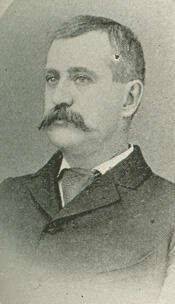
Here you will find contact information for Representative Charles Addison Russell, including email address, phone number, and mailing address.
| Name | Charles Addison Russell |
| Position | Representative |
| State | Connecticut |
| District | 3 |
| Party | Republican |
| Status | Former Representative |
| Term Start | December 5, 1887 |
| Term End | March 3, 1903 |
| Terms Served | 8 |
| Born | March 2, 1852 |
| Gender | Male |
| Bioguide ID | R000521 |
About Representative Charles Addison Russell
Charles Addison Russell (March 2, 1852 – October 23, 1902) was a Republican member of the United States House of Representatives from Connecticut, serving eight consecutive terms in Congress from 1887 until his death in 1902. Over the course of his legislative career, he represented his constituents during a significant period in American history and contributed to the national lawmaking process as a member, and later as a committee chairman, in the House of Representatives.
Russell was born in Worcester, Massachusetts, on March 2, 1852. He attended the public schools of Worcester, receiving his early education in the local system. Demonstrating academic promise, he went on to attend Yale College, from which he graduated in 1873. His Yale education placed him among the ranks of New England’s educated professional class and provided a foundation for his subsequent work in journalism, manufacturing, and public service.
Immediately following his graduation from Yale, Russell embarked on a career in journalism in his native Worcester. From 1873 until 1879 he served as city editor of the Worcester Press, a position that immersed him in local affairs and public discourse. In 1879 and 1880 he continued his work in the press as associate editor of the Worcester Spy. These editorial roles gave him practical experience in political reporting and public communication, skills that would later serve him in elective office.
In 1879, Russell moved from Massachusetts to Killingly, Connecticut, where he entered the woolen manufacturing business. Engaging in the manufacture of woolen products, he became part of the industrial and commercial life of northeastern Connecticut at a time when textile production was a central element of the regional economy. His standing in the community and his business experience helped propel him into state politics. In 1881 he served as aide-de-camp on the staff of Governor Hobart B. Bigelow of Connecticut, an appointment that brought him into closer contact with state government. He was elected a member of the Connecticut House of Representatives in 1883, and later held statewide executive office as Secretary of the State of Connecticut in 1885 and 1886.
Russell’s state-level service provided a springboard to national office. A member of the Republican Party, he was elected as a Republican to the Fiftieth Congress and to the seven succeeding Congresses, representing Connecticut in the U.S. House of Representatives from March 4, 1887, until his death on October 23, 1902. His eight terms in office spanned a transformative era in American political and economic life, and he participated in the democratic process by advocating for the interests of his Connecticut constituents on the floor of the House and in committee work. During the Fifty-seventh Congress he served as chairman of the Committee on Expenditures in the Department of War, a position that placed him in a key oversight role with respect to federal military spending.
Russell’s congressional career was cut short when he died in office. Having been renominated as the Republican candidate for reelection in 1902, he was actively seeking another term at the time of his death. He died in Killingly, Connecticut, on October 23, 1902, while still serving in the House of Representatives. He was interred in High Street Cemetery in the Dayville section of Killingly, Connecticut. His death placed him among the members of the United States Congress who died in office in the early twentieth century, and his life and character were subsequently commemorated in memorial addresses delivered in the House of Representatives and the Senate in 1903.