Representative Charles W. Sandman Jr.
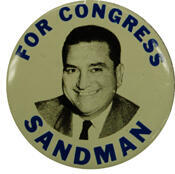
Here you will find contact information for Representative Charles W. Sandman Jr., including email address, phone number, and mailing address.
| Name | Charles W. Sandman Jr. |
| Position | Representative |
| State | New Jersey |
| District | 2 |
| Party | Republican |
| Status | Former Representative |
| Term Start | January 10, 1967 |
| Term End | January 3, 1975 |
| Terms Served | 4 |
| Born | October 23, 1921 |
| Gender | Male |
| Bioguide ID | S000045 |
About Representative Charles W. Sandman Jr.
Charles William Sandman Jr. (October 23, 1921 – August 26, 1985) was an American politician and jurist who represented Cape May County in the New Jersey Senate from 1954 to 1966 and represented southern New Jersey in the United States House of Representatives from 1967 to 1975. A member of the Republican Party, he served four terms in Congress and was a prominent figure in New Jersey politics for more than two decades. He sought the Republican nomination for Governor of New Jersey three times, losing to Wayne Dumont in 1965 and William T. Cahill in 1969, and finally securing the nomination in 1973 by defeating incumbent Governor Cahill before losing the general election to Democrat Brendan Byrne in a historic landslide.
Sandman was born in Philadelphia, Pennsylvania, on October 23, 1921. He grew up in southern New Jersey and graduated from Cape May High School. He went on to attain a bachelor’s degree from Temple University in Philadelphia, reflecting an early commitment to higher education that would underpin his later legal and political career. He subsequently earned a law degree from Rutgers School of Law–Newark, preparing for admission to the bar and the practice of law in New Jersey.
During World War II, Sandman served in the United States Army Air Corps as a navigator. His military service was marked by significant personal sacrifice: he was shot down in combat and spent seven months as a prisoner of war in Germany. This experience as a POW during a global conflict shaped his outlook and added to his public stature when he later entered elective office. After the war, he returned to New Jersey, completed his legal training, and embarked on a career in law and public service.
Sandman’s political career began at the state level. He was elected to the New Jersey Senate representing Cape May County and served from 1954 to 1966. He was elected to three four-year terms, in 1955, 1959, and 1963, and rose to a leadership role as Majority Leader of the New Jersey Senate in 1964 and 1965. During this period he also became active in national Republican politics, serving as a delegate to the Republican National Conventions in 1956, 1960, 1964, and 1968. In 1965 he sought the Republican nomination for Governor of New Jersey but lost to Wayne Dumont, and in 1969 he again pursued the nomination, losing to William T. Cahill. In 1966, while still holding his State Senate seat, Sandman ran for Congress; upon winning election to the U.S. House of Representatives, he resigned from the state legislature to assume his new federal office.
From January 3, 1967, to January 3, 1975, Charles William Sandman served as a Representative from New Jersey in the United States Congress, representing southern New Jersey. Over the course of his four terms in the House of Representatives, he participated in the legislative process during a significant period in American history, including the Vietnam War era and the unfolding of the Watergate scandal. As a member of the House Judiciary Committee, he played a central role when the committee considered articles of impeachment against President Richard Nixon. Initially, Sandman emerged as the most forceful and vitriolic defender of Nixon in the televised hearings, insisting on detailed examination of each alleged impeachable offense. However, after the release of the so‑called “smoking gun” transcript in August 1974, he reversed his position and announced that he would vote to impeach the President when the articles came before the full House, calling the contents of the transcript “devastating—impeachable.” Despite this change of stance, his reputation was significantly damaged by his earlier defense of Nixon.
In 1973, while still a prominent Republican figure, Sandman mounted his third campaign for governor, running as a conservative challenger to moderate Republican Governor William T. Cahill. In a primary result that “shocked party leaders,” according to contemporary accounts, he defeated Cahill for the Republican nomination. In the general election, however, he was decisively defeated by Democrat Brendan Byrne in a landslide. Sandman’s loss was part of a broader pattern in which New Jersey voters often favored moderate Republicans in statewide races and rejected more conservative candidates. The scale of his defeat contributed to a major setback for Republicans in the 1973 state legislative elections, in which Democrats captured supermajorities in both houses of the New Jersey Legislature.
The aftermath of Watergate and his role in the impeachment proceedings weighed heavily on Sandman’s political fortunes. In the 1974 congressional elections, Republicans across the country suffered because of the scandal, which had by then forced President Nixon to resign. Sandman’s district was no exception. Despite his eventual support for impeachment, his earlier televised defense of Nixon remained fresh in voters’ minds, and he was soundly defeated for reelection by Democrat William J. Hughes. Reflecting on the outcome, Sandman described 1974 as “not a Republican year.” Following his defeat, he was approached by Vice President Nelson Rockefeller with offers to join the Ford administration in various capacities, including the possibility of an ambassadorship of his choosing. Sandman declined these federal opportunities and instead accepted New Jersey Governor Thomas Kean’s invitation to serve on the bench of the Superior Court of New Jersey, continuing his public service in the judiciary.
Sandman’s personal life was rooted in southern New Jersey. He married Marion L. Cooney of Philadelphia, and the couple had six children. Several of his sons—Robert S. Sandman, Charles W. Sandman III, and Richard E. Sandman—followed him into the legal profession, establishing a law practice in Cape May Court House, New Jersey. At the time of his later career and until his death, he resided in the Erma section of Lower Township, New Jersey, maintaining close ties to the community he had long represented and served.
On August 18, 1985, Sandman suffered a stroke and was hospitalized in Cape May Court House. He died there on August 26, 1985, at the age of 63. He was interred in Cold Spring Presbyterian Cemetery in Cold Spring, New Jersey. His legacy in local education was recognized the following year, when in 1986 all members of the Lower Township School District board agreed to rename Lower Township Consolidated School as the Charles W. Sandman Consolidated School in his honor. His public career has also been remembered in popular culture; in the 2019 Apple TV+ series “For All Mankind,” actor Saul Rubinek portrayed Sandman in a fictional storyline involving NASA, Wernher von Braun, and space policy issues.