Representative Charles Reginald Schirm
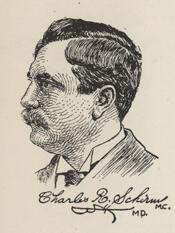
Here you will find contact information for Representative Charles Reginald Schirm, including email address, phone number, and mailing address.
| Name | Charles Reginald Schirm |
| Position | Representative |
| State | Maryland |
| District | 4 |
| Party | Republican |
| Status | Former Representative |
| Term Start | December 2, 1901 |
| Term End | March 3, 1903 |
| Terms Served | 1 |
| Born | August 12, 1864 |
| Gender | Male |
| Bioguide ID | S000127 |
About Representative Charles Reginald Schirm
Charles Reginald Schirm (August 12, 1864 – November 2, 1918) was a U.S. Representative from Maryland and a member of the Republican Party who served one term in the United States Congress from 1901 to 1903. Born in Baltimore, Maryland, to German immigrant parents, he grew up in a city that was a major center of industry and commerce in the post–Civil War era. He attended the public schools of Baltimore, receiving a basic education that prepared him for both manual and professional pursuits in an era when many children of immigrants were entering the industrial workforce.
As a young man, Schirm commenced an apprenticeship in iron molding, a skilled trade closely tied to the expanding industrial economy of the late nineteenth century, but he did not complete this apprenticeship. Seeking broader opportunities, he pursued higher education and attended Washington & Jefferson College in Washington, Pennsylvania. Although details of his course of study are not extensively documented, his time at the college reflected an ambition to move beyond manual labor into the professions. After his studies, he worked as a schoolteacher in both Pennsylvania and Maryland, gaining experience in education and public service that would later inform his political career.
Schirm subsequently turned to the study of law, a common pathway into public life at the time. He read law and was admitted to the Baltimore County bar in 1896. Establishing a legal practice in the Baltimore area, he built a professional reputation that soon led to involvement in state and local government. His legal training and growing prominence in Republican circles positioned him for elective office during a period when Maryland politics were closely contested between the major parties.
From 1898 to 1900, Schirm served as a member of the Maryland House of Delegates, where he participated in state legislative affairs at the close of the nineteenth century. Concurrently, he served as counsel to the board of police commissioners of the city of Baltimore in 1899 and 1900, advising on legal matters related to municipal law enforcement and public order. These roles gave him practical experience in legislative procedure, municipal governance, and public administration, and helped establish his credentials for higher office.
Schirm was elected as a Republican to the Fifty-seventh Congress, representing Maryland in the U.S. House of Representatives from March 4, 1901, to March 3, 1903. His service in Congress occurred during a significant period in American history, marked by the nation’s emergence as an international power in the aftermath of the Spanish–American War and by ongoing debates over economic policy, industrial regulation, and civil service reform. As a member of the House of Representatives, he contributed to the legislative process, participated in the democratic governance of the country, and represented the interests of his Maryland constituents in the national legislature. He was an unsuccessful candidate for reelection in 1902 to the Fifty-eighth Congress, bringing his congressional service to a close after one term.
After leaving Congress, Schirm returned to the practice of law in Baltimore, continuing his legal career while remaining active in political affairs. By the early 1910s, he aligned himself with the Progressive movement that had grown within and then split from the Republican Party. In 1912 he served as a delegate to the Progressive Party’s national convention—often referred to as the Bull Moose National Convention—supporting the insurgent candidacy of former President Theodore Roosevelt. His participation in that convention reflected his ongoing engagement with national political issues and reform currents in the early twentieth century.
In his later years, Schirm continued to reside and work in Baltimore, maintaining his law practice until his death. He died in Baltimore on November 2, 1918, during a year marked by the final months of World War I and the global influenza pandemic. He was interred in Loudon Park Cemetery in Baltimore. His career, spanning education, law, state legislation, municipal service, and a term in the U.S. House of Representatives, exemplified the trajectory of a late nineteenth- and early twentieth-century public servant rising from immigrant roots to national office.