Representative Charles August Sulzer
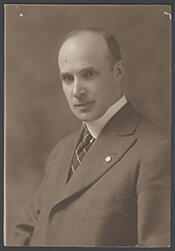
Here you will find contact information for Representative Charles August Sulzer, including email address, phone number, and mailing address.
| Name | Charles August Sulzer |
| Position | Representative |
| State | Alaska |
| District | At-Large |
| Party | Unknown |
| Status | Former Representative |
| Term Start | April 2, 1917 |
| Term End | March 3, 1921 |
| Terms Served | 2 |
| Born | February 24, 1879 |
| Gender | Male |
| Bioguide ID | S001064 |
About Representative Charles August Sulzer
Charles August Sulzer (February 24, 1879 – April 15, 1919) was a veteran of the Spanish–American War who served as a delegate to the United States House of Representatives from the Territory of Alaska from 1917 to 1919. He served as a Representative from Alaska in the United States Congress from 1917 to 1921, and as a member of the House of Representatives he participated in the democratic process and represented the interests of his constituents during a significant period in American history. Over the course of what were effectively two terms in office, he contributed to the legislative process as a member of the Democratic Party, although earlier accounts have listed his party affiliation as unknown.
Sulzer was born on February 24, 1879, in Roselle, Union County, New Jersey. He was the son of Thomas Sulzer, a German immigrant, and Lydia (Jelleme) Sulzer, who was of Frisian descent. Raised in a family of recent European origin, he grew up in an environment shaped by immigrant experience and the rapid industrial and political changes of the late nineteenth century. His brother, William Sulzer, would also go on to a prominent political career as a member of the United States Congress and as governor of New York, situating Charles Sulzer within a family deeply engaged in public life.
Sulzer received his early education in the public schools of New Jersey before attending the Pingry School in Elizabeth, New Jersey, and Berkeley Academy in New York City. He later entered the United States Military Academy at West Point, New York, reflecting both an early commitment to military service and the leadership training that would inform his later public career. Although his time at West Point did not lead to a long-term regular Army commission, it provided him with formal military education at one of the nation’s premier institutions.
During the Spanish–American War, Sulzer served with the Fourth Regiment, New Jersey Volunteer Infantry. His service in this conflict, which marked the emergence of the United States as a global power at the turn of the twentieth century, established him as a Spanish–American War veteran and gave him firsthand experience of military organization and national service. This background would later lend weight to his perspectives as a territorial delegate during a period that included the First World War.
After the war, Sulzer moved to the Territory of Alaska in 1902 and engaged in mining. Arriving at a time when Alaska’s economy was heavily influenced by mineral development and frontier enterprise, he became part of the region’s expanding non-Native population and economic life. His involvement in mining placed him in close contact with the concerns of workers, entrepreneurs, and communities dependent on resource extraction, experience that would later inform his legislative priorities.
Sulzer entered territorial politics as Alaska moved toward more formal structures of self-government. He was elected a member of the Alaska Territorial Senate in 1914, participating in the early legislative efforts of the territory following the establishment of the Alaska Territorial Legislature in 1912. In this role he helped shape local laws and policies during the formative years of territorial administration, gaining recognition that would support his subsequent election to national office.
In national politics, Sulzer presented his credentials as a Democratic delegate-elect to the Sixty-fifth Congress and served from March 4, 1917, to January 7, 1919, when he was succeeded by James Wickersham, who had contested his election. Despite this interruption, Sulzer remained a significant political figure in Alaska. He later presented his credentials as a Delegate-elect to the Sixty-sixth Congress and served from March 4, 1919, until his death on April 15, 1919, before the convening of Congress. His congressional service thus spanned the years 1917 to 1921 in terms of electoral cycles, during which he represented Alaska’s territorial interests in Washington at a time of war, postwar adjustment, and ongoing debates over development and governance in the territory.
Sulzer’s life ended while he was still in office. According to published accounts dated April 16, he took ill in the community of Sulzer in Alaska and died aboard a boat while en route to a hospital in Ketchikan. His death placed him among the members of the United States Congress who died in office in the first half of the twentieth century. He was interred in Evergreen Cemetery in Hillside, New Jersey, returning in death to his home state. His career, bridging military service, frontier enterprise, territorial legislation, and representation in the United States Congress, reflected both the opportunities and the challenges of American expansion and governance in the early twentieth century.