Senator Charles Sumner
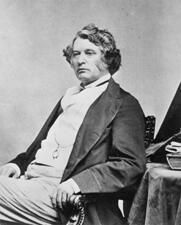
Here you will find contact information for Senator Charles Sumner, including email address, phone number, and mailing address.
| Name | Charles Sumner |
| Position | Senator |
| State | Massachusetts |
| Party | Liberal Republican |
| Status | Former Representative |
| Term Start | December 1, 1851 |
| Term End | March 3, 1875 |
| Terms Served | 4 |
| Born | January 6, 1811 |
| Gender | Male |
| Bioguide ID | S001068 |
About Senator Charles Sumner
On This Page
Charles Sumner (January 6, 1811 – March 11, 1874) was an American lawyer and statesman who represented Massachusetts in the United States Senate from 1851 until his death in 1874. Before and during the American Civil War, he was a leading American advocate for the abolition of slavery, and after the war he was a key figure in the Reconstruction era, during which he and other Radical Republicans successfully fought to end slavery and ensure basic rights for Black Americans.
Early Life and Education
Charles Sumner was born at 58 Irving Street in Boston on January 6, 1811. His father, Charles Pinckney Sumner, was a Harvard-educated lawyer, abolitionist, and early proponent of racial integration. His mother, Relief Jacob, worked as a seamstress before marrying Charles. Growing up in a majority Black part of the Beacon Hill neighborhood, Sumner was shaped by stories of injustice from his Black neighbors, which spurred his future fight for racial equality.
Sumner attended Boston Latin School, where he befriended Robert Charles Winthrop, Wendell Phillips, and others. In 1830, he graduated from Harvard College, and then attended Harvard Law School, where he became a protégé of Joseph Story. After graduating in 1834, Sumner was admitted to the bar and entered private practice in Boston.
In 1837, Sumner traveled extensively in Europe, becoming fluent in French, Spanish, German, and Italian. His time in Paris, where he observed Black students treated as equals by their white classmates, convinced him that racial prejudice was learned rather than natural, solidifying his commitment to abolitionism.
Early Political Activism
Sumner embarked on a public political career in 1845, delivering a powerful Independence Day oration, “The True Grandeur of Nations,” that criticized the move toward war with Mexico. He became recognized as a leader of the “Conscience” faction of the Massachusetts Whig Party and helped organize the Free Soil Party.
Sumner also represented the plaintiffs in Roberts v. City of Boston, which challenged the legality of racial segregation in public schools — arguments that foreshadowed Brown v. Board of Education over a century later.
United States Senate (1851–1874)
In 1851, Sumner was elected to the U.S. Senate by a coalition of Democratic and Free Soil legislators. His election marked a sharp break in Massachusetts politics, as his abolitionist stance contrasted sharply with that of his predecessor Daniel Webster.
The Caning of Charles Sumner
On May 19–20, 1856, Sumner delivered his famous “Crime against Kansas” speech, denouncing the Kansas–Nebraska Act and attacking Senators Stephen A. Douglas and Andrew Butler. On May 22, Representative Preston Brooks, Butler’s cousin, beat Sumner nearly to death on the Senate floor with a heavy cane. Sumner was left with severe injuries, including post-traumatic stress disorder, and spent years recovering. His empty chair in the Senate became a powerful symbol of the anti-slavery cause. Massachusetts reelected him in 1856, and he did not return full-time to the Senate until 1859.
Civil War and Emancipation
During the Civil War, Sumner was among the Radical Republicans who pushed President Lincoln to make emancipation the war’s primary objective. As chair of the Senate Foreign Relations Committee from 1861 to 1871, he worked to prevent Britain and France from intervening on behalf of the Confederacy. He played a key role in the Trent Affair, persuading Lincoln to release captured Confederate diplomats to avert war with Britain.
Reconstruction and Civil Rights
After the war, Sumner fought to provide equal civil and voting rights for freedmen. He championed the Thirteenth, Fourteenth, and Fifteenth Amendments and co-authored the Civil Rights Act of 1875 with John Mercer Langston. He repeatedly tried to remove the word “white” from naturalization laws and defended Chinese immigrants’ right to citizenship.
Sumner supported the annexation of Alaska in 1867, delivering a three-hour speech in its favor and suggesting the territory be called by its Aleutian name. However, he bitterly opposed President Grant’s attempt to annex the Dominican Republic, which led to his removal from the Foreign Relations Committee chairmanship in 1871.
Death and Legacy
Sumner died of a heart attack at his home in Washington, D.C., on March 11, 1874, at the age of 63. He lay in state at the United States Capitol rotunda. His pallbearers included Henry Wadsworth Longfellow, Oliver Wendell Holmes, Ralph Waldo Emerson, and John Greenleaf Whittier.
Historians credit Sumner with coining the phrase “equality before the law.” Modern scholars have emphasized his role as a foremost champion of Black rights before, during, and after the Civil War, with one historian describing him as “perhaps the least racist man in America in his day.”