Representative Charles Quincy Tirrell
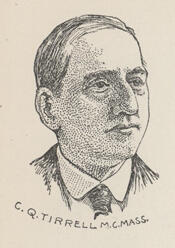
Here you will find contact information for Representative Charles Quincy Tirrell, including email address, phone number, and mailing address.
| Name | Charles Quincy Tirrell |
| Position | Representative |
| State | Massachusetts |
| District | 4 |
| Party | Republican |
| Status | Former Representative |
| Term Start | December 2, 1901 |
| Term End | March 3, 1911 |
| Terms Served | 5 |
| Born | December 10, 1844 |
| Gender | Male |
| Bioguide ID | T000287 |
About Representative Charles Quincy Tirrell
Charles Quincy Tirrell (December 10, 1844 – July 31, 1910) was an American lawyer, educator, and Republican politician who served as a U.S. Representative from Massachusetts from 1901 until his death in 1910. Over the course of five consecutive terms in the United States House of Representatives, he represented his Massachusetts constituents during a significant period in American political and economic development at the turn of the twentieth century.
Tirrell was born in Sharon, Massachusetts, on December 10, 1844. He was educated in the public schools of his hometown, reflecting the expanding system of common schooling in New England in the mid-nineteenth century. Demonstrating early academic promise, he pursued higher education and legal studies, preparing for a professional career that would combine teaching, the practice of law, and public service.
Tirrell attended Dartmouth College, where he studied law and graduated in 1866. His Dartmouth education provided him with a classical and legal foundation that would shape both his work as an educator and his later legal and legislative career. Shortly after graduation, he embarked on a career in education, taking leadership roles in secondary schools in northern New England.
Following his graduation, Tirrell served as principal of Peacham Academy in Peacham, Vermont, for one year, and then as principal of St. Johnsbury High School in St. Johnsbury, Vermont, for two years. In these positions he was responsible for the administration of the schools and the supervision of academic programs, gaining experience in management and public leadership. After several years in education, he turned more fully to the law, a field for which he had formally prepared at Dartmouth.
Tirrell was admitted to the bar in 1870 and commenced the practice of law in Boston, Massachusetts. His legal work in Boston placed him at the center of the Commonwealth’s commercial and political life and facilitated his entry into elective office. In 1872 he was elected to the Massachusetts House of Representatives, marking his first service in public office. The following year, in 1873, he moved to Natick, Massachusetts, which would remain his home and political base for the rest of his life. Continuing his state-level career, he served in the Massachusetts Senate in 1881 and 1882, participating in the legislative affairs of the Commonwealth during a period of industrial growth and social change.
In addition to his professional and political activities, Tirrell was active in fraternal and civic organizations. He became a prominent member of the Independent Order of Odd Fellows in Massachusetts and rose to the position of past grand master of the grand lodge of that order in the state. This role reflected both his standing in the community and his engagement with voluntary associations that played an important part in the social and charitable life of the era.
Tirrell was elected as a Republican to the Fifty-seventh Congress and to the four succeeding Congresses, serving in the U.S. House of Representatives from March 4, 1901, until his death on July 31, 1910. His decade in Congress spanned the administrations of Presidents William McKinley, Theodore Roosevelt, and William Howard Taft, a time marked by progressive reforms, debates over regulation of industry, and the expansion of the federal government’s role in economic and social policy. As a member of the House of Representatives, he participated in the legislative process and represented the interests of his Massachusetts constituents, contributing to national deliberations on issues characteristic of the early twentieth century. His service in Congress occurred during a significant period in American history, and he remained in office continuously for five terms, underscoring the confidence placed in him by the voters of his district.
Charles Quincy Tirrell died in office in Natick, Massachusetts, on July 31, 1910, while still serving in the House of Representatives. He was interred in Dell Park Cemetery in Natick. His death placed him among the members of the United States Congress who died in office in the first half of the twentieth century, and his career was later commemorated in memorial addresses delivered in the House of Representatives and the Senate, recognizing his long record as an educator, lawyer, state legislator, and U.S. Representative from Massachusetts.