Representative Charles Herman Weisse
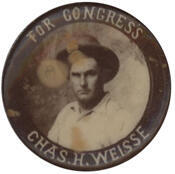
Here you will find contact information for Representative Charles Herman Weisse, including email address, phone number, and mailing address.
| Name | Charles Herman Weisse |
| Position | Representative |
| State | Wisconsin |
| District | 6 |
| Party | Democratic |
| Status | Former Representative |
| Term Start | November 9, 1903 |
| Term End | March 3, 1911 |
| Terms Served | 4 |
| Born | October 24, 1866 |
| Gender | Male |
| Bioguide ID | W000259 |
About Representative Charles Herman Weisse
Charles Herman Weisse (October 24, 1866 – October 8, 1919) was a German American tanner, businessman, and Democratic politician from Sheboygan Falls, Wisconsin. He served as a Representative from Wisconsin in the United States Congress from March 4, 1903, to March 3, 1911, representing Wisconsin’s 6th congressional district for four consecutive terms. A member of the Democratic Party, he contributed to the legislative process during a significant period in American history and was, for a time, the only Democratic member of Wisconsin’s congressional delegation. He also served three terms as president of the village of Sheboygan Falls and was a prominent local industrialist.
Weisse was born near Sheboygan Falls, Wisconsin, the second of six children of Charles Samuel Weisse and Wilhelmine “Minne” (née Kalenberg), both immigrants from the Thuringia region of Germany. His elder brother, Henry, died just before his eighteenth birthday in 1877, leaving Charles as the eldest surviving child. He attended the public schools of Sheboygan Falls and St. Paul Lutheran School, receiving a basic education typical of the period. Raised in a German American household in a growing industrial community, he was introduced early to the family’s tanning enterprise, which would shape his career and public standing.
At age fourteen, Weisse went to work in his father’s tannery business, later known as Chas. S. Weisse & Co., tanners and furriers. By age twenty-two he had become a partner in the firm, joining his younger brothers Louis, Otto, and Emil in the enterprise. After the death of their father, Weisse, as the eldest surviving son, became president of the company. Under his leadership, the Weisse tannery grew into a major employer in Sheboygan Falls, contributing significantly to the local economy and establishing the family as one of the community’s leading business interests. His prominence in business provided both the resources and public visibility that facilitated his entry into local politics.
Weisse’s political career began at the municipal level. He served as village president of Sheboygan Falls from 1893 to 1896, holding the office for three terms. In this role he was involved in the administration and development of the village during a period of economic growth. He further contributed to local public affairs as treasurer of the school board from 1897 until 1900, reflecting his engagement with educational and civic matters. These positions helped build his reputation as a community leader and laid the groundwork for his subsequent campaigns for higher office.
In 1900, Weisse made his first bid for national office, running for the United States House of Representatives as a Democrat in Wisconsin’s 5th congressional district against incumbent Republican Samuel S. Barney. He received approximately 41 percent of the vote in the general election, losing by about 5,000 votes. The following year, redistricting shifted Sheboygan County into the 6th congressional district, along with Ozaukee, Washington, Fond du Lac, and Dodge counties, creating a new political landscape. In 1902, Weisse sought the Democratic nomination in the 6th district and faced a contentious convention against former congressman Owen A. Wells of Fond du Lac, James E. Malone of Dodge County, and Henry Blank of Washington County. After a three-day deadlock, on the twenty-sixth ballot, Michael E. Burke, chairman of the Dodge County delegation, called for a compromise and cast his delegation’s votes for Weisse. Other delegates followed, and Weisse was nominated unanimously. In the general election he campaigned as a vocal critic of the Dingley Act tariffs and pledged to seek adjustments; he won with 52 percent of the vote over Republican William Froehlich, then Wisconsin secretary of state, carrying every county in the district and becoming the only Democrat in Wisconsin’s delegation to the 58th Congress.
Weisse served four terms in the U.S. House of Representatives, from March 4, 1903, to March 3, 1911, representing Wisconsin’s 6th congressional district. During his tenure, he participated in the legislative process at a time marked by the Progressive Era’s reforms and debates over tariffs, regulation, and economic policy. As a Democratic member from a largely Republican state, he played a distinctive role in representing his constituents’ interests in Washington. In addition to his congressional duties, he was active in national party affairs, serving as a delegate from Wisconsin to the Democratic National Conventions in 1904 and 1908. At the 1908 convention he took a leading role in crafting the party platform; contemporary accounts, including the Chicago Tribune, described his efforts as “neither a radical nor a conservative, but endeavoring to produce a platform upon which the whole Democratic party could go before the people.” In 1910, after three re-elections, he declined renomination to the House and instead sought the Democratic nomination for the United States Senate. Although he secured the party’s nomination, U.S. senators were still chosen by state legislatures, and the overwhelmingly Republican 50th Wisconsin Legislature easily re-elected incumbent Senator Robert M. La Follette.
After leaving Congress in 1911, Weisse devoted most of his time to his business and civic interests in Sheboygan Falls and the surrounding region. He resumed full leadership of Chas. S. Weisse & Co. and continued to oversee what remained one of the community’s principal industries. In his final year in office, he had also become a partner in the ownership of The Sheboygan Press, the main newspaper serving the Sheboygan area. His investment in the paper enabled the acquisition of new machinery and facilities, modernizing its production process and enhancing its role in local public life. Beyond business, he remained a figure of influence in Democratic politics and community affairs, though he did not return to elective office.
Weisse’s personal life was marked by both family ties and tragedy. He married Jennie Koster in 1889, and the couple had one daughter; however, both Jennie and the child died in 1891. He later married Caroline H. “Lena” Kallenberg, with whom he had no further children. His brothers Louis, Otto, and Emil continued as his partners in the tannery business, reinforcing the family character of the enterprise. The family home built by his father at 309 Broadway Street in Sheboygan Falls remained intact into the modern era and is listed in the Wisconsin Historical Society’s register of historically significant properties, reflecting the enduring local recognition of the Weisse family’s role in the community.
Weisse’s life ended abruptly in an industrial accident connected to the very enterprise that had defined his career. On September 30, 1919, a catastrophic fire destroyed the entire Chas. S. Weisse & Co. factory in Sheboygan Falls, causing an estimated $150,000 in damage, equivalent to roughly $5 million in 2024 dollars. Only one brick wall of the factory remained standing. On October 8, 1919, Weisse joined several employees in inspecting the ruins of the plant. During the inspection, a strong gust of wind caused the remaining wall to collapse onto the group. Weisse suffered a severe head wound and died within minutes; two other men were killed and six more were injured in the collapse. He was interred at Sheboygan Falls Cemetery, leaving behind a legacy as a local industrial leader, village president, and four-term Democratic Representative from Wisconsin during a transformative era in American politics.