Representative Charles E. Wiggins
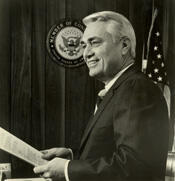
Here you will find contact information for Representative Charles E. Wiggins, including email address, phone number, and mailing address.
| Name | Charles E. Wiggins |
| Position | Representative |
| State | California |
| District | 39 |
| Party | Republican |
| Status | Former Representative |
| Term Start | January 10, 1967 |
| Term End | January 3, 1979 |
| Terms Served | 6 |
| Born | December 3, 1927 |
| Gender | Male |
| Bioguide ID | W000448 |
About Representative Charles E. Wiggins
Charles Edward Wiggins (December 3, 1927 – March 2, 2000) was a United States Representative from California and later a United States circuit judge of the United States Court of Appeals for the Ninth Circuit. A member of the Republican Party, he served six terms in the United States House of Representatives from 1967 to 1979, initially representing California’s 25th congressional district, which was renumbered as the 39th congressional district prior to the 1974 election. His congressional service occurred during a significant period in American history, including the Vietnam War, the civil rights era, and the Watergate scandal, during which he played a prominent role in the impeachment proceedings against President Richard M. Nixon.
Wiggins was born in El Monte, California, and attended the public schools there. He entered the United States Army during the final phase of World War II, serving as a First Lieutenant from 1945 to 1948, and returned to active duty from 1950 to 1952 during the Korean War period. After his military service, he pursued higher education at the University of Southern California, receiving a Bachelor of Science degree in 1953. He continued at the University of Southern California Law School, where he earned a Bachelor of Laws (LL.B.) in 1956, preparing for a career in law and public service.
Following law school, Wiggins served as a law clerk to Judge Swain of the Appellate Division of the Los Angeles County Superior Court, gaining early experience in appellate practice. He became active in local civic affairs in his hometown of El Monte, serving on the El Monte Planning Commission from 1954 to 1960. In 1957 he entered private legal practice in El Monte, beginning what would become a long legal career. His involvement in local government deepened when he was elected an El Monte city councilman, serving from 1960 to 1964, and then as mayor of El Monte from 1964 to 1966, positions that established his reputation as a capable Republican officeholder and set the stage for his entry into national politics.
Wiggins was elected as a Republican to the Ninetieth Congress and to the five succeeding Congresses, serving from January 3, 1967, to January 3, 1979. He represented much of the territory in southern California that Richard Nixon had represented in the House from 1947 to 1950, and he contributed actively to the legislative process during his six terms in office, participating in committee work and floor debates and representing the interests of his constituents. As a member of the House Judiciary Committee during the Watergate investigation, Wiggins initially emerged as one of Nixon’s most vigorous defenders, arguing against impeachment during the committee’s deliberations. His advocacy for Nixon, however, became a central part of his public profile and had political repercussions in his later campaigns.
Wiggins’s stance shifted dramatically after the release of the so‑called “Smoking Gun” tape in August 1974. He had been invited to the White House by Chief of Staff Alexander Haig to review transcripts of the presidential tapes before their public release. After reading the transcript, Wiggins concluded that the evidence showed Nixon had participated in a plan to cover up the Watergate break‑in and related illegal activities. In a public statement, he declared that “the facts then known to me now have changed,” and that it was clear Nixon had a “plan of action” to obstruct the investigation, which he believed was “legally sufficient” to prove a conspiracy to obstruct justice. While he suggested that “a competent counsel” might offer an innocent explanation for Nixon’s conduct in a Senate trial, he concluded that a prolonged impeachment proceeding would not be in the national interest. He therefore urged Nixon to resign and allow Vice President Gerald Ford to succeed him, warning that if Nixon did not resign, he was prepared to vote to impeach the President for obstruction of justice, though he expressed reservations about supporting the other articles of impeachment because of concerns about setting “unfortunate historical precedents.” Several other Republicans on the Judiciary Committee followed his lead, a development highlighted by The New York Times under the headline, “Wiggins for Impeachment; Others in G.O.P. Join Him.”
Wiggins’s earlier, highly visible defense of Nixon contributed to a reduced margin of victory in his 1974 reelection campaign, reflecting the political fallout from Watergate in his district. He was nonetheless reelected in 1976 to his sixth and final term. Choosing not to be a candidate for reelection to the Ninety‑sixth Congress in 1978, he left the House of Representatives at the conclusion of his term on January 3, 1979. After his congressional service, Wiggins returned to the practice of law, working in private practice in Los Angeles, California, from 1979 to 1982, in Washington, D.C., from 1982 to 1984, and in San Francisco, California, in 1984, continuing to draw on his legislative and legal experience.
On August 1, 1984, President Ronald Reagan nominated Wiggins to a newly created seat on the United States Court of Appeals for the Ninth Circuit, established by statute at 98 Stat. 333. The United States Senate confirmed his nomination on October 3, 1984, and he received his commission on October 11, 1984. As a circuit judge, Wiggins participated in the adjudication of a wide range of federal appellate cases arising from the western states within the Ninth Circuit’s jurisdiction. He assumed senior status on December 31, 1996, continuing to serve the court in a reduced but still active capacity until his death.
Charles Edward Wiggins died of cardiac arrest on March 2, 2000, in Las Vegas, Nevada. He was buried in Arlington National Cemetery, reflecting his military service and federal judicial career. A cenotaph monument in his honor stands at Savannah Memorial Park in Rosemead, California, commemorating his life and service in his home region.