Representative Charles Grandison Williams
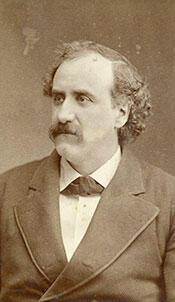
Here you will find contact information for Representative Charles Grandison Williams, including email address, phone number, and mailing address.
| Name | Charles Grandison Williams |
| Position | Representative |
| State | Wisconsin |
| District | 1 |
| Party | Republican |
| Status | Former Representative |
| Term Start | December 1, 1873 |
| Term End | March 3, 1883 |
| Terms Served | 5 |
| Born | October 18, 1829 |
| Gender | Male |
| Bioguide ID | W000492 |
About Representative Charles Grandison Williams
Charles Grandison Williams (October 18, 1829 – March 30, 1892) was an American lawyer and Republican politician who served as a Representative from Wisconsin in the United States Congress from 1873 to 1883. Over the course of five consecutive terms in the House of Representatives, he represented Wisconsin’s 1st congressional district and rose to become chairman of the House Committee on Foreign Affairs, contributing to the legislative process during a significant period in American history.
Williams was born on October 18, 1829, in Royalton, Niagara County, New York. He pursued an academic course in his youth and subsequently studied law in Rochester, New York, preparing for a professional career in the legal field. Early in his adult life he married, but after the death of his first wife he chose to relocate westward, a move that would shape his subsequent legal and political career.
In 1856, following his bereavement, Williams moved to Wisconsin and settled in Janesville, in Rock County. There he was admitted to the bar and commenced the practice of law. He soon became a well-known attorney in the region and entered into a law partnership with David Noggle and Henry A. Patterson, both prominent figures in Wisconsin’s legal and political circles. Through his legal work and growing involvement in public affairs, Williams established himself as a respected member of the Janesville community and of the emerging Republican Party in the state.
Williams’s formal political career began at the state level. A committed Republican, he was elected to the Wisconsin State Senate in 1868 and was re-elected in 1870. During his tenure in the Senate, he was chosen as president pro tempore for the 1871 and 1872 legislative sessions, reflecting the confidence his colleagues placed in his leadership. In addition to his legislative duties in Madison, he participated in national politics as a presidential elector for Ulysses S. Grant in the 1868 United States presidential election, casting his vote in support of the Republican ticket during the Reconstruction era.
In 1872, Williams was elected to the United States House of Representatives from Wisconsin’s 1st congressional district as a member of the Republican Party. He took his seat in the Forty-third Congress on March 4, 1873, and was subsequently re-elected four times, serving continuously until March 3, 1883. His decade in Congress coincided with the later years of Reconstruction and the nation’s transition into the Gilded Age, and he participated in the democratic process by representing the interests of his Wisconsin constituents on a wide range of legislative matters. During the Forty-seventh Congress (1881–1883), he served as chairman of the House Committee on Foreign Affairs, a position that placed him at the center of debates over the United States’ relations with other nations and underscored his prominence within the Republican majority.
Williams sought a sixth term in the House but was defeated in the 1882 election, bringing his congressional service to a close in March 1883. Shortly after his departure from Congress, he continued in federal service when he was appointed register of the land office for the Dakota Territory. In connection with this appointment, he moved to Watertown in the Dakota Territory, where he oversaw matters related to public lands during a period of rapid settlement and development on the American frontier. He remained in Watertown for the rest of his life, maintaining his involvement in public affairs in a territorial setting after his long tenure in national legislative office.
Charles Grandison Williams died in Watertown, Dakota Territory, on March 30, 1892. His body was returned to Wisconsin, and he was interred at Oak Hill Cemetery in Janesville, the community where he had first established his legal practice and launched his political career. His life encompassed service at the state and national levels, including a decade in the United States House of Representatives and leadership of the House Committee on Foreign Affairs during a formative era in American political and diplomatic history.