Representative Charlotte Reid
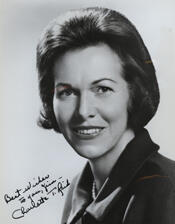
Here you will find contact information for Representative Charlotte Reid, including email address, phone number, and mailing address.
| Name | Charlotte Reid |
| Position | Representative |
| State | Illinois |
| District | 15 |
| Party | Republican |
| Status | Former Representative |
| Term Start | January 9, 1963 |
| Term End | January 3, 1971 |
| Terms Served | 5 |
| Born | September 27, 1913 |
| Gender | Female |
| Bioguide ID | R000143 |
About Representative Charlotte Reid
Charlotte Thompson Reid (September 27, 1913 – January 25, 2007) was an American politician and public servant who represented Illinois in the United States House of Representatives from 1963 to 1971 and later served as a commissioner of the Federal Communications Commission from 1971 to 1976. A member of the Republican Party, she served five terms in Congress during a significant period in American history, contributing to the legislative process and representing the interests of her constituents in Illinois’s 15th Congressional District.
Born Charlotte Leota Thompson, she grew up in Aurora, Illinois, and attended the public schools there. She later pursued higher education at Illinois College in Jacksonville, Illinois. Before entering political life, she developed a career in entertainment; under the professional name “Annette King,” she was a featured vocalist on the NBC radio program Breakfast Club with Don McNeill, a popular national morning show. This early experience in broadcasting and public performance would later complement her public speaking and political communication skills.
On January 1, 1938, Charlotte Thompson married Frank R. Reid Jr., the son of former U.S. Representative Frank R. Reid, who had served six terms in Congress as a U.S. Representative from Illinois. The couple had four children, one of whom, Patricia Reid Lindner, later served as a member of the Illinois House of Representatives. Frank R. Reid Jr. sought to follow his father into Congress and, in 1962, won the Republican nomination for the U.S. House seat from Illinois’s 15th District, defeating eight other candidates. However, he died in August 1962 before he could stand in the general election. Because of Charlotte Reid’s active involvement in her husband’s campaign and her familiarity with the district’s political landscape, she was chosen by party leaders to replace him on the ballot.
Reid won election to Congress in November 1962 and took office on January 3, 1963, in the 88th Congress. She was the only new woman elected to the House of Representatives that year, joining a body that then included 12 female Representatives and two female Senators. She was subsequently re-elected to four successive terms, serving until 1971. Her congressional service thus spanned a transformative era marked by the civil rights movement, the escalation of the Vietnam War, and major domestic policy debates. During her tenure, she was initially assigned to the Committee on Interior and Insular Affairs and the Committee on Public Works, where she participated in deliberations over infrastructure, natural resources, and territorial issues. She also served on the House Republican Policy Committee and the Committee on Standards of Official Conduct, reflecting the confidence of her colleagues in her judgment and party leadership role.
As her seniority increased, Reid gained a seat on the powerful Committee on Appropriations, where she served on two key subcommittees: Foreign Operations and Labor-Health, Education and Welfare. In these roles she helped shape federal spending priorities in foreign aid, labor policy, health care, and education. She was appointed as one of the first six congressional members of the Board of Governors of the John F. Kennedy Center for the Performing Arts, underscoring her continuing interest in culture and the arts, and she also served on the Board of Governors of the Capitol Hill Club, a prominent Republican social and political institution in Washington. Reid addressed the Republican National Convention in San Francisco in 1964 and again in Miami in 1968, further elevating her national profile within the party. In legislative matters, she was the only member of Congress from Illinois to vote against the Civil Rights Act of 1964, but she later supported the Voting Rights Act of 1965 and the Civil Rights Act of 1968, reflecting a complex record on civil rights legislation during the 1960s.
Reid’s congressional career also included notable milestones for women in national politics. In 1965, during her second term, she paid for her own trip to Vietnam to visit servicemembers from her district, including 23 men serving on an aircraft carrier in the China Sea. Upon returning to the United States, she contacted their families to share information and reassurance, an experience she later described as “one of the most gratifying things that happened to me in Congress.” In 1968, she became the first woman to deliver a formal response to the President’s State of the Union address, marking a significant step in women’s visibility in national political discourse. The following year, in 1969, she became the first woman to wear pants on the floor of the House of Representatives, a small but widely noted moment in the gradual evolution of norms and expectations for women in public life.
In the middle of her fifth term, Reid resigned from Congress in 1971 to accept an appointment as a commissioner of the Federal Communications Commission. She was only the second woman to serve on the FCC in its 37-year history. At the Commission, she was designated Commissioner of Defense, with responsibilities focused on emergency preparedness and defense mobilization in the communications sector—an important portfolio during the Cold War era. She served on the FCC until 1976, helping to oversee regulatory policy in broadcasting and telecommunications at a time of rapid technological and institutional change.
After leaving government service in 1976, Reid remained active in both corporate and public affairs. She served on the board of Liggett Group from 1977 to 1981, on the board of Motorola from 1978 to 1983, and on the board of Midatlantic Bank of New Jersey from 1978 to 1985, bringing her experience in federal regulation and public policy to major private-sector institutions. She was a member of the Defense Advisory Committee on Women in the Services (DACOWITS) from 1982 to 1984, advising the Department of Defense on issues affecting women in the armed forces. From 1985 to 1987 she served on the Presidential Task Force on International Private Enterprise, and from 1982 to 1989 she was on the Board of Governors of the Hoover Institution at Stanford University, contributing to policy research and public affairs discussions. In recognition of her public service and professional accomplishments, she received honorary Doctor of Laws degrees from John Marshall Law School, Illinois College, and Aurora University.
Charlotte Thompson Reid died on January 25, 2007. Her career encompassed entertainment, electoral politics, federal regulation, and corporate governance, and her decade in Congress from 1963 to 1973—together with her subsequent service at the Federal Communications Commission from 1971 to 1976—placed her at the center of major political and policy developments in mid-20th-century America.