Senator Chauncey Goodrich
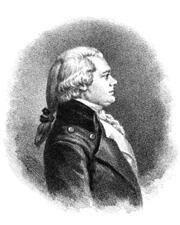
Here you will find contact information for Senator Chauncey Goodrich, including email address, phone number, and mailing address.
| Name | Chauncey Goodrich |
| Position | Senator |
| State | Connecticut |
| Party | Federalist |
| Status | Former Representative |
| Term Start | December 7, 1795 |
| Term End | March 3, 1813 |
| Terms Served | 4 |
| Born | October 20, 1759 |
| Gender | Male |
| Bioguide ID | G000293 |
About Senator Chauncey Goodrich
Chauncey Goodrich (October 20, 1759 – August 18, 1815) was an American lawyer and Federalist politician from Connecticut who represented that state in the United States Congress as both a senator and a representative. Born in Durham in the Connecticut Colony, he was the son of Congregational minister Elizur Goodrich and the brother of Elizur Goodrich, who would also become a member of Congress. Raised in a clerical and educated household, he was part of a family that would play a prominent role in early national politics and public life.
Goodrich pursued a classical education and graduated from Yale College in 1776, during the American Revolutionary War. After graduation he taught school and, from 1779 to 1781, served on the Yale faculty as a tutor. He then studied law and was admitted to the Connecticut bar in 1781. Establishing his practice in Hartford, he quickly became a respected attorney, which laid the foundation for his entry into public service and political life in the new republic.
Goodrich’s political career began in state government. He served in the Connecticut House of Representatives from 1793 to 1794. After an unsuccessful campaign for Congress in 1793, he was elected as a Federalist to the Fourth Congress from Connecticut’s Second District. He was subsequently re-elected to the Fifth and Sixth Congresses, serving in the United States House of Representatives from March 4, 1795, to March 3, 1801. In the Sixth Congress he served alongside his brother Elizur Goodrich, reflecting the family’s strong Federalist alignment and influence in Connecticut politics. Throughout this period he contributed to the legislative process during what would later be recognized as a formative era in the development of the federal government.
After leaving the House, Goodrich returned to Connecticut and resumed his law practice in Hartford. He was appointed to the Governor’s Council, serving from 1802 to 1807, and at the same time held judicial office as a judge of the Connecticut Supreme Court of Errors, then the state’s highest court. His combined legislative and judicial responsibilities underscored his standing as a leading Federalist and legal authority in the state. These roles also positioned him for a return to national office when a vacancy arose in the United States Senate.
Goodrich entered the United States Senate as a Federalist from Connecticut when the Connecticut General Assembly elected him to complete the term of Senator Uriah Tracy, who had died in office. He took his seat on October 25, 1807, and was subsequently re-elected to a full term. He served in the Senate in the Tenth, Eleventh, Twelfth, and Thirteenth Congresses, remaining in office until May 1813. His tenure in the Senate thus extended from 1807 to 1813, a period that included rising tensions with Great Britain and the approach of the War of 1812. On June 17, 1812, he voted against declaring war on Britain; although he opposed the conflict, the Senate approved the declaration by a vote of 19 to 13. His service in Congress, encompassing his earlier House tenure from 1795 to 1801 and his Senate service from 1807 to 1813, occurred during a significant period in American history, and he consistently represented the interests of his Connecticut constituents within the Federalist Party framework.
While still a senator, Goodrich expanded his responsibilities in state and local government. In 1812 he was elected mayor of Hartford, a position of growing importance as the city developed into a regional center of commerce and politics. He also became lieutenant governor of Connecticut, holding both the mayoralty of Hartford and the lieutenant governorship simultaneously. He retained these offices until his death, illustrating the degree of confidence placed in him by Federalist leaders and the electorate. During the closing years of the War of 1812, he further distinguished himself as a Connecticut delegate to the Hartford Convention in 1814 and 1815, where New England Federalists met to discuss their grievances regarding the war and federal policy.
Goodrich’s personal life connected him to other prominent families of the early republic. He married Mary Ann Wolcott, the daughter of Oliver Wolcott, a signer of the Declaration of Independence and a former governor of Connecticut, thereby linking the Goodrich family to one of the state’s leading Revolutionary-era dynasties. His nephew, Chauncey Allen Goodrich, later married a daughter of lexicographer Noah Webster and edited Webster’s Dictionary after Webster’s death, further extending the family’s influence into American intellectual and cultural life.
Chauncey Goodrich died on August 18, 1815, in Hartford, Connecticut, while still serving as mayor of the city and lieutenant governor of the state. He was buried in Old North Cemetery in Hartford. His public career, spanning service in the Connecticut legislature, the United States House of Representatives, the United States Senate, the state judiciary, and high executive and municipal offices, reflected the broad scope of leadership roles assumed by Federalist statesmen in the early decades of the United States.