Representative Chester Charles Thompson
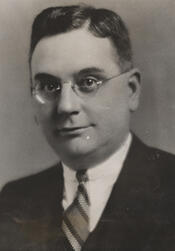
Here you will find contact information for Representative Chester Charles Thompson, including email address, phone number, and mailing address.
| Name | Chester Charles Thompson |
| Position | Representative |
| State | Illinois |
| District | 14 |
| Party | Democratic |
| Status | Former Representative |
| Term Start | March 9, 1933 |
| Term End | January 3, 1939 |
| Terms Served | 3 |
| Born | September 19, 1893 |
| Gender | Male |
| Bioguide ID | T000197 |
About Representative Chester Charles Thompson
Chester Charles Thompson (September 19, 1893 – January 30, 1971) was an Illinois politician who represented Illinois’s 14th congressional district in the United States House of Representatives from 1933 to 1939. A member of the Democratic Party, he served three consecutive terms in Congress during the New Deal era and earlier held local offices as Rock Island County treasurer and mayor of Rock Island, Illinois. Over a public career spanning roughly fifty years, Thompson was a prominent Democratic figure in a region that had long been dominated by Republicans.
Thompson was born on September 19, 1893, in Rock Island, Rock Island County, Illinois, the son of Charles L. Thompson and Susan Miller Thompson. His father’s service as an alderman on the Rock Island city council introduced him at an early age to local politics and public affairs. He attended the Rock Island public schools and graduated from Rock Island High School in 1911. Even before finishing high school, he entered the plastering trade in 1910, a business in which he remained engaged until 1932. During World War I, Thompson served in the United States Army as a corporal in Headquarters Company of the Twenty-Fifth Coast Artillery from 1918 to 1919, contributing to the nation’s war effort before returning to civilian life and local business.
Thompson’s formal political career began in the 1920s. On November 7, 1922, he was elected Rock Island County treasurer, one of only two Democrats to win county office that year, and he served in that capacity until 1926. In the 1922 election he received 15,042 votes (74 percent) to 5,419 votes (26 percent) for his Republican opponent, John G. Miller, reflecting a strong personal mandate in a county that was otherwise largely Republican. As county treasurer, Thompson gained administrative experience and visibility that positioned him for higher office.
In late 1926 Thompson announced his candidacy for mayor of Rock Island. At the time, the city had been predominantly Republican for decades, and he faced a difficult contest against popular Republican alderman William R. Carse. In the April 1927 election Thompson won 5,526 votes (52 percent) to Carse’s 5,060 votes (48 percent), becoming Rock Island’s first Democratic mayor in thirty years and stunning local observers with the upset. He consolidated his position by winning reelection twice. In April 1929 he defeated former mayor Walter A. Rosenfield by a wide margin, 7,700 votes (64 percent) to 4,248 votes (36 percent), and in April 1931 he prevailed again with 7,677 votes (65 percent) to 4,062 votes (35 percent) over Republican John W. Dee. His mayoral tenure coincided with the onset of the Great Depression, and his growing identification as a New Deal Democrat helped shape his subsequent bid for national office.
In 1931 Thompson announced his candidacy for the U.S. House of Representatives from Illinois’s 14th congressional district, pledging to help bring the nation out of the Great Depression. He secured the Democratic nomination and, in the general election of November 1932, defeated incumbent Republican Congressman John Clayton Allen in a hard-fought race, winning 50,277 votes (54 percent) to Allen’s 43,082 votes (46 percent). Riding the nationwide Democratic landslide that accompanied Franklin D. Roosevelt’s election to the presidency, Thompson entered the Seventy-third Congress on March 4, 1933. He was reelected in 1934, again defeating Allen with 44,965 votes (53 percent) to 39,330 votes (47 percent), and in 1936 he won a third term by defeating Republican Clinton Searle, 58,809 votes (54 percent) to 49,250 votes (46 percent). His service in the House extended from 1933 to 1939, encompassing the Seventy-third, Seventy-fourth, and Seventy-fifth Congresses.
During his three terms in Congress, Thompson was a consistent supporter of President Franklin D. Roosevelt and the New Deal legislative program. As a member of the House of Representatives, he participated in the legislative process at a time of sweeping federal intervention in economic and social policy and represented the interests of his Rock Island–area constituents. Working with Rock Island mayor Robert P. Galbraith and utilizing New Deal programs, Thompson helped secure federal funding for local public works, including the construction of a new high school and a water treatment plant in Rock Island, projects that provided employment and improved local infrastructure. Despite his alignment with the popular Roosevelt administration, Thompson was defeated for reelection in November 1938 by Republican political newcomer Anton J. Johnson, who received 44,243 votes (51 percent) to Thompson’s 41,682 votes (49 percent), ending his congressional service on January 3, 1939.
After leaving Congress, Thompson continued to hold significant positions in public and quasi-public service. On November 15, 1939, he was appointed president and chairman of the board of the Inland Waterways Corporation, a federal government-owned barge line, where he oversaw operations related to inland water transportation. He served in that post until his resignation on August 15, 1944. Subsequently, he became president of American Waterways Operations, Inc., an organization involved in the inland waterways industry, and remained in that position until his retirement in 1957. Returning to local public affairs in Rock Island County, Thompson served as a member and chairman of the Rock Island County Jury Commission and as a member and chairman of the county board of supervisors from 1965 until his death, continuing his long engagement in civic administration.
In 1964, demonstrating his enduring interest in municipal leadership, Thompson announced that he would once again run for mayor of Rock Island. In the nonpartisan April 1965 election he was narrowly defeated by City Councilman James H. Haymaker, who received 5,023 votes (53 percent) to Thompson’s 4,497 votes (47 percent). Thompson remained a respected figure in local Democratic politics and public life until his death. He died in Rock Island on January 30, 1971, at the age of seventy-seven, concluding a half-century of service as a public official at the municipal, county, federal, and national transportation levels.