Senator Christopher S. Bond
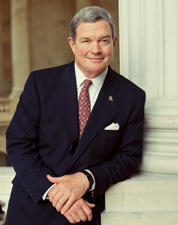
Here you will find contact information for Senator Christopher S. Bond, including email address, phone number, and mailing address.
| Name | Christopher S. Bond |
| Position | Senator |
| State | Missouri |
| Party | Republican |
| Status | Former Representative |
| Term Start | January 6, 1987 |
| Term End | January 3, 2011 |
| Terms Served | 12 |
| Born | March 6, 1939 |
| Gender | Male |
| Bioguide ID | B000611 |
About Senator Christopher S. Bond
Christopher Samuel Bond (March 6, 1939 – May 13, 2025) was an American attorney and Republican politician from Missouri who served four terms as a United States Senator from Missouri from January 3, 1987, to January 3, 2011. Earlier in his career, he held two non-consecutive terms as governor of Missouri, from January 8, 1973, to January 10, 1977, and from January 12, 1981, to January 14, 1985, and served as State Auditor of Missouri from 1971 to 1973. His first election as governor in 1972 ended a 28-year Democratic streak in that office and made him, at age 33, the youngest governor in Missouri’s history.
A sixth-generation Missourian, Bond was born in St. Louis, Missouri, on March 6, 1939, the son of Elizabeth (née Green) and Arthur D. Bond. His father, a Rhodes Scholar, had been captain of the 1924 Missouri Tigers football team. Bond’s maternal grandfather, A. P. Green, founded A. P. Green Industries, a major fireclay manufacturing concern and a principal employer in Mexico, Missouri, where Bond was raised. A. P. Green was also the benefactor and namesake of A. P. Green Chapel at the University of Missouri. Bond attended Deerfield Academy in Massachusetts, graduating in 1956, and then enrolled at Princeton University. He received an A.B. degree in 1960 from the Woodrow Wilson School of Public and International Affairs, completing a 162-page senior thesis titled “Missouri Farm Organizations and the Problems of Agriculture.” While at Princeton, he was a member of the Quadrangle Club. He went on to the University of Virginia School of Law, where he graduated first in his class in 1963 with a J.D.
After law school, Bond began his legal career as a law clerk from 1963 to 1964 to Chief Judge Elbert Tuttle of the United States Court of Appeals for the Fifth Circuit in Atlanta, Georgia. He then practiced law in Washington, D.C., with the firm of Covington & Burling from 1964 to 1967. In the fall of 1967, he returned to his hometown of Mexico, Missouri, and entered electoral politics. In 1968 he ran for Congress in Missouri’s 9th congressional district, a largely rural district in the northeastern part of the state. He won the August Republican primary over Anthony Schroeder by a margin of 56 percent to 44 percent, carrying 19 of the district’s 23 counties. In the November general election he came close to unseating incumbent Democratic Representative Bill Hungate, losing 48 percent to 52 percent, but winning eight counties; it proved to be Hungate’s narrowest re-election margin.
Bond’s near success in 1968 brought him to the attention of state leaders, and in 1969 Missouri Attorney General John Danforth hired him as an Assistant Attorney General, placing him in charge of the office’s Consumer Protection Division. In 1970, at age 31, Bond was elected State Auditor of Missouri, defeating seventeen-year Democratic incumbent Haskell Holman. As auditor, he expanded the professional capacity of the office by hiring seven certified public accountants, increasing the number of CPAs on staff from one to eight. In 1972 he ran for governor and was elected with 55 percent of the vote to 45 percent over his Democratic opponent, becoming the first Republican in 28 years to hold the office. His residency qualifications were challenged under a Missouri law requiring ten years’ residence, in light of his years in Virginia, Georgia, Washington, D.C., and Kentucky for education, work, and personal matters, but the Missouri Supreme Court upheld his eligibility, ruling that residence was “largely a matter of intention” and did not require continuous physical presence.
During his first term as governor, from 1973 to 1977, Bond often governed as a moderate Republican. He drew criticism from some conservatives for supporting the Equal Rights Amendment. On June 25, 1976, he signed an executive order formally rescinding Missouri’s 1838 “Extermination Order” (Executive Order 44) issued by Governor Lilburn W. Boggs, which had ordered the expulsion or extermination of Mormons from the state; Bond coupled the rescission with an apology to Mormons on behalf of all Missourians. In 1976 he endorsed President Gerald Ford over Ronald Reagan in the Republican presidential primaries, a decision that angered some Missouri Republicans, and Bond was mentioned as being on Ford’s short list for the vice-presidential nomination. That same year, he sought a second term as governor but was defeated by Jackson County Prosecutor Joseph P. Teasdale. Despite early polls showing Bond with a substantial lead, Teasdale focused on utility rates and mounted an intensive late advertising campaign, ultimately defeating Bond by a little more than 13,000 votes. Bond later reflected that he had failed to respond adequately to negative attacks. After leaving office in 1977, he returned to private law practice and founded the Great Plains Legal Foundation, an organization that challenged agricultural regulations.
Bond staged a political comeback in 1980. He defeated incumbent Republican Lieutenant Governor Bill Phelps in the gubernatorial primary and went on to unseat Governor Teasdale in the general election, beginning his second term as governor in January 1981. His second administration was immediately confronted with serious budgetary constraints; the state’s commissioner of administration, Stephen Bradford, informed him during the transition that “there’s no money.” Despite fiscal pressures, Bond advanced several policy initiatives, most notably helping to expand the Parents as Teachers program statewide, an early childhood education and parental support program that became a model for other states. In 1983 he served as chairman of the Midwestern Governors Association. He chose not to seek a third consecutive term in 1984 and left office on January 14, 1985. He was succeeded by Republican John Ashcroft, whom Bond had earlier appointed to complete his unexpired term as state auditor; Ashcroft would later serve alongside Bond in the U.S. Senate. As governor, Bond also signed in 1983 a declaration of recognition in support of the group known as the Northern Cherokee, later called the Northern Cherokee Nation of the Old Louisiana Territory, as part of the group’s effort to obtain federal recognition and related benefits.
In 1986, after Democratic Senator Thomas Eagleton declined to seek re-election, Bond ran for the U.S. Senate. He defeated Democratic Lieutenant Governor Harriett Woods by a margin of 53 percent to 47 percent in the general election and took office on January 3, 1987. He was re-elected to the Senate in 1992, defeating St. Louis County Councilwoman Geri Rothman-Serot; in 1998, when he decisively defeated Missouri Attorney General and future governor Jay Nixon and Libertarian candidate Tamara Millay after a hard-fought campaign; and in 2004, when he won a fourth term with 56 percent of the vote over Democratic State Treasurer Nancy Farmer. His four terms in the Senate spanned a period of significant change in American domestic and foreign policy, and he participated in the legislative process on issues ranging from trade and energy to national security and campaign finance. On January 8, 2009, facing the expiration of his fourth term in January 2011, Bond announced that he would not seek re-election to a fifth term in the 2010 elections. Republican Representative Roy Blunt won the seat in November 2010, defeating Democratic Secretary of State Robin Carnahan, and succeeded Bond in the Senate on January 3, 2011.
During his Senate career, Bond took particular interest in trade, energy, and intelligence matters. He was a strong supporter of expanding free trade to the developing world and favored granting presidents fast-track authority to negotiate trade agreements. He voted in favor of the North American Free Trade Agreement (NAFTA) and the Central America Free Trade Agreement (CAFTA), and he supported permanent normal trade relations with the People’s Republic of China and Vietnam. In energy policy, he expressed support for zero-carbon nuclear power in a 2008 Senate floor speech, emphasizing its role in meeting energy needs while limiting greenhouse gas emissions. Bond also became known for pointed public comments, as when he criticized the Internal Revenue Service after an IRS spokesman suggested that a fan who caught a record-breaking Mark McGwire home run ball might owe tax on a “large gift” valued at about $140,000; Bond remarked that if the IRS wished to understand why it was “the most hated federal agency in America,” it need look no further than such positions.
Bond’s positions on civil liberties and national security drew both support and controversy. He opposed legislation that would have required the Central Intelligence Agency to conform its interrogation methods to those in the U.S. Army Field Manual. Although he stated on the Senate floor that he did not favor or approve of torture, he argued against publicly specifying all permissible techniques, contending that such disclosure would enable enemy combatants to train for and resist interrogation. In a memo to CIA Director John Brennan and others, he suggested banning particular methods that could be considered torture while allowing room for the development of other techniques, a stance that attracted criticism. He also drew public scrutiny when, in a debate, he compared waterboarding to swimming—“There are different ways of doing it. It’s like swimming, freestyle, backstroke”—in response to a question about whether waterboarding constituted torture. In domestic policy, Bond consistently opposed same-sex marriage and supported proposed constitutional amendments to ban it. While he voted to prohibit members of Congress from receiving gifts from lobbyists, he generally opposed broader campaign finance reforms, voting against the McCain–Feingold Bipartisan Campaign Reform Act and against measures to limit contributions from corporations or labor organizations.
After leaving the Senate in January 2011, Bond entered private practice and became a partner at the law firm Thompson Coburn, continuing his involvement in legal and public policy matters. Over the course of his long public career—from state auditor to two-time governor and four-term U.S. senator—he represented Missouri during a period of significant political and economic change, participating in the democratic process and representing the interests of his constituents at both the state and national levels. He died on May 13, 2025.