Representative Christopher Columbus Bowen
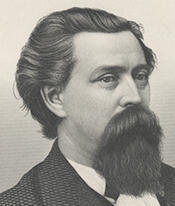
Here you will find contact information for Representative Christopher Columbus Bowen, including email address, phone number, and mailing address.
| Name | Christopher Columbus Bowen |
| Position | Representative |
| State | South Carolina |
| District | 2 |
| Party | Republican |
| Status | Former Representative |
| Term Start | March 4, 1867 |
| Term End | March 3, 1871 |
| Terms Served | 2 |
| Born | January 5, 1832 |
| Gender | Male |
| Bioguide ID | B000681 |
About Representative Christopher Columbus Bowen
Christopher Columbus Bowen (January 5, 1832 – June 23, 1880) was a United States Representative from South Carolina who served in Congress from 1867 to 1871 during the Reconstruction era. Over the course of two terms in the House of Representatives, he participated in the legislative process and represented the interests of his South Carolina constituents at a time of profound political and social transformation in the post–Civil War South. Although later accounts differ on his partisan alignment, he was associated with both Republican and Democratic factions in South Carolina politics during Reconstruction and is identified in some records as a member of the Republican Party.
Bowen was born in Providence, Rhode Island, on January 5, 1832, and attended the public schools there. As a young man seeking opportunity in the expanding South, he moved to Georgia in 1850, attracted by the availability of good agricultural land. In Georgia he engaged in agricultural pursuits, gaining experience in the rural economy of the antebellum South. During this period he also began the study of law, laying the foundation for the legal career that would later support his entry into public life.
By the early 1860s Bowen had relocated to Charleston, South Carolina, where he completed his legal training. He was admitted to the bar in 1862 and commenced the practice of law in Charleston. During the American Civil War he enlisted in the Confederate States Army and served throughout the conflict as a captain in the Coast Guard, a role that involved the defense of the Confederate coastline and maritime approaches. At the close of the war he returned to Charleston and resumed the practice of law, positioning himself to participate in the turbulent political realignments of Reconstruction.
Bowen quickly emerged as an active figure in South Carolina’s postwar politics. He served as a member of the Republican State convention held in Charleston in May 1867, reflecting his early identification with Reconstruction-era Republican efforts in the state. At the same time, he was also chosen as the first chairman of the South Carolina Democratic State central committee, an indication of the fluid and often contested nature of party affiliations in the immediate postwar years. In November 1867 he served as a delegate to the South Carolina constitutional convention, which was responsible for drafting a new state constitution as a condition of readmission to the Union.
Upon the readmission of South Carolina to the Union in 1868, Bowen was elected to the United States House of Representatives as a Democrat to the Fortieth and Forty-first Congresses. He served from July 20, 1868, to March 3, 1871, a period that corresponds to the 1867–1871 span often cited for his congressional service. During these two terms he contributed to the legislative process in Washington, D.C., representing South Carolina at a time when Congress was shaping the legal and political framework of Reconstruction. His tenure placed him at the center of national debates over civil rights, readmission of former Confederate states, and the restructuring of Southern society and governance.
In 1870 Bowen sought reelection to the Forty-second Congress but was unsuccessful, losing to Robert C. De Large, a Republican. Contending that the election had been improperly conducted, he challenged De Large’s victory. The House Committee on Elections undertook a prolonged review of the contest, ultimately determining that there were so many irregularities in the 1870 election that it could not declare a clear victor. As a result, the committee recommended that the congressional seat be declared vacant in 1873. During this same period, Bowen continued to be active in state politics. He served as a member of the South Carolina House of Representatives from 1871 to 1872, further extending his influence in state affairs during Reconstruction.
After his service in the state legislature, Bowen remained a prominent public official in Charleston. In November 1872 he was elected sheriff of Charleston, a position that placed him at the intersection of law enforcement and local governance in a city still grappling with the legacies of war and emancipation. His combined experience as a lawyer, legislator, and local official reflected a career deeply intertwined with the political and legal reconstruction of South Carolina in the late nineteenth century.
Christopher Columbus Bowen died in New York City on June 23, 1880. His remains were returned to South Carolina, and he was interred in St. Laurence Cemetery in Charleston. His life and career, spanning from his New England upbringing and Southern agricultural pursuits to his Civil War service and Reconstruction-era political roles, illustrate the complex personal and political realignments that characterized the United States in the decades surrounding the Civil War.