Representative Clare Eugene Hoffman
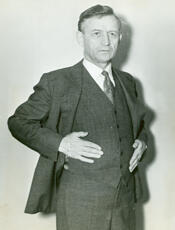
Here you will find contact information for Representative Clare Eugene Hoffman, including email address, phone number, and mailing address.
| Name | Clare Eugene Hoffman |
| Position | Representative |
| State | Michigan |
| District | 4 |
| Party | Republican |
| Status | Former Representative |
| Term Start | January 3, 1935 |
| Term End | January 3, 1963 |
| Terms Served | 14 |
| Born | September 10, 1875 |
| Gender | Male |
| Bioguide ID | H000683 |
About Representative Clare Eugene Hoffman
Clare Eugene Hoffman (September 10, 1875 – November 3, 1967) was a United States Representative from Michigan’s 4th congressional district who served in the U.S. House of Representatives from 1935 to 1963. A member of the Republican Party, he held his seat for 14 consecutive terms, participating in the legislative process during a significant period in American history and representing the interests of his Michigan constituents through the Great Depression, World War II, the early Cold War, and the dawn of the civil rights era.
Hoffman was born on September 10, 1875, and came of age in the closing decades of the nineteenth century, a time of rapid industrialization and political realignment in the United States. His early life in the Midwest exposed him to the economic and social changes that would shape his later political views, including the growth of manufacturing, the rise of organized labor, and the increasing role of the federal government in economic affairs. These formative experiences helped frame the conservative, often skeptical attitude he later brought to questions of federal power and public expenditure.
Educated in an era when legal training was a common pathway into public life, Hoffman studied law and prepared for a career in the legal profession before entering politics. His legal education provided him with a grounding in constitutional principles, statutory interpretation, and the workings of American institutions, skills that would prove central to his long tenure in Congress. Admission to the bar enabled him to practice law, and his early professional years were spent in legal work that brought him into contact with local government, business interests, and community affairs in Michigan.
Hoffman’s political career developed out of this legal and civic engagement. As a Republican, he aligned himself with a party that, in Michigan, was closely associated with business interests, fiscal conservatism, and skepticism toward expansive federal programs. His reputation as a lawyer and community figure helped him secure election to the U.S. House of Representatives in 1934, at a time when the New Deal was reshaping the relationship between the federal government and American society. Taking office on January 3, 1935, he began what would become nearly three decades of continuous congressional service.
During his congressional service from 1935 to 1963, Hoffman represented Michigan’s 4th congressional district through a series of transformative national events. He served in the House during the latter years of the Great Depression, the entirety of World War II, and the onset of the Cold War, as well as during the Korean War and the early stages of the civil rights movement. As a member of the House of Representatives, Clare Eugene Hoffman participated in the democratic process and contributed to the legislative debates of his time, reflecting the priorities and concerns of his district. Over 14 terms in office, he became a familiar figure in the House, known for his adherence to Republican principles and his consistent engagement with the legislative issues that came before Congress.
Hoffman’s long tenure meant that he witnessed and took part in the evolution of federal policy across multiple administrations, from Franklin D. Roosevelt through John F. Kennedy. He was part of the congressional deliberations over wartime mobilization, postwar reconstruction, and the expansion of federal programs in areas such as social welfare, infrastructure, and national defense. In representing Michigan’s 4th district, he balanced national considerations with local concerns, including the economic health of his region, the interests of its businesses and workers, and the broader political culture of his state.
After choosing not to seek re-election in 1962, Hoffman left Congress at the conclusion of his final term on January 3, 1963, closing a 28-year career in the House. In his later years, he remained identified with the generation of legislators who had guided the country through depression, global war, and the early Cold War. Clare Eugene Hoffman died on November 3, 1967, bringing to a close the life of a long-serving Republican representative whose congressional career spanned some of the most consequential decades in twentieth-century American history.