Representative Clarence J. Brown
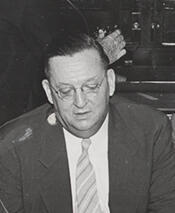
Here you will find contact information for Representative Clarence J. Brown, including email address, phone number, and mailing address.
| Name | Clarence J. Brown |
| Position | Representative |
| State | Ohio |
| District | 7 |
| Party | Republican |
| Status | Former Representative |
| Term Start | January 3, 1939 |
| Term End | January 3, 1967 |
| Terms Served | 14 |
| Born | July 14, 1895 |
| Gender | Male |
| Bioguide ID | B000909 |
About Representative Clarence J. Brown
Clarence James Brown Sr. (July 14, 1893 – August 23, 1965) was an American politician and newspaper executive who represented Ohio as a Republican in the United States House of Representatives from January 3, 1939, until his death in Bethesda, Maryland, in 1965. Over fourteen consecutive terms in Congress, he became a prominent conservative voice in the House while also playing a significant role in advancing key civil rights legislation in the 1950s and 1960s. His long tenure in public life included early statewide office in Ohio and leadership of a major family-owned publishing enterprise.
Brown was born on July 14, 1893, and grew up in Ohio, where he developed an early interest in politics and journalism. Little is recorded in standard references about his formal schooling, but his subsequent career in both public office and business indicates that he entered adulthood with a strong grounding in civic affairs and the newspaper trade. His family’s involvement in publishing would shape his professional path and provide a platform for his later political influence.
At the remarkably young age of 25, Brown was elected in 1918 as the 36th lieutenant governor of Ohio, becoming the youngest man ever to hold that office. He served as lieutenant governor from 1919 to 1923. During this period, he emerged as a visible figure in state politics and aligned himself with the Republican Party’s conservative wing while also taking notable stands on civil rights issues. In 1920, he became president of the Brown Publishing Company, a family-owned newspaper and printing concern based in Ohio. Under his leadership, Brown Publishing expanded substantially, eventually becoming a large media company that endured for approximately 90 years. In 1926, Brown was elected Ohio Secretary of State, serving from 1927 to 1933, further consolidating his position as a leading Republican figure in the state.
Brown’s early public career coincided with the height of the Ku Klux Klan’s influence in Ohio in the early 1920s. In 1921, he supported federal civil rights legislation aimed at stopping the lynching of African Americans, an unusual stance for a conservative Republican at that time. By 1938, as he prepared to seek a seat in the U.S. House of Representatives, he was one of only 67 out of 870 candidates for the House, and one of only 8 out of 96 sitting senators, to pledge support to the NAACP for federal anti-lynching legislation, a legislative precursor to modern civil rights laws. Brown twice sought the governorship of Ohio, losing the Republican primary in 1932 and, after winning the Republican nomination in 1934, losing the general election. He remained active in national party affairs, serving as a delegate to the Republican National Conventions in 1936, 1940, 1944, and 1948, and as a member of the Republican National Committee beginning in 1944.
In 1938, Brown was elected as a Republican to the Seventy-sixth Congress and to the thirteen succeeding Congresses, serving from January 3, 1939, until his death on August 23, 1965. During his early years in Congress, he was a staunch opponent of President Franklin D. Roosevelt’s New Deal, resisting efforts to expand the federal bureaucracy and centralize power in Washington. He also opposed broad foreign military entanglements prior to the United States’ entry into World War II, though in March 1941 he voted in favor of increased military aid to the United Kingdom in its struggle against Nazi Germany. In the Eightieth Congress, he served as chairman of the Select Committee on Newsprint, reflecting both his legislative seniority and his expertise in the publishing industry. He developed a close personal friendship with Democratic Speaker of the House Sam Rayburn of Texas, an alliance that transcended party lines and ideological differences.
Throughout the 1940s and 1950s, Brown continued to articulate conservative positions on domestic and foreign policy. After World War II, he warned against the continuation and expansion of foreign aid programs that had been conceived as temporary wartime or immediate postwar measures. Under President Harry S. Truman, he opposed the Fair Deal, which he regarded as an extension of New Deal-style federal expansion and, in his view, a form of corrupt cronyism through the enlargement of the federal bureaucracy. He cosponsored legislation creating the Hoover Commission—formally the Commission on the Organization of the Executive Branch of Government—and served on that body, which was tasked with studying and recommending reforms to improve the efficiency and organization of the federal government.
Brown’s congressional career was also marked by a sustained engagement with civil rights issues, often in tension with his broader conservative record. In 1940, during debate over federal anti-lynching legislation, he spoke forcefully in favor of protecting vulnerable citizens, declaring that if democracy were to survive in the United States and around the world, those with power must ensure that “the full rights of the weak and defenseless are safeguarded against the violence and the intolerance of the strong and the mighty.” In 1947, during a heated floor exchange involving Representative Adam Clayton Powell Jr. of New York and Representative John E. Rankin of Mississippi, Brown successfully pressed Speaker Joseph W. Martin Jr. to change House rules to prohibit the use of racially offensive language on the House floor, a procedural reform that reflected his insistence on basic standards of decorum and respect in congressional debate.
By the 1950s, Brown had become the ranking minority member of the powerful House Rules Committee, a central gatekeeping body that controlled the flow of legislation to the floor. In the 1960s, he worked closely with the committee’s chairman, Democrat Howard W. Smith of Virginia, to block or limit expansive federal legislation sought by Presidents John F. Kennedy and Lyndon B. Johnson, particularly in areas where he believed federal authority was overreaching. Smith was a leading figure in the Southern Bloc of white Democrats who had long opposed civil rights measures. Yet near the end of his life, Brown used his influence and personal relationship with Smith to secure consideration of landmark civil rights bills. He voted in favor of the Civil Rights Acts of 1957, 1960, and 1964, and in 1965 he played a critical role in advancing the Voting Rights Act. Despite serious illness, he checked out of the hospital to return to Washington and help shepherd the Voting Rights Act of 1965 through the Rules Committee, persuading Smith to allow the measure to reach the House floor. He then voted for the act, which provided federal enforcement of the right to vote for all citizens, and thereby contributed significantly to the achievements of the civil rights movement.
Clarence J. Brown died from uremic poisoning due to kidney failure at Bethesda Naval Hospital in Bethesda, Maryland, on August 23, 1965, while still serving in Congress. He was buried in the I.O.O.F. Cemetery in Blanchester, Ohio. Brown was active in numerous fraternal organizations, including the Masons, Knights of Pythias (K. of P.), Independent Order of Odd Fellows (I.O.O.F.), Loyal Order of Moose, and Modern Woodmen of America (M.W.A.). He and his wife, Ethel, had three children: Betty, Dorothy, and Clarence J. “Bud” Brown Jr. Following his death, Bud Brown won the special election in 1965 to fill his father’s seat in Congress, continuing the family’s political legacy. Brown’s grandson, Clancy Brown, became a well-known actor. Clarence J. Brown is not related to the film director of the same name.