Representative Clarence Eugene Hancock
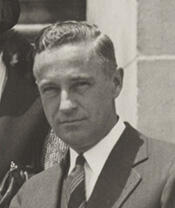
Here you will find contact information for Representative Clarence Eugene Hancock, including email address, phone number, and mailing address.
| Name | Clarence Eugene Hancock |
| Position | Representative |
| State | New York |
| District | 36 |
| Party | Republican |
| Status | Former Representative |
| Term Start | December 5, 1927 |
| Term End | January 3, 1947 |
| Terms Served | 10 |
| Born | February 13, 1885 |
| Gender | Male |
| Bioguide ID | H000146 |
About Representative Clarence Eugene Hancock
Clarence Eugene Hancock (February 13, 1885 – January 3, 1948) was an American attorney and Republican politician from New York, most notable for his service as a U.S. Representative from 1927 to 1947. Over the course of ten consecutive terms in the House of Representatives, he contributed to the legislative process during a significant period in American history, representing the interests of his constituents through the late 1920s, the Great Depression, World War II, and the immediate postwar era.
Hancock was born in Syracuse, New York, on February 13, 1885, the son of Martha (Connelly) Hancock and Theodore E. Hancock. His father was an attorney and prominent political figure who served as New York Attorney General from 1894 to 1898. Clarence Hancock attended Syracuse’s Madison School and graduated from Syracuse Central High School. He then enrolled at Wesleyan University, from which he graduated in 1906, and continued his legal education at New York Law School, receiving his LL.B. in 1908. After being admitted to the bar, he returned to Syracuse and established a law practice, beginning a professional career that would combine legal work, public service, and civic leadership.
Hancock’s early public service was shaped by military experience. As a member of the New York National Guard’s 1st Cavalry Regiment, he attained the rank of sergeant and served on the Mexican border during the 1916 Pancho Villa Expedition. During World War I, he served in France with the 104th Machine Gun Battalion of the 27th Division and rose to the rank of captain as commander of Company D. He later served as an assistant to the division’s judge advocate, J. Leslie Kincaid. On October 18, 1918, during combat at Jonc de Mer Ridge near Le Cateau-Cambrésis, France, Hancock personally conducted front line reconnaissance under fire to determine the best locations for his machine guns and maintained liaison with the infantry units his company supported. For his bravery in this action, he was cited by division commander Major General John F. O’Ryan and awarded the Citation Star, which was converted and upgraded to the Silver Star when that decoration was established in 1932.
Following the war, Hancock resumed his legal career in Syracuse and entered municipal service. He served as Syracuse’s corporation counsel from 1926 to 1927, providing legal advice to the city government. In addition to his law practice, he became active in business and civic affairs. He was a longtime member of Wesleyan University’s board of trustees and served on the board of directors of the Syracuse Journal newspaper. From 1928 to 1948 he was a director of Syracuse’s Merchants National Bank and Trust Company. Professionally, he belonged to the Onondaga County Bar Association and the New York State Bar Association, and he was active in the Syracuse Chamber of Commerce. His civic and cultural engagements included service as president of the Syracuse Music Festival Association and vice commander of his American Legion post. An enthusiastic sportsman, he belonged to the Sedgwick Farm Club (tennis), the Cazenovia Club (golf and tennis), the Onondaga Golf and Country Club (golf), and the Skaneateles Country Club (golf), and he was also a member of Syracuse’s University Club and the Century Club of Syracuse.
Hancock’s congressional career began with a special election in 1927. A Republican, he was elected to the United States House of Representatives to fill a vacancy and took his seat on November 8, 1927. He was subsequently reelected every two years from 1928 through 1944, serving ten terms in all and remaining in office until January 3, 1947. During his tenure, he served on key committees, including the Judiciary Committee and the Naval Affairs Committee, and he played an active role in party politics as chair of the Republican Congressional Campaign Committee’s speakers’ bureau. In the 1936 elections he headed the Republican Party’s eastern speakers’ bureau. In the House, Hancock opposed President Franklin D. Roosevelt’s New Deal, reflecting the views of many in his party who were skeptical of expansive federal intervention in the economy. Throughout his two decades in Congress, he participated in the democratic process at the national level during an era marked by economic crisis, global conflict, and major shifts in federal policy.
Hancock chose not to run for reelection in 1946 because of declining health, bringing his congressional service to a close on January 3, 1947. In his later years he continued to be associated with the business and civic institutions in Syracuse with which he had long been involved. His personal life was rooted in family and community ties. In 1912 he married Emily W. Shonk (1885–1974) of Plymouth, Pennsylvania. They were the parents of one son, John S. Hancock (1914–2007), who served in World War II and later pursued a banking career in Syracuse. Hancock’s brother, Stewart Freeman Hancock (1883–1966), was a prominent Syracuse attorney, and his nephew, Stewart F. Hancock Jr., later served as a judge of the New York Court of Appeals.
Clarence Eugene Hancock died in Washington, D.C., on January 3, 1948, and was buried at Woodlawn Cemetery in Syracuse, New York. His legacy in central New York is reflected in the naming of Syracuse Hancock International Airport and the co-located Hancock Field Air National Guard Base in his honor. After his death, his family donated his congressional and personal papers to Syracuse University; they were later transferred to the State University of New York at Albany. These materials, cataloged as the “Clarence E. Hancock Papers, 1929–1946,” are preserved in the M. E. Grenander Department of Special Collections, documenting his two decades in Congress and his broader contributions to public life.