Representative Clarence MacGregor
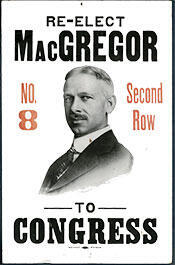
Here you will find contact information for Representative Clarence MacGregor, including email address, phone number, and mailing address.
| Name | Clarence MacGregor |
| Position | Representative |
| State | New York |
| District | 41 |
| Party | Republican |
| Status | Former Representative |
| Term Start | May 19, 1919 |
| Term End | March 3, 1929 |
| Terms Served | 5 |
| Born | September 16, 1872 |
| Gender | Male |
| Bioguide ID | M000009 |
About Representative Clarence MacGregor
Clarence MacGregor (September 16, 1872 – February 18, 1952) was a Republican member of the United States House of Representatives from New York who served in Congress from 1919 to 1929. He was born in Newark, New York, where he spent his early years before pursuing formal education that would prepare him for a career in law and public service. Details of his family background and early schooling are not extensively documented, but his subsequent academic and professional trajectory reflects a solid grounding in classical and legal studies typical of late nineteenth-century American public figures.
MacGregor graduated from Hartwick Seminary in 1893. Hartwick Seminary, located in Otsego County, New York, was a prominent Lutheran institution that combined secondary and collegiate-level instruction and was known for preparing students for the ministry, teaching, and the professions. His completion of studies there in the final decade of the nineteenth century placed him among the educated young men of his generation in upstate New York and provided the intellectual foundation for his entry into law and politics.
Before his election to Congress, MacGregor built his public career in New York state politics. He served as a member of the New York State Assembly representing Erie County’s 8th District in 1908, 1909, 1910, 1911, and 1912. During these five consecutive terms in the Assembly, he participated in the legislative process in Albany at a time when New York was grappling with rapid industrialization, urban growth, and progressive-era reforms. His repeated reelection from an Erie County district indicates a sustained base of local support and established him as a reliable Republican legislator within the state party organization.
MacGregor was elected as a Republican to the 66th, 67th, 68th, 69th, and 70th United States Congresses, holding office from March 4, 1919, until his resignation on December 31, 1928. Representing a New York district in the U.S. House of Representatives, he served five terms during a significant period in American history that encompassed the immediate post–World War I era, the early years of Prohibition, and the economic and social transformations of the 1920s. As a member of the House of Representatives, Clarence MacGregor participated in the democratic process and represented the interests of his constituents, contributing to the legislative work of Congress as the nation addressed issues of veterans’ affairs, economic adjustment after the war, and evolving federal regulatory policies. His decade of service in Congress reflected both his standing within the Republican Party and the confidence placed in him by voters in his district.
MacGregor’s resignation from Congress at the end of 1928 marked a transition from legislative to judicial service. In 1929 he became a justice of the New York Supreme Court, the state’s trial court of general jurisdiction, a position he held until the end of 1942, when he reached the constitutional age limit for judicial service. His tenure on the Supreme Court spanned the onset of the Great Depression, the New Deal era, and the early years of World War II, placing him at the center of important legal and social questions arising in New York during a period of profound national change. His service on the bench underscored his reputation for legal competence and public trust.
After retiring from regular judicial duties due to age restrictions, MacGregor continued to serve the judiciary. He was appointed official referee of the New York Supreme Court and served in that capacity from January 7, 1943, until his death. As an official referee, he handled referred cases and special proceedings, allowing him to apply his long experience as a jurist to the resolution of complex legal matters even after formal retirement from the Supreme Court.
Clarence MacGregor died on February 18, 1952, in Buffalo, New York. His public life, extending from his early legislative work in the New York State Assembly, through five terms in the United States House of Representatives from 1919 to 1929, and culminating in more than a decade on the New York Supreme Court followed by service as an official referee, reflected a sustained commitment to public service in both the legislative and judicial branches of government.