Representative Clark MacGregor
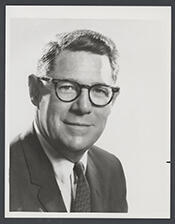
Here you will find contact information for Representative Clark MacGregor, including email address, phone number, and mailing address.
| Name | Clark MacGregor |
| Position | Representative |
| State | Minnesota |
| District | 3 |
| Party | Republican |
| Status | Former Representative |
| Term Start | January 3, 1961 |
| Term End | January 3, 1971 |
| Terms Served | 5 |
| Born | July 12, 1922 |
| Gender | Male |
| Bioguide ID | M000010 |
About Representative Clark MacGregor
Clark MacGregor (July 12, 1922 – February 10, 2003) was an American politician and lawyer who served as a Republican U.S. Representative from Minnesota’s 3rd Congressional District for five terms from 1961 to 1971. A member of the Republican Party, he contributed to the legislative process during a significant period in American history and represented the interests of his suburban Minneapolis constituents in the U.S. House of Representatives.
MacGregor was born in Minneapolis, Minnesota, on July 12, 1922. He attended local schools before enrolling at Dartmouth College, where he graduated cum laude in 1944. Following his undergraduate studies, he returned to his home state and pursued legal training at the University of Minnesota Law School, from which he graduated in 1946. In 1949, he married Barbara Spicer; the couple had three daughters and remained married until his death.
After completing his legal education, MacGregor entered the practice of law in Minnesota and became active in Republican politics. Building a reputation as a capable attorney and an articulate advocate for his party’s positions, he emerged as a leading Republican figure in the Minneapolis area. His growing prominence in local and state politics set the stage for his entry into national office at the beginning of the 1960s.
MacGregor was elected to the U.S. House of Representatives in 1960, defeating six-term Democratic incumbent Roy Wier. He served in the 87th, 88th, 89th, 90th, and 91st Congresses, from January 3, 1961, to January 3, 1971. During his decade in Congress, he participated actively in the democratic process at a time marked by the civil rights movement, the Cold War, and the escalation of U.S. involvement in Vietnam. He voted in favor of the Civil Rights Act of 1964, the Voting Rights Act of 1965, the Civil Rights Act of 1968, and the 24th Amendment to the U.S. Constitution, which abolished the poll tax in federal elections, aligning himself with key federal civil rights and voting rights measures of the era. He also took part in the broader legislative work of the House, contributing to debates and policymaking affecting both Minnesota and the nation.
In addition to his formal legislative duties, MacGregor was engaged in the political life of his party. He served as a delegate to the Republican National Conventions in 1964 and 1968 from Minnesota, reflecting his influence within Republican ranks. In 1963, he made an unusual appearance for a sitting member of Congress by participating in a satirical revue staged by Dudley Riggs’ Brave New Workshop in Minneapolis, an event that highlighted his willingness to engage with contemporary political culture in a less formal setting. Choosing not to seek reelection to the House in 1970, he instead ran for the U.S. Senate from Minnesota. He was an unsuccessful candidate, losing to former Democratic Vice President Hubert Humphrey. MacGregor had initially expected to run against the incumbent senator, Eugene McCarthy, and later remarked privately that he would not have entered the race had he known he would be facing Humphrey.
After his time in Congress, MacGregor moved into senior roles in the Nixon administration. In 1970 he became Assistant to President Richard Nixon for congressional relations, serving as a key liaison between the White House and Capitol Hill. From 1971 to 1972 he held the position of Counsel to the President on congressional relations, continuing to manage legislative strategy and communication with members of Congress. In July 1972, following the resignation of former Attorney General John Mitchell amid the unfolding Watergate political scandal, MacGregor was appointed Chairman of the Committee to Re-elect the President (CREEP), a post he held until November 1972 during Nixon’s successful re-election campaign. As investigative reporting by Bob Woodward and Carl Bernstein of The Washington Post began to reveal the scope of the campaign’s espionage and sabotage operations, MacGregor publicly defended the administration. In an October 1972 press conference, he attacked The Washington Post for allegedly “using innuendo, third-person hearsay, unsubstantiated charges, anonymous sources, and huge scare headlines … maliciously … to give the appearance of a direct connection between the White House and the Watergate — a charge the Post knows — and a half dozen investigations have found — to be false.”
After 1973, MacGregor left active politics and did not seek further elective or appointive office. He continued to reside in Washington, D.C., where he entered the private sector and worked for United Technologies Corporation. He also remained involved in civic and cultural affairs, serving on the boards of the National Symphony Orchestra and the Wolf Trap Foundation, reflecting a long-standing interest in the arts and public service beyond the political arena.
Clark MacGregor died on February 10, 2003, while on vacation in Pompano Beach, Florida. The cause of death was respiratory failure. He was survived by his wife, Barbara, and their three daughters.