Senator Clifford P. Hansen
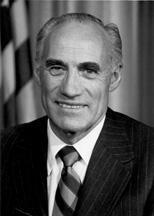
Here you will find contact information for Senator Clifford P. Hansen, including email address, phone number, and mailing address.
| Name | Clifford P. Hansen |
| Position | Senator |
| State | Wyoming |
| Party | Republican |
| Status | Former Representative |
| Term Start | January 10, 1967 |
| Term End | January 3, 1979 |
| Terms Served | 6 |
| Born | October 16, 1912 |
| Gender | Male |
| Bioguide ID | H000170 |
About Senator Clifford P. Hansen
Clifford Peter Hansen (October 16, 1912 – October 20, 2009) was an American politician and rancher from the state of Wyoming who served as the 26th governor of Wyoming from 1963 to 1967 and as a United States senator from 1967 to 1978. A Republican, he was a prominent public figure in Wyoming for more than three decades and was widely known for combining the outlook of a lifelong cattleman with the pragmatism of a small-town elected official. Before his death he was the oldest living former U.S. senator as well as the third-oldest living former U.S. governor, and upon the death of former Senator Hiram L. Fong of Hawaii in August 2004 he became the oldest living person to have served in the United States Senate.
Hansen was born in Zenith, then a small settlement in Lincoln County, Wyoming (now part of Teton County), so small that it later disappeared from state road maps. He was the son of ranchers Peter Christofferson Hansen and Sylvia Irene (née Wood) Hansen. His father, of Danish extraction from Soda Springs, Idaho, had some college training and worked as a “practical” engineer, doing surveying and ditch work on ranch lands, while his mother, of English descent, was born in Blackfoot, Idaho. Clifford Hansen grew up in Jackson Hole, a high-mountain valley that includes what is now Grand Teton National Park, and attended public schools there. As a child he struggled with a severe stutter that initially led some teachers to consider him “uneducable.” After attending a special school that helped him overcome the speech impediment, he became a lifelong advocate of education, often telling his grandchildren that education was “the one thing no one can take away from you.”
Hansen attended the University of Wyoming in Laramie, where he studied animal science and was a member of the Epsilon Delta chapter of the Sigma Nu fraternity. He received his bachelor’s degree in animal science in 1934. That same year, he married Martha Close (June 5, 1914 – September 29, 2011), whom he had met at the university and who had been raised in Sheridan, Wyoming. The couple established a ranching life together and became the parents of two children, Peter Arthur Hansen and Mary Mead. Their family would later become one of Wyoming’s most prominent political families; a grandson, Matthew H. “Matt” Mead (born March 1, 1962), would serve as United States Attorney in Cheyenne from 2001 to 2007 and as the 32nd governor of Wyoming from 2011 to 2019, having been elected in 2010 and re-elected in 2014.
Hansen’s public career began at the local and educational levels while he continued to ranch in Teton County. From 1943 to 1951 he served as a Teton County commissioner, based in Jackson, the county seat of Teton County in northwestern Wyoming. In 1946 he was elected to the board of trustees of his alma mater, the University of Wyoming, on which he served for two decades until 1966. He was president of the board of trustees from 1955 until 1962, when he resigned to run for governor. In addition to his university and county responsibilities, he was active in the state’s livestock industry and served as president of the Wyoming Stock Growers Association from 1953 to 1955. These roles established his reputation as a spokesman for ranchers and rural communities and laid the foundation for his later statewide political career.
In 1962 Hansen sought the governorship of Wyoming as a Republican. He first won the Republican primary over two opponents with 57 percent of the vote. In the general election he faced Democratic Governor Jack R. Gage, who had served fewer than two years after succeeding to the office. Hansen defeated Gage in the 1962 midterm elections by roughly 10,000 votes, receiving 64,970 votes (54.5 percent) to Gage’s 54,298 (45.5 percent). Newspapers in the American West often referred to Hansen as Wyoming’s “cowboy governor,” reflecting both his ranching background and his public persona. As governor, he brought what contemporaries described as down‑to‑earth pragmatism and personal affability to the state capital in Cheyenne. Among his policy initiatives, he increased appropriations for state programs to combat alcoholism and mental illness by more than 50 percent, signaling a significant expansion of Wyoming’s commitment to mental health and substance-abuse services.
As his gubernatorial term drew to a close, Hansen decided to run for the United States Senate seat being vacated by retiring Republican Senator Milward L. Simpson. In the 1966 election, a generally favorable year for Republicans nationally, Hansen won the seat with just under 52 percent of the vote. He defeated Democratic Representative-at-large Teno Roncalio, receiving 63,548 votes (51.8 percent) to Roncalio’s 59,141 (48.2 percent). Hansen resigned from the University of Wyoming board of trustees in 1966 as he prepared to assume federal office. He took his Senate seat in January 1967, beginning what would be two full terms in the upper chamber; he later resigned his seat effective December 31, 1978, after choosing not to seek a third term. In 1972 he was overwhelmingly re-elected to the Senate, defeating Democrat Mike Vinich by a margin of 101,314 votes (71.3 percent) to 40,753 (28.7 percent).
During his Senate career, which extended from 1967 to 1978, Hansen was known as a social and fiscal conservative who nonetheless occasionally broke with his party’s leadership. He voted against sending the proposed Equal Rights Amendment to the states for ratification and opposed the Nixon administration’s deployment of an anti-ballistic missile system, a stance that placed him at odds with Secretary of Defense Melvin R. Laird. At the same time, he supported key civil rights measures and judicial appointments, voting in favor of the Civil Rights Act of 1968 and for the confirmation of Thurgood Marshall to the United States Supreme Court. He served on the Senate Finance Committee under Chairman Russell B. Long, where he played a significant role in shaping tax and resource policy. One of his notable legislative accomplishments was national legislation increasing the share of mineral royalties collected on federal lands within western states from 37.5 percent to 50 percent. According to calculations requested by Wyoming Governor Dave Freudenthal from the state Department of Revenue, this change brought an additional $2.8 billion to Wyoming over the years. Hansen also supported President Gerald R. Ford Jr.’s nomination and election bid in 1976; Ford carried Wyoming’s three electoral votes that year. A member of the Republican Party throughout his career, Hansen was recognized for his cordial relationships across party lines and his accessibility to staff and workers throughout the Capitol, many of whom considered him a personal friend.
After declining to run for a third Senate term, Hansen resigned his Senate seat on December 31, 1978, and returned to his home near Jackson, Wyoming. He continued to be involved in ranching and remained a respected elder statesman in Wyoming politics. His long public service and contributions to western ranching culture were recognized in 1995 when he was inducted into the Hall of Great Westerners at the National Cowboy & Western Heritage Museum in Oklahoma City, Oklahoma, alongside Texas artist and illustrator Thomas C. Lea III. His official gubernatorial portrait was painted by Michele Rushworth, who sought to capture what she described as the former governor’s soul and character in paint. The Clifford P. Hansen Papers are preserved at the American Heritage Center, documenting his extensive career in public life.
In his later years, Hansen and his wife Martha remained in Wyoming and were frequently cited as an example of enduring partnership; theirs was the longest active marriage of any present or former U.S. senator. In a 2006 interview he reported that they were in “pretty good health” for their ages, though his vision had deteriorated enough that they had hired a driver. By mid-October 2009 he fell seriously ill following complications from a broken pelvis. After a brief hospitalization, he returned home to be with Martha, his wife of more than seventy-five years. Hansen died on October 20, 2009, four days after his 97th birthday, not far from the log house where he had been born. At the time of his death he was survived by his wife, his son Peter, a brother, Robert Hansen, a sister, Ordeen Hansen, five grandchildren, and ten great-grandchildren. His daughter, Mary Mead, had predeceased him. His grandson Matt Mead would go on to win election as governor the following year.
Following his death, Hansen lay in state at the Wyoming State Capitol in Cheyenne in a casket draped with the Wyoming state flag. State funeral services were held on October 24, 2009, at the Cheyenne Civic Center. Governor Dave Freudenthal eulogized him as a beloved figure “woven into who we are and through the fabric of this wonderful state,” while Martha Hansen recalled her husband’s abiding faith in the American people and his belief that “everybody is important,” a principle she said guided his actions in and out of politics. Former staff member Pete Williams remembered Hansen as “an honest man, of rock solid integrity, who loved his wife, his children, and his state,” noting that when his service to the nation was complete, he returned quietly to Wyoming. At his funeral, former Senator Alan Simpson, who succeeded him in the Senate and later became Senate Republican whip, paid tribute by saying, “I owe him much. All of Wyoming and the nation owe him much. . . . He was a dear and special man who gave much and asked [for] very little, and fought on always with integrity, courage, and an uncommon degree of common sense.”