Representative Clinton Levi Merriam
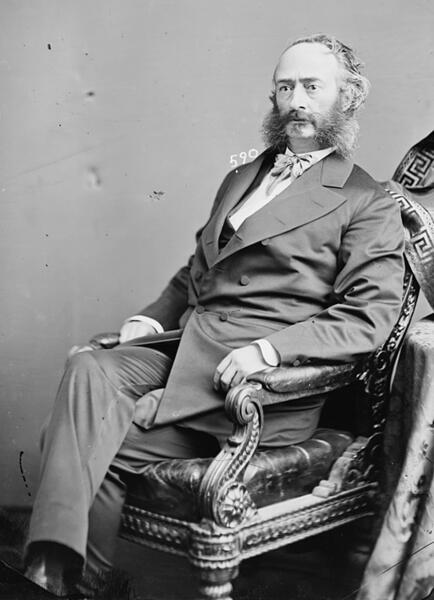
Here you will find contact information for Representative Clinton Levi Merriam, including email address, phone number, and mailing address.
| Name | Clinton Levi Merriam |
| Position | Representative |
| State | New York |
| District | 21 |
| Party | Republican |
| Status | Former Representative |
| Term Start | March 4, 1871 |
| Term End | March 3, 1875 |
| Terms Served | 2 |
| Born | March 25, 1824 |
| Gender | Male |
| Bioguide ID | M000653 |
About Representative Clinton Levi Merriam
Clinton Levi Merriam (March 25, 1824 – February 18, 1900) was a United States Representative from New York and a member of the Republican Party who served two terms in Congress during the early 1870s. He was born in Leyden, Lewis County, New York, on March 25, 1824, into a family whose roots were in upstate New York agriculture and commerce. Raised in a rural community, he attended the local common schools, which provided the foundation of his early education, and later pursued further study at Copenhagen Academy in Copenhagen, New York, a regional institution that prepared young men for business and professional life.
After completing his schooling, Merriam engaged in mercantile pursuits in Utica, New York, entering the commercial life of one of the state’s growing inland cities. Seeking broader opportunities, he moved to New York City in 1847, where he became an importer, participating in the expanding trade networks of the nation’s principal port. His work as an importer placed him at the center of the commercial and financial growth that characterized the mid-nineteenth-century metropolis. In 1860 he expanded his professional activities by engaging in banking, further consolidating his position in the business community and gaining experience in finance and investment.
Merriam returned to his native Leyden in 1864, withdrawing from the immediate bustle of New York City but retaining the economic and social standing he had built through his mercantile and banking enterprises. Back in Lewis County, he became a prominent local figure, managing his affairs from the family estate known as “Locust Grove.” His residence there, a house called “Homewood,” became both his personal retreat and the center of his later life. His business background and Republican affiliation positioned him to enter public service at a time when the nation was emerging from the Civil War and confronting the challenges of Reconstruction and industrial expansion.
Elected as a Republican to the Forty-second and Forty-third Congresses, Merriam served in the United States House of Representatives from March 4, 1871, to March 3, 1875, representing a New York district during a significant period in American history. His service in Congress occurred in the post–Civil War era, when issues of Reconstruction, economic development, and federal policy toward the rapidly industrializing nation were at the forefront of the legislative agenda. As a member of the House of Representatives, he participated in the democratic process, contributed to the legislative work of the body, and represented the interests of his New York constituents, drawing on his experience in commerce and banking to inform his views on economic and financial matters.
After completing his two terms in Congress, Merriam did not seek further national office and retired from active business pursuits. He returned fully to life at “Homewood” on the “Locust Grove” estate near Leyden, where he lived in retirement. From there he remained a respected figure in his community, identified with the Republican Party and with the generation of businessmen who had helped shape New York’s commercial prominence in the nineteenth century. His personal papers from this period, which span roughly from 1848 to 1899, later became part of archival collections, including the Clinton Levi Merriam Papers held by the Smithsonian Institution Archives, reflecting his connections to scientific and intellectual circles through his family.
Merriam’s family life was notable for the distinguished scientific careers of his children. His son, Clinton Hart Merriam, became a prominent zoologist and a leading figure in American biology and conservation, serving as the first chief of the U.S. Biological Survey and contributing significantly to the study of North American fauna. His daughter, Florence Augusta Merriam Bailey, achieved recognition as an ornithologist and nature writer, known for her influential works on bird study and for promoting bird protection and field observation. Through their achievements, the Merriam family name became associated not only with politics and business but also with the advancement of American natural science.
Clinton Levi Merriam died while on a visit to Washington, D.C., on February 18, 1900, closing a life that had spanned from the era of Jacksonian democracy through the Gilded Age. He was interred in Leyden Hill Cemetery in Port Leyden, New York, returning in death to the region where he had been born, educated, and where he had chosen to spend his later years in retirement.