Representative Clyde Howard Tavenner
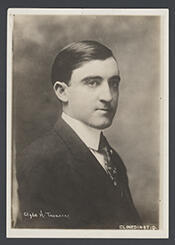
Here you will find contact information for Representative Clyde Howard Tavenner, including email address, phone number, and mailing address.
| Name | Clyde Howard Tavenner |
| Position | Representative |
| State | Illinois |
| District | 14 |
| Party | Democratic |
| Status | Former Representative |
| Term Start | April 7, 1913 |
| Term End | March 3, 1917 |
| Terms Served | 2 |
| Born | February 4, 1882 |
| Gender | Male |
| Bioguide ID | T000059 |
About Representative Clyde Howard Tavenner
Clyde Howard Tavenner (February 4, 1882 – February 6, 1942) was an American politician, journalist, and publisher who served as a Democratic U.S. Representative from Illinois’s 14th congressional district from 1913 to 1917. Over the course of two terms in the United States House of Representatives, he represented a traditionally Republican district in northwestern Illinois and participated actively in the legislative process during a significant period in American political and economic history.
Tavenner was born in Cordova, Rock Island County, Illinois, on February 4, 1882. He attended the public schools of Cordova and entered the printing trade at an unusually early age, beginning work at about eight years old as a newspaper sales boy and typesetter. Demonstrating an early interest in journalism and publishing, he launched a small paper titled The Boys’ Bulletin at the age of fourteen. These formative experiences in the print industry laid the foundation for his later career as a political correspondent, publicist, and publisher.
After his early years in Cordova, Tavenner moved to Chicago, where he worked for the City Press Association. In that role he gained widespread recognition for the accuracy and credibility of his reporting. He subsequently relocated to Washington, D.C., as a political correspondent for the Rock Island Argus. From the capital he wrote a series of widely circulated letters and articles, known as “Tav’s Articles,” which were distributed to more than 1,200 newspapers across the United States, from the Pacific to the Atlantic coasts. His work as a correspondent brought him into close contact with national political leaders and issues, enhancing his reputation as an informed observer of congressional affairs.
Tavenner’s growing prominence in Democratic political circles led to his appointment in 1910 by House Democratic leader Champ Clark as director of publicity for the Democratic Congressional Campaign Committee. That same year he sought elective office himself, winning the Democratic nomination for the U.S. House of Representatives from Illinois’s 14th congressional district, a constituency that had long voted heavily Republican. Running an energetic campaign with the backing of Clark and other prominent Democrats, Tavenner challenged incumbent Republican James McKinney, focusing particularly on McKinney’s support for the Payne–Aldrich Tariff Act, which had imposed high tariff rates and provoked controversy within the Republican Party. In the general election of November 8, 1910, Tavenner lost by a relatively narrow margin, receiving 12,980 votes (40 percent) to McKinney’s 17,004 votes (52 percent), with minor-party candidates Milton L. Morrill and Samuel S. Chapman dividing the remaining vote.
Undeterred by his initial defeat, Tavenner announced in early 1912 that he would again seek the Democratic nomination after Congressman McKinney declined to run for another term. He secured the nomination over Dr. John P. Riggs of Media, Illinois, while Republicans chose Charles J. Searle, a Rock Island businessman and former city alderman, who was initially regarded as the favorite in the strongly Republican district. During the campaign Tavenner drew on his journalistic skills, issuing “Tavenner’s Daily Bulletin” in every daily newspaper in the district to present his qualifications and positions. He pledged to reduce taxes and tariff rates and emphasized his experience and connections in Washington. His wife was also an active participant in the campaign. The Republican candidate’s refusal to accept support from the progressive wing of his party drove many progressive Republicans to Tavenner, and in the general election of November 5, 1912, he was elected with 17,024 votes (47 percent), defeating Searle, who received 15,816 votes (44 percent), and two minor-party candidates. He became the first Democrat elected from the district since 1892 and benefited from the broader Democratic sweep that brought his party control of both the House of Representatives and the presidency.
Tavenner took his seat in the Sixty-third Congress on March 4, 1913, and was reelected to the Sixty-fourth Congress in 1914. In the 1914 election, held on November 3, he increased his margin of victory, receiving 17,221 votes (44 percent) against Republican Frank Abbey’s 16,132 votes (41 percent), with Progressive candidate Henry E. Burgess and Socialist candidate Edgar Owens dividing the remainder. His reelection was aided by the continuing split between traditional and progressive Republicans. During his two terms in Congress, Tavenner was known for his opposition to monopolies and what he regarded as excessive influence of large business interests. He spoke frequently against wasteful government spending and corruption, delivering speeches and lectures across the country. In the Sixty-fourth Congress he served as chairman of the Committee on Expenditures in the Post Office Department, where he was involved in oversight of federal postal operations and expenditures. His tenure coincided with major national debates over tariff reform, regulation of business, and preparedness for World War I, and he participated in the legislative process as part of the Democratic majority.
In the 1916 election cycle, Tavenner faced a resurgent Republican Party in his district. On November 7, 1916, he was narrowly defeated for a third term by Republican attorney William J. Graham of Aledo, Illinois. Graham received 23,099 votes (48 percent) to Tavenner’s 22,591 votes (47 percent), with Socialist candidate Nick S. Dexter and Progressive candidate Cloyd E. Kaufman receiving the remaining votes. After leaving Congress on March 3, 1917, Tavenner resumed his work in journalism and publishing. During World War I he supported the United States war effort, drawing on his background as a publicist and commentator to advocate for national policies.
In the postwar years, Tavenner continued to be active in public affairs from Washington, D.C. In 1923 he founded a monthly magazine, the Philippine Republic, published in Washington, which reflected his interest in U.S.–Philippine relations and questions of colonial policy and self-government. In 1931 and 1932 he traveled extensively in Europe, the Near East, and the Far East as a member of a mission from the Philippine Islands, further deepening his engagement with international and colonial issues. Later, in 1939, he returned to the orbit of Congress as a legislative analyst for the House Committee on Rules, applying his experience as a former representative and political journalist to the study and interpretation of legislative procedures and proposals.
Clyde Howard Tavenner died in Washington, D.C., on February 6, 1942. He was interred in the Congressional Cemetery in Washington, a resting place for many figures associated with the national legislature, thus closing a career that had combined early work in the printing trade, national political journalism, congressional service, and continued involvement in legislative and international affairs.