Representative Colgate Whitehead Darden
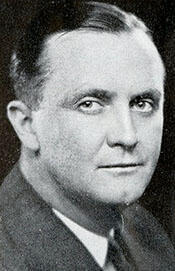
Here you will find contact information for Representative Colgate Whitehead Darden, including email address, phone number, and mailing address.
| Name | Colgate Whitehead Darden |
| Position | Representative |
| State | Virginia |
| District | 2 |
| Party | Democratic |
| Status | Former Representative |
| Term Start | March 9, 1933 |
| Term End | January 3, 1943 |
| Terms Served | 4 |
| Born | February 11, 1897 |
| Gender | Male |
| Bioguide ID | D000050 |
About Representative Colgate Whitehead Darden
Colgate Whitehead Darden Jr. (February 11, 1897 – June 9, 1981) was an American lawyer, Democratic politician, and educator aligned with Virginia’s Byrd Organization who served as a U.S. Representative from Virginia (1933–37, 1939–41), the 54th Governor of Virginia (1942–46), Chancellor of the College of William and Mary (1946–47), and the third President of the University of Virginia (1947–59). A member of the Democratic Party, he contributed to the legislative process during four terms in the United States House of Representatives, representing Virginia both at-large and from the 2nd congressional district during a significant period in American history that encompassed the Great Depression and the early years of World War II. The Darden Graduate School of Business Administration at the University of Virginia is named in his honor.
Darden was born on Marle Hill, a farm in Southampton County, Virginia, near Franklin, to Katherine Lawrence (Pretlow) Darden (1870–1936), a schoolteacher, and Colgate Whitehead Darden (1867–1945), a farmer and businessman. His family had deep roots in Southampton County; Darden’s Tavern, associated with his ancestors, had figured in Nat Turner’s Rebellion in 1831. He grew up on the family farm and attended local public schools, experiences that helped shape his later interest in rural issues and public education. In 1914 he entered the University of Virginia, where he studied for two years before the First World War drew him into military service abroad.
In 1916, before the United States entered World War I, Darden volunteered for service in the French Army and became an ambulance driver with an ambulance corps of the American Field Service in France. While serving near Verdun he contracted malaria in the trenches and returned to the United States in 1917 to recuperate. After the United States declared war on Germany, he enlisted in the United States Marine Corps, was commissioned a lieutenant, earned his pilot’s wings, and served as a Marine aviator. A few weeks before the armistice in 1918, he was seriously injured in an airplane crash and spent about ten months hospitalized. After the war, he returned to the University of Virginia, where he was a member of the Phi Gamma Delta fraternity, and received his degree in 1922. He then pursued legal studies at Columbia Law School, graduating in 1923, and continued his education at Oxford University. On December 3, 1927, he married Constance Simons du Pont, daughter of industrialist Irénée du Pont of the prominent du Pont family of Wilmington, Delaware.
Admitted to the Virginia bar, Darden established a law practice in Norfolk, Virginia, and quickly became active in local Democratic politics, aligning himself with the powerful Byrd Organization that dominated Virginia’s political life for much of the twentieth century. In 1929 he won his first elective office as one of Norfolk’s four part-time representatives in the Virginia House of Delegates. He was re-elected and served alongside Daniel Coleman, Vivian L. Page, and Wilson W. Vellines from 1930 to 1933. He resigned from the House of Delegates in 1933 following his election to Congress; Ralph H. Daughton and Richard W. Ruffin were chosen in a special election to fill the vacancies created by his resignation and the death of Vellines.
Darden entered national politics in 1932, when he was elected as a Democrat in an at-large election to the 73rd Congress after the Byrd Organization–controlled Virginia legislature temporarily replaced district-based elections with an at-large system to unseat Republican Menalcus Lankford of the 2nd district. In that 24-way at-large race, Darden was elected with 8.24 percent of the vote as part of a Democratic sweep of all Virginia seats. He was re-elected in 1934, this time representing the 2nd congressional district in the 74th Congress, defeating Republican Gerould M. Rumble, Socialist George Rohlsen, and Communist Herbert S. Carrington with 76.14 percent of the vote, and served from March 4, 1933, to January 3, 1937. Although he lost the 1936 Democratic primary to Norfolk port official and Portsmouth publisher Norman R. Hamilton and did not serve in the 75th Congress, Darden defeated Hamilton in the 1938 primary and returned to the House, winning the general election for the 76th Congress in 1938 against Independent Carl P. Spaeth with 87.7 percent of the vote, and securing re-election unopposed in 1940 to the 77th Congress. In this second period of service he served from January 3, 1939, until his resignation on March 1, 1941, to run for governor. As a loyal Byrd Organization congressman, he supported the Dies Committee, the predecessor of the House Un-American Activities Committee, and in 1940 opposed federal anti-lynching legislation while supporting Virginia legislation addressing the same crime. He also favored extending loans to European allies as early as 1939, before the United States formally entered World War II.
In 1941, Darden sought and won the governorship of Virginia. In the general election he was elected governor with 80.72 percent of the vote, defeating Republican Benjamin Muse, Communist Alice Burke, and Socialist M. Hilliard Bernstein. Inaugurated on January 21, 1942, he served as the 54th Governor of Virginia until January 16, 1946, guiding the Commonwealth through most of World War II. As governor, he reorganized Virginia’s civil defense apparatus to meet wartime needs, reformed the state’s penal system, and established a pension plan for state employees and teachers. Reflecting the Byrd Organization’s fiscal conservatism, he eliminated the state debt and created a surplus, which he directed toward vocational schools, colleges, hospitals, and other public services, including the electrification of all Virginia educational institutions. His record on race relations, however, reflected the segregationist values of the era and of the Byrd Organization. While his administration provided financial assistance for Black Virginians to study at Meharry Medical College in Tennessee because Virginia’s medical schools remained restricted to white students, and he called for the removal of legislative barriers to Black citizens serving on juries, he declined to intervene when several Black educators were dismissed following the 1940 federal equal-pay decision in Alston v. School Board of Norfolk.
After leaving the governorship, Darden continued his public service in higher education. He served briefly as Chancellor of the College of William and Mary from 1946 to 1947. In 1947 he was elected the third president of the University of Virginia, despite misgivings among some faculty who questioned his lack of academic experience and concerns among some students that he might abolish the fraternity system, based on his earlier recommendation as governor that students at the College of William and Mary be barred from living in fraternity or sorority houses as “undemocratic” and financially burdensome. As president, he did not abolish fraternities at Virginia but did seek to regulate them, including an attempt to ban first-year rushing. During his tenure he oversaw the construction of the student union building, Newcomb Hall, named for his predecessor John Lloyd Newcomb; established the Judiciary Committee to handle student misconduct not rising to the level of honor offenses; and led significant improvements in faculty salaries. He also guided the creation of the university’s graduate school of business administration, later named the Darden Graduate School of Business Administration in his honor. In recognition of his service, he received the Thomas Jefferson Award and the Raven Award upon his retirement from the presidency in 1959.
Darden’s views on race and education during his university presidency reflected both continuity and evolution from his earlier positions. He generally supported the “separate but equal” doctrine prevalent among white Southern leaders before Brown v. Board of Education (1954), and in 1950 he publicly advocated that public schools remain racially “segregated” but “first-rate.” After federal court decisions required the admission of African Americans to graduate and professional programs, he favored their admission to such schools at the University of Virginia, and in 1950 Gregory Swanson became the first Black student admitted to the University of Virginia School of Law following litigation. At the same time, Darden testified in favor of segregation in Davis v. County School Board of Prince Edward County, one of the cases later consolidated into Brown v. Board of Education; in upholding segregated and unequal schools, a three-judge federal panel cited his testimony before the Supreme Court ultimately reversed that decision. In August 1954, speaking to a Ruritan gathering in Southampton County, he warned of the white race being only a small fraction of the world’s population, reflecting contemporary racial anxieties. By the mid-1950s, however, he broke with the Byrd Organization’s policy of Massive Resistance to school desegregation, and in 1955 President Dwight D. Eisenhower appointed him a United States delegate to the United Nations General Assembly.
In his later years, Darden remained an influential figure in Virginia civic and educational life. In 1955, the graduate school of business administration at the University of Virginia was formally named for him, recognizing his role in its creation and his broader contributions to the university. In 1968, the Board of Visitors of Old Dominion University voted to rename its school of education the Darden School of Education in honor of his advocacy for education during his term as governor; in 1986 it became the Darden College of Education. Darden Hall, a 35,000-square-foot building on the campus of the University of Virginia’s College at Wise, was named in recognition of his instrumental role, as president of the University of Virginia, in the founding of that college; the building houses computer and mathematics laboratories, classrooms, the Technical Assistance Center, and faculty offices. The Darden Society, the oldest and most prestigious honor society at UVA Wise, also bears his name and selects members on the basis of scholarly achievement and intellectual promise.
Darden enjoyed a close personal friendship with Tidewater resident Barham Gary; Gary’s sister, the writer Myra Page, referred to him by the nickname “Clukey.” His family continued to play a prominent role in Virginia public life. His younger brother, Joshua Pretlow Darden, served as mayor of Norfolk from 1949 to 1950, and his nephew Joshua Darden later became rector of the University of Virginia and head of its governing board. Joshua Darden’s daughters, Audrey and Holley Darden, represent another generation of the family’s ongoing association with the university and the state.
Colgate Whitehead Darden Jr. died on June 9, 1981, at his home in Norfolk, Virginia. He was buried in the family plot alongside his parents in Southampton County. In addition to his wife, Constance du Pont Darden, he was survived by his brother Joshua Pretlow Darden. His life and career are commemorated by a historic marker at the site of his birth at Marle Hill, and by the several educational institutions and programs that bear his name.