Representative Colleen Hanabusa
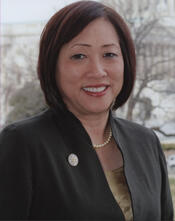
Here you will find contact information for Representative Colleen Hanabusa, including email address, phone number, and mailing address.
| Name | Colleen Hanabusa |
| Position | Representative |
| State | Hawaii |
| District | 1 |
| Party | Democratic |
| Status | Former Representative |
| Term Start | January 5, 2011 |
| Term End | January 3, 2019 |
| Terms Served | 4 |
| Born | May 4, 1951 |
| Gender | Female |
| Bioguide ID | H001050 |
About Representative Colleen Hanabusa
Colleen Wakako Hanabusa (born May 4, 1951) is an American lawyer and Democratic politician from Hawaii who served as the U.S. representative for Hawaii’s 1st congressional district from January 3, 2011, to January 3, 2015, and again from November 14, 2016, to January 3, 2019. Over four terms in the House of Representatives, she represented urban Honolulu and surrounding communities, participating in the legislative process during a significant period in American political history and advocating for the interests of her constituents. She later sought higher office, including campaigns for the United States Senate, the governorship of Hawaii, and the mayoralty of Honolulu.
Hanabusa was born in Honolulu, Territory of Hawaii, and is of Japanese ancestry, a Sansei (third-generation Japanese American). She grew up in Waianae on the leeward coast of Oahu, where her family operated a small business, and she was raised in a working-class community shaped by Hawaii’s plantation and post‑statehood economy. She attended public schools in the state and went on to the University of Hawaiʻi at Mānoa, earning a Bachelor of Arts degree in economics and sociology in 1973. She continued at the University of Hawaiʻi’s William S. Richardson School of Law, receiving her Juris Doctor in 1977. After law school she was admitted to the Hawaii bar and began practicing law, developing a career in labor law and commercial litigation that would inform her later work on economic and labor issues in public office.
Before her election to Congress, Hanabusa built a prominent career in the Hawaii State Senate. First elected to the Senate in the late 1990s, she represented a district that included parts of the leeward coast and became known for her work on labor, land use, and economic development. She rose in the chamber’s leadership, serving as Senate Majority Leader and, in 2007, was elected Hawaii’s first female President of the Senate, a historic milestone in the state’s political history. In that role she presided over the upper chamber, helped shape legislative priorities, and gained experience in budgetary and policy negotiations that would later carry over to her federal service.
Hanabusa first sought a seat in the U.S. House of Representatives in 2010, when Representative Neil Abercrombie resigned to run for governor. She ran in the May 22, 2010, special election to fill the remainder of Abercrombie’s term in Hawaii’s 1st congressional district. In that all‑party, winner‑take‑all contest, then–Honolulu City Councilman Charles Djou, a Republican, prevailed without winning a majority, as the Democratic vote was split between Hanabusa and former Representative Ed Case, a moderate Democrat. U.S. Senators Daniel Inouye and Daniel Akaka strongly supported Hanabusa’s special election campaign and continued to back her in the subsequent Democratic primary, while some in the national Democratic Party signaled a preference for Case; the national party leadership, however, remained officially neutral. After finishing behind Djou and Case in the special election, Case announced on May 30, 2010, that he would withdraw from the race for the regularly scheduled November election and endorsed Hanabusa to avoid further splitting the Democratic vote. Hanabusa then became the leading Democratic candidate, won the September primary, and went on to defeat Djou in the November 2, 2010, general election by a margin of 53.2 percent to 46.8 percent, taking office in the 112th Congress on January 3, 2011.
As a member of the House of Representatives, Hanabusa served during a period marked by debates over federal spending, economic recovery, and U.S. engagement in the Asia‑Pacific region. Representing Hawaii’s 1st congressional district, she participated in the democratic process through committee work, floor debate, and sponsorship of legislation, focusing on issues important to Hawaii such as defense and veterans’ affairs, maritime and transportation policy, and the preservation of federal support for Hawaii’s unique economic and cultural needs. She was reelected in 2012, again facing Charles Djou and defeating him by a margin of approximately 55 percent to 45 percent. During this time, she also became closely associated with Senator Daniel Inouye, who had represented Hawaii in Congress since statehood and served as a mentor to her.
The death of Senator Inouye on December 17, 2012, marked a turning point in Hanabusa’s career. Shortly before his death, Inouye, the second‑longest‑serving U.S. senator in history, sent a letter to Governor Neil Abercrombie requesting that Hanabusa be appointed to fill his Senate seat for the remainder of his term. Hanabusa submitted her name to the Democratic Party of Hawaii, which included her on a list of three candidates forwarded to the governor. Abercrombie, however, chose Lieutenant Governor Brian Schatz, who was sworn in on December 26, 2012. On May 2, 2013, Hanabusa announced that she would challenge Schatz in the 2014 Democratic primary for the special election to complete Inouye’s term, arguing that Schatz had been appointed rather than elected and that voters should decide who would represent them in the Senate. She was endorsed by Inouye’s widow, Irene Inouye, and hired many of the late senator’s staffers. After a closely watched and competitively polled campaign, Schatz narrowly defeated Hanabusa, receiving 115,401 votes to her 113,632. Her decision to run for the Senate meant that she did not seek reelection to the House in 2014, and her initial period of congressional service concluded on January 3, 2015.
Hanabusa returned to the House following the illness and death of her successor, Representative Mark Takai. In May 2016, Takai announced that he would not run for reelection due to pancreatic cancer and endorsed Hanabusa as his preferred successor. After Takai’s death on July 20, 2016, Hanabusa announced on August 3, 2016, that she would run both in the regularly scheduled election for a full term and in the November 8, 2016, special election to complete the remainder of his term in the 114th Congress. She easily won the Democratic primary on August 13, 2016, and, after resigning as chair of the Honolulu Authority for Rapid Transportation (HART) Board on October 24, 2016, she prevailed in both the special and general elections with more than 65 percent of the vote. Although her seniority from her prior House service was restored immediately after the special election, she was required to be sworn in again to perform congressional duties and took the oath of office on November 14, 2016. She then served in the 114th and 115th Congresses, once more representing Hawaii’s 1st congressional district and continuing her work on issues central to Hawaii’s economy, infrastructure, and military presence.
In 2017, during her renewed House tenure, Hanabusa announced that she would not seek reelection to the House in 2018 and would instead run for governor of Hawaii. She entered the Democratic primary against incumbent Governor David Ige. Early polling in 2018 suggested that she was favored to defeat Ige, reflecting her high name recognition and support among some party leaders and labor organizations. However, in the August 2018 Democratic primary, Ige won renomination with 50 percent of the vote to Hanabusa’s 43 percent. As a result of her gubernatorial bid, she left Congress at the end of her term on January 3, 2019, and fellow Democrat Ed Case ran for and won election to her House seat, taking office in January 2019.
After leaving Congress, Hanabusa remained active in public affairs and local politics. On February 29, 2020, she formally launched a campaign for mayor of Honolulu in the 2020 election, joining a crowded nonpartisan field. In the August 2020 nonpartisan blanket primary she placed third and did not advance to the general election. She subsequently endorsed businessman Rick Blangiardi, who went on to win the mayoral race in November. Throughout her career, from her early years as a labor attorney and state legislator to her four terms in the U.S. House of Representatives and her later statewide and municipal campaigns, Colleen Hanabusa has been a prominent figure in Hawaii’s Democratic politics and a notable trailblazer as the first woman to serve as president of the Hawaii State Senate.