Representative Collin C. Peterson
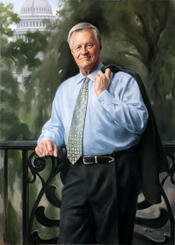
Here you will find contact information for Representative Collin C. Peterson, including email address, phone number, and mailing address.
| Name | Collin C. Peterson |
| Position | Representative |
| State | Minnesota |
| District | 7 |
| Party | Democratic |
| Status | Former Representative |
| Term Start | January 3, 1991 |
| Term End | January 3, 2021 |
| Terms Served | 15 |
| Born | June 29, 1944 |
| Gender | Male |
| Bioguide ID | P000258 |
About Representative Collin C. Peterson
Collin Clark Peterson (born June 29, 1944) is an American accountant, politician, and lobbyist who served as the U.S. representative for Minnesota’s 7th congressional district from January 3, 1991, to January 3, 2021. A member of the Minnesota Democratic–Farmer–Labor Party (DFL), the state affiliate of the Democratic Party, he was elected to 15 consecutive terms in the House of Representatives, making him the most senior U.S. representative from Minnesota and the dean of Minnesota’s congressional delegation. Over the course of his 30-year tenure, Peterson became known as one of the most conservative Democrats in Congress and a leading voice on agricultural policy, chairing the House Committee on Agriculture from 2007 to 2011 and again from 2019 to 2021, and serving as the committee’s ranking member from 2005 to 2007 and from 2011 to 2019.
Peterson was born in Fargo, North Dakota, and grew up on a farm in Baker, Minnesota, in the state’s northwestern region. Raised in a rural, agricultural setting, he developed an early familiarity with the issues facing farmers and small-town communities that would later define much of his public life. He attended Minnesota State University Moorhead (then Moorhead State College), where he received a Bachelor of Arts degree. Trained as an accountant, he worked in accounting and related business pursuits before entering elective office, gaining practical experience in finance and management that informed his later legislative work on fiscal and agricultural matters.
Peterson’s political career began in state government. He was elected to the Minnesota Senate as a member of the Democratic–Farmer–Labor Party in 1976, representing a district in northwestern Minnesota. In that race he defeated Republican nominee Frank DeGroat by a margin of 55 percent to 45 percent. He served in the Minnesota Senate from 1977 to 1986, building a reputation as a pragmatic legislator attentive to rural concerns. In 1982, he narrowly won reelection against state representative Cal Larson by just 200 votes, a 0.8 percent difference, underscoring the competitive nature of his region. During this period, Peterson also became increasingly active in federal-level politics, positioning himself as a potential challenger for the U.S. House seat in Minnesota’s 7th congressional district.
Peterson first sought election to Congress in 1984, running for Minnesota’s 7th congressional district, then held by Republican Representative Arlan Stangeland. He lost that race by a 57 percent to 43 percent margin. Undeterred, he ran again in 1986 and came within 121 votes of unseating Stangeland in a rematch. In 1988, Peterson made a third attempt but lost the DFL primary to state senator Marv Hanson, 55 percent to 45 percent; Hanson went on to lose to Stangeland in the general election by the same 55 percent to 45 percent margin. Peterson ran for a fourth time in 1990, won the DFL primary, and in the general election defeated seven-term incumbent Stangeland by 54 percent to 46 percent. Stangeland’s standing had been damaged by revelations that he had made a number of personal calls on his House credit card, an ethics issue that contributed to the shift in voter sentiment. Peterson took office on January 3, 1991, representing a largely rural, increasingly conservative district in northwestern Minnesota.
Once in Congress, Peterson quickly established himself as a key figure on agricultural and rural issues. He served on the House Committee on Agriculture beginning with the 102nd Congress and remained on the committee throughout his tenure. He became ranking member of the committee from 2005 to 2007, then chairman from 2007 to 2011, playing a central role in shaping major farm bills and federal agricultural policy. After Republicans gained control of the House, he served again as ranking member from 2011 to 2019, and he returned to the chairmanship in the 116th Congress from 2019 to 2021. As chairman of the full committee, he served as an ex officio member of all its subcommittees. Peterson also served on the Committee on Veterans’ Affairs, first in the 106th and 107th Congresses and then again in the 116th Congress, and earlier in his House career he served on the Committee on Oversight and Government Reform during the 102nd through 105th Congresses. He co-chaired the Military Veterans Caucus and was a member of the Congressional Arts Caucus, reflecting broader interests beyond agriculture.
Electorally, Peterson’s hold on his district evolved from narrow early victories to a long period of dominance, followed by increasingly competitive races as the region trended Republican. In 1992, he narrowly won reelection by a 50 percent to 49 percent margin against former state representative Bernie Omann, and in a 1994 rematch he again prevailed, 51 percent to 49 percent, despite the national Republican wave that year. His margins then expanded: in 1996 he won reelection with 68 percent of the vote, carrying every county in the district, and in 1998 he was reelected with 72 percent. In the 2000s he rarely faced serious opposition, winning with 69 percent of the vote in 2000, 65 percent in 2002, 66 percent in 2004, 70 percent in 2006, and 72 percent in 2008. In 2000 he was mentioned as a possible Democratic candidate for the U.S. Senate against Republican Rod Grams but chose instead to seek reelection to the House. In 2010, amid another Republican wave, he defeated Republican Lee Byberg 55 percent to 38 percent, his weakest showing since 1994. In 2012 he again defeated Byberg, winning 60.38 percent of the vote to Byberg’s 34.85 percent, with Independent candidate Adam Steele receiving 4.67 percent.
As national partisanship intensified, Peterson became a particular target for Republicans, who viewed his rural, Republican-leaning district as a prime pickup opportunity. After Mitt Romney carried Minnesota’s 7th district in the 2012 presidential election, Republican organizations increased their efforts to pressure Peterson to retire, including airing television advertisements, hiring a press staffer to distribute opposition research, employing a tracker to follow him around the district, and sending mobile billboards with critical messages through his hometown. Peterson publicly dismissed these tactics, stating that “they don’t have anybody else to go after” and calling the efforts “kind of ridiculous.” When rumors circulated that he planned to buy a house in Florida and retire there, he responded that the Republican campaign had moved him from being neutral about running again to “90 percent” in favor of seeking reelection, saying, “You can’t let these people be in charge of anything, in my opinion.” On March 17, 2014, he formally announced he would run again, saying, “I still have a lot of work to do.” Despite heavy national targeting, he defeated Republican state senator Torrey Westrom in the 2014 general election by a margin of 54 percent to 46 percent. In October 2014, he remarked that he might continue running until 2020 because Republicans “made me mad” with their efforts to unseat him, and in January 2015 he said he was “running at this point” for reelection in 2016, noting that Republican attempts to defeat him had “energized” him and “got me fired up.” He went on to defeat Republican retired Air Force Major Dave Hughes in closely contested races in both 2016 and 2018.
Throughout his congressional service, Peterson represented one of the most Republican-leaning districts in the country held by a Democrat. From 2000 to 2016, the Republican presidential nominee carried the district by double digits in three of five elections, culminating in 2016 when Donald Trump won the 7th district with 62 percent of the vote, his best performance in Minnesota. Peterson’s situation was often compared to that of Representative Gene Taylor of Mississippi’s 4th congressional district, another Democrat who held a very conservative district for many years before losing in 2010. Peterson’s voting record reflected his constituency: he was a founder of the Blue Dog Coalition, the caucus of House Democrats who identify as moderates and conservatives, and he frequently crossed party lines. He diverged from most Democrats on issues such as same-sex marriage, health care, the estate tax, tort reform, gun control, environmental regulation, District of Columbia statehood, and abortion. A 2008 report by Congressional Quarterly found that he had the lowest party loyalty score over the previous five years of any member of the Minnesota congressional delegation. In the 109th Congress, he was rated 50 percent conservative by a conservative group and 57 percent progressive by a liberal group, underscoring his centrist and sometimes unpredictable profile. During the first session of the 115th Congress, the Bipartisan Index, created by the Lugar Center and Georgetown University’s McCourt School of Public Policy, ranked him the most bipartisan member of the House of Representatives.
Peterson’s policy positions were notably conservative on many social issues. He strongly opposed legal abortion and was one of the few Democrats to vote against embryonic stem cell research. He supported legislation to ban physician-assisted suicide and voted for the proposed Flag Desecration Amendment to the United States Constitution. He voted for the Defense of Marriage Act and supported the death penalty. On immigration and border security, in January 2019 he remarked, in reference to President Donald Trump’s proposed wall along the southern border, “I’d give him the whole thing … and put strings on it so you make sure he puts the wall where it needs to be. Why are we fighting over this? We’re going to build that wall anyway, at some time.” He suggested that any funding should include stipulations directing resources to the Border Patrol and improvements to security at ports of entry. On April 4, 2019, he was the only Democrat to vote against reauthorization of the Violence Against Women Act, explaining that he opposed provisions he believed would “strip individuals’ right to due process with respect to their 2nd Amendment rights.”
Reflecting the character of his district—Minnesota’s most rural and home to some of its most conservative counties—Peterson was a staunch supporter of gun rights and an avid hunter. Many DFL voters outside the Twin Cities are hunters and trappers who oppose gun control, and Peterson consistently aligned with them. He received successive “A” and “A+” ratings from the National Rifle Association Political Victory Fund (NRA-PVF) and earned NRA endorsements in 2010, 2014, and 2020. At the same time, he described himself as a conservationist, though he opposed what he viewed as “excessive environmental regulation,” arguing that such measures could harm farmers. He supported animal trapping and opposed many restrictions on hunting, yet in 2000 he joined with the Humane Society of the United States to pass legislation that stopped the interstate shipping of birds for cockfighting. He also supported legislation to remove federal Endangered Species Act protections for wolves. In 2004, he joined Minnesota Attorney General Mike Hatch in suing the state of North Dakota over laws they argued discriminated against non–North Dakota residents by forbidding them from hunting during the first week of the waterfowl season; the United States District Court for the District of North Dakota rejected their case, and the United States Court of Appeals for the Eighth Circuit upheld that decision.
In the November 2020 general election, Peterson was defeated for reelection by Republican former state senator and former lieutenant governor Michelle Fischbach. In that election, Donald Trump again carried Minnesota’s 7th district with his best margin in the state, winning 64 percent of the vote and a 29-point margin over Joe Biden. Peterson lost to Fischbach by 14 percentage points, the largest margin of defeat for any House incumbent that year. Despite the loss, he remained the top-performing Democrat on the ballot in his district, outperforming presidential nominee Joe Biden by 16 points. Peterson was the only non-freshman member of the House of Representatives to lose reelection in 2020, and Minnesota’s 7th district was one of only two congressional districts that Republicans flipped in 2020 that they had not held prior to 2018, the other being Iowa’s 2nd congressional district. His defeat ended a 30-year tenure in the House, during which he had participated in the legislative process across three decades of significant change in American politics and policy.
After leaving Congress in January 2021, Peterson transitioned to work in consulting and advocacy. In 2022, he opened an eponymous consulting firm and registered as a federal lobbyist, continuing his involvement in public policy, particularly in areas related to agriculture and rural affairs. His post-congressional activities extended his long-standing engagement with the issues and constituencies he had represented in Congress, drawing on his experience as an accountant, state legislator, and senior member of the House Committee on Agriculture.