Senator Conrad R. Burns
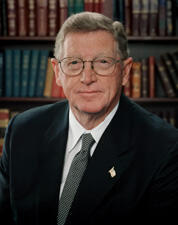
Here you will find contact information for Senator Conrad R. Burns, including email address, phone number, and mailing address.
| Name | Conrad R. Burns |
| Position | Senator |
| State | Montana |
| Party | Republican |
| Status | Former Representative |
| Term Start | January 3, 1989 |
| Term End | January 3, 2007 |
| Terms Served | 9 |
| Born | January 25, 1935 |
| Gender | Male |
| Bioguide ID | B001126 |
About Senator Conrad R. Burns
Conrad Ray Burns (January 25, 1935 – April 28, 2016) was an American politician, broadcaster, auctioneer, and lobbyist who served as a United States Senator from Montana from January 3, 1989, to January 3, 2007. A member of the Republican Party, he was only the second Republican popularly elected to represent Montana in the Senate and became the longest-serving Republican senator in the state’s history. During three terms in office, he participated actively in the legislative process and represented the interests of his Montana constituents during a significant period in American political life.
Burns was born on a farm near Gallatin, Daviess County, Missouri, to Russell and Mary Frances (Knight) Burns. He graduated from Gallatin High School in 1952 and subsequently enrolled in the College of Agriculture at the University of Missouri, where he was a member of the Alpha Gamma Rho fraternity. After two years of study, he left the university without graduating and enlisted in the United States Marine Corps in 1955. Burns served in Japan and Korea as a small-arms instructor, an experience that shaped his views on national defense and public service.
After completing his military service in 1957, Burns began a civilian career in the transportation industry, working for Trans World Airlines and Ozark Air Lines. In 1962, he moved to Montana, traveling the state as a field representative for Polled Hereford World magazine based in Billings. He married Phyllis Jean Kuhlmann in 1967, and the couple had three children: Kate, Keely, and Garrett. In 1968, Burns declined a transfer to Iowa and instead became a cattle auctioneer for the Billings Livestock Commission. He later served as the first manager of the Northern International Livestock Exposition, further cementing his ties to Montana’s agricultural community. During this period he began reporting on agricultural market news, launched a radio show, and subsequently worked as a farm reporter for KULR-TV in Billings.
In 1975, Burns founded the Northern Agricultural Network (NAN) with four radio stations, providing agricultural news and market information to rural audiences. By 1986, the network had expanded to serve thirty-one radio stations and six television stations across the region. That same year, he sold the network to enter electoral politics. Motivated in part by dissatisfaction with local government, he successfully ran for a seat on the Yellowstone County Commission, where he served for two years. His extensive broadcasting work had given him substantial name recognition throughout Montana, which would prove critical as he transitioned from local to national politics.
Though a political novice at the statewide level, Burns was recruited by the Republican Party to challenge incumbent Democratic Senator John Melcher in 1988. In the campaign, Burns portrayed Melcher as “a liberal who is soft on drugs, soft on defense and very high on social programs,” and argued that Melcher had been in Washington, D.C., too long, aligning himself with the then-popular cause of congressional term limits. Melcher’s standing was weakened by public opposition to certain Yellowstone National Park fire-management policies and by President Ronald Reagan’s pocket veto of Melcher’s bill to place 1.4 million acres of Montana forest off-limits to logging and mineral development. Aided by the strong performance in Montana of Republican presidential nominee and Vice President George H. W. Bush, Burns defeated Melcher by 13,636 votes in the November 8, 1988, election and entered the Senate on January 3, 1989.
During his Senate career, Burns developed a reputation as a conservative Republican with a strong focus on appropriations and telecommunications policy. He served on the Senate Appropriations Committee and chaired its Subcommittee on the Interior, positions that enabled him to secure substantial federal funding for projects in Montana and made him well known for his ability to obtain appropriations for his home state. He also chaired the Communications Subcommittee of the Senate Committee on Commerce, Science, and Transportation, where he played a prominent role in telecommunications and technology legislation. His voting record reflected consistently conservative positions: he received ratings of 0% from NARAL Pro-Choice America and the American Civil Liberties Union, 100% from the National Right to Life Committee and the Christian Coalition of America, 91% from the American Conservative Union, 94% from the U.S. Chamber of Commerce, 5% from the League of Conservation Voters, an “A” rating from the NRA Political Victory Fund, 29% from the AFL–CIO, 67% from the National Taxpayers Union, 70% from the Cato Institute, 10% from the American Public Health Association, 0% from the National Education Association, and 100% from the American Land Rights Association.
Burns was reelected to the Senate in 1994, defeating Democratic challenger Jack Mudd, former dean of the University of Montana School of Law. Former Senator Melcher was among the candidates in the Democratic primary that year, but Mudd secured the nomination. Burns prevailed over Mudd by 86,697 votes in a race observers described as marked by an underfunded and unfocused Democratic campaign. In 2000, Burns sought a third term and faced an unexpectedly competitive race. In February 1999, he announced that he would not honor his 1988 pledge to limit himself to two terms, stating, “Circumstances have changed, and I have rethought my position.” That same month, while speaking to the Montana Equipment Dealers Association about American dependence on foreign oil, he referred to Arabs as “ragheads,” a remark for which he later apologized, saying he had become “too emotionally involved” in the speech.
The Democratic nominee in 2000 was Brian Schweitzer, a rancher from Whitefish, Montana. Burns attempted to link Schweitzer to Democratic presidential nominee Al Gore, whom Schweitzer had never met, while Schweitzer portrayed himself as largely nonpolitical and focused his campaign on prescription drug prices. Schweitzer organized bus trips taking Montana senior citizens to Canada and Mexico to purchase lower-cost medications, while Burns charged that Schweitzer favored “Canadian-style government controls” and controversially claimed that some seniors went to doctors primarily “to have somebody to visit with.” Burns also faced criticism over his initial support for legislation limiting compensation in asbestos-related cases, an issue of particular sensitivity in Libby, Montana, where asbestos exposure had caused numerous deaths. Under public pressure, he withdrew his support for the bill and secured $11.5 million for Libby in an appropriations measure. Burns spent roughly twice as much as Schweitzer on the campaign and won reelection by 13,652 votes, even as Republican presidential nominee George W. Bush carried Montana by 103,052 votes. Schweitzer was later elected Governor of Montana in 2004.
During his third term, Burns continued to play a central role in appropriations and communications policy and coauthored significant legislation. In December 2003, he and Senator Ron Wyden, Democrat of Oregon, saw their bipartisan bill to combat unsolicited commercial email, the CAN-SPAM Act, signed into law. Burns stated that he and Wyden had worked to craft “common-sense legislation to deal with spam,” though anti-spam organizations such as Spamhaus later argued that the law did not sufficiently curb spam originating in the United States. Burns’s tenure, however, was also marked by controversy. In April 2006, Time magazine named him one of “America’s Five Worst Senators,” dubbing him “The Shock Jock” and calling him “serially offensive” for a series of controversial statements, including his 1999 “ragheads” remark. The magazine also criticized what it described as his “meager” legislative record and highlighted questions surrounding his relationship with lobbyist Jack Abramoff, which contributed to high disapproval ratings in his final years in office.
Burns’s public career was punctuated by several widely reported incidents involving racially insensitive language and remarks about foreign policy and immigration. After passage of the Civil Rights Act of 1991, he invited a racially mixed group of lobbyists to what he termed a “slave auction,” later explaining that such events in Montana involved auctioning children’s volunteer labor for charity and were “rather common,” but the terminology drew sharp criticism. On another occasion, during a visit to the Bozeman Daily Chronicle, he recounted an anecdote about an elderly Montana rancher who asked him, “Conrad, how can you live back there with all those niggers?” to which Burns said he replied that it was “a hell of a challenge.” After public outcry, he apologized, stating that such views were inappropriate and belonged in the past and that he did not share them, though he acknowledged that he had not challenged the term when he heard it. He also drew criticism for erroneously asserting that one or more of the September 11 hijackers had entered the United States from Canada, a claim later refuted by Canadian officials.
By 2006, Burns was widely viewed as one of the most vulnerable incumbents in the Senate. His narrow victory in 2000, the Democratic takeover of Montana’s state government in 2004, polls showing his support hovering around 40 percent, and negative publicity from the Abramoff investigation all contributed to this perception. On June 6, 2006, he easily won the Republican primary, setting up a general election contest with Democrat Jon Tester, president of the Montana State Senate and an organic farmer. In early August, CQPolitics shifted its rating of the race from “Leans Republican” to “No Clear Favorite,” and some polls showed Burns’s approval rating falling as low as 39 percent, the lowest of any sitting senator at the time. The Montana Democratic Party employed a staffer, Kevin O’Brien, to follow Burns nationwide, filming his public appearances; similar “tracker” tactics had been used against him in 2000. In an October 2006 debate with Tester on the Iraq War, Burns defended President George W. Bush’s strategy, saying, “He’s not going to tell everyone in the world” the plan, and told Tester, “We’re not going to tell you what our plan is, Jon, because you’re just going to go out and blow it.” On November 9, 2006, after a close race, Burns conceded defeat to Tester. On November 15, he reacted angrily when questioned about his remaining time as a lame-duck senator, telling reporters, “I’m not going to negotiate my problems with the goddamn press… Goodbye! Goodbye! Goodbye!”
After leaving the Senate in January 2007, Burns entered the lobbying and consulting world. He joined the Washington, D.C.–based firm GAGE, founded by his former chief of staff Leo Giacometto, and in February 2008 registered as a lobbyist for the American Quarter Horse Association. He also founded Rural Solutions Corporation, a communications company focused on expanding broadband and telecommunications services in rural areas, and he maintained his long-standing auctioneering business. Remaining active in Republican politics, he endorsed Congressman Denny Rehberg in Rehberg’s unsuccessful 2012 Senate campaign to unseat Jon Tester.
In his later years, Burns experienced significant health challenges. On December 9, 2009, he suffered a stroke, likely related to atrial fibrillation, at his home in Arlington, Virginia. He was initially taken to Virginia Hospital Center and then transferred to the intensive care unit of a Washington, D.C., hospital before undergoing rehabilitation at National Rehabilitation Hospital. After his recovery period, he returned home to Montana. Conrad Burns died in Billings, Montana, on April 28, 2016, at the age of 81, closing a public life that spanned military service, agricultural broadcasting, local government, three terms in the United States Senate, and a post-congressional career in lobbying and rural communications.