Representative Constance A. Morella
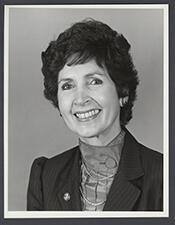
Here you will find contact information for Representative Constance A. Morella, including email address, phone number, and mailing address.
| Name | Constance A. Morella |
| Position | Representative |
| State | Maryland |
| District | 8 |
| Party | Republican |
| Status | Former Representative |
| Term Start | January 6, 1987 |
| Term End | January 3, 2003 |
| Terms Served | 8 |
| Born | February 12, 1931 |
| Gender | Female |
| Bioguide ID | M000941 |
About Representative Constance A. Morella
Constance Morella (née Albanese; born February 12, 1931) is an American politician, educator, and diplomat who represented Maryland’s 8th congressional district in the United States House of Representatives from 1987 to 2003. A member of the Republican Party, she served eight terms in Congress and later was United States Permanent Representative to the Organisation for Economic Co-operation and Development (OECD) from 2003 to 2007. Known as a leading moderate and often independent-minded Republican, she built a career focused on women’s rights, human rights, public health, and science and technology policy, and has remained active in public life and higher education.
Morella was born Constance Albanese in Somerville, Massachusetts, where she was raised in a blue-collar, Democratic family. She graduated from Somerville High School in 1948 and went on to attend Boston University, earning an Associate of Arts degree in 1950 and a Bachelor of Arts degree in 1954. After college she met Anthony C. “Tony” Morella, a Republican who had worked for liberal Republicans such as New York Mayor John Lindsay, New York Governor Nelson Rockefeller, and U.S. Senator Charles Mathias. Influenced in part by his brand of moderate Republicanism, she joined the Republican Party. After their marriage, the couple settled in Bethesda, Maryland. Following the death of her sister from cancer, Connie and Tony Morella adopted her sister’s six children, raising them along with their own three children.
Before entering elective office, Morella pursued a career in education. She became a secondary school teacher in the Montgomery County Public Schools in Maryland, teaching from 1957 to 1961. She continued her own education at American University in Washington, D.C., where she received a Master of Arts degree in 1967. She joined the faculty at American University as an instructor from 1968 to 1970, and in 1970 became a professor at Montgomery College in Rockville, Maryland. She taught at Montgomery College until 1985, when she left full-time teaching to focus on her growing political career. Over these years she also became active in civic and women’s organizations, including the League of Women Voters.
Morella’s formal political career began at the local and state level. In 1971 she was appointed a founding member of the Montgomery County Commission for Women, an advisory women’s advocacy body, and she was elected its president in 1973. She first sought elective office in 1974, running unsuccessfully for the Maryland House of Delegates from the 16th District, based in Bethesda. Undeterred, she ran again in 1978 and won, receiving more votes than the three incumbent delegates. She was reelected for an additional term, serving in the Maryland House of Delegates until she sought federal office. Her work in Annapolis, combined with her profile as an advocate for women and families, positioned her as a strong candidate for Congress when an opportunity arose in the mid-1980s.
In 1986, Morella ran for the open U.S. House seat in Maryland’s 8th congressional district, which was being vacated by Democrat Michael Barnes, who was seeking the Democratic nomination for the U.S. Senate. Her Democratic opponent in the general election was State Senator Stewart Bainum, a multimillionaire business executive who led in most polls during the campaign. A turning point came when Morella received unexpected endorsements from both The Baltimore Sun and The Washington Post. She won the election, becoming the first woman to represent Maryland’s 8th district in Congress. Although she was a Republican in a district that was increasingly and heavily Democratic, she proved highly popular with her constituents and was reelected seven times, serving continuously from January 3, 1987, until January 3, 2003.
During her eight terms in the House of Representatives, Morella participated actively in the legislative process and developed a reputation as a socially liberal, fiscally moderate Republican. She often opposed her party’s positions on abortion, gun control, gay rights, and environmental policy. She supported government funding of contraceptives and needle-exchange programs for drug addicts, favored the legalization of medical marijuana, and received some support from organized labor. She opposed many tax cuts advanced by Republican leadership. Nonetheless, she joined all other congressional Republicans in voting against President Bill Clinton’s 1993 budget. She voted against declaring English the official language of the United States and, in 1996, opposed a major immigration bill that was overwhelmingly approved by Congress and signed by President Clinton to combat illegal immigration. That same year she was one of only five Republicans to vote against the Cuban Liberty and Democratic Solidarity (LIBERTAD) Act. In 1998, she was one of only three Republicans to vote against renaming Washington National Airport as Ronald Reagan Washington National Airport. Remarkably, she was the only Republican in the entire Congress to vote against authorizing the use of military force in Iraq both in 1991 and again in 2002.
Morella’s committee assignments reflected her interest in science, technology, government oversight, and the District of Columbia. She served on the Committee on Government Reform, including the Subcommittee on Civil Service and Agency Organization and the Subcommittee on the District of Columbia, which she chaired. She also served on the Committee on Science, including the Subcommittee on Environment, Technology, and Standards. She was active in human rights, women’s health, and domestic violence issues, and she represented the United States as a congressional delegate to major international conferences. In 1994 she served as U.S. representative to the United Nations International Conference on Population and Development in Cairo, and in 1995 she was co-chair of the congressional delegation to the U.N. Fourth World Conference on Women in Beijing. Among the legislation she sponsored were the 1992 Battered Women’s Testimony Act, which provided funds for indigent women to obtain expert testimony in domestic abuse cases, and the Judicial Training Act, which funded programs to educate judges about domestic violence, particularly in child custody disputes.
As national politics shifted in the 1990s, Morella increasingly found herself at odds with the leadership of her own party. After Republicans won control of the House in the 1994 elections, she signed the Contract with America championed by Speaker Newt Gingrich but maintained a mixed record in supporting the new majority’s agenda. She did not openly challenge the House leadership until 1997, when she voted “present” rather than for Gingrich in the election for Speaker. During the impeachment proceedings against President Clinton in 1998, she was one of only four Republicans—along with Amo Houghton and Peter T. King of New York and Chris Shays of Connecticut—to oppose all four articles of impeachment. As a Republican representing an affluent, strongly Democratic district in an increasingly Democratic state, she faced a series of increasingly strong Democratic challengers. She survived difficult reelection contests even in Democratic wave years such as 1992, 1996, and 1998, but the low popularity of the Republican-controlled Congress gradually eroded her support. Her Democratic opponents argued that a vote for Morella was effectively a vote to keep Republican leaders such as Tom DeLay in power, despite her moderate record.
Following the 2000 Census, Maryland’s Democratic leadership undertook a redistricting effort that significantly altered Morella’s district. Maryland Senate President Thomas V. “Mike” Miller stated that he intended to draw Morella’s district out from under her after her relatively narrow reelection in 2000. Because Democrats controlled both the state legislature and the governor’s office, they controlled the redistricting process. Staffers for Miller, House Speaker Cas Taylor, and Governor Parris Glendening drafted maps designed to gerrymander out Morella and fellow moderate Republican Bob Ehrlich. One proposal would have split her district in two, effectively creating a new seat for State Senator Chris Van Hollen and forcing Morella to run against Delegate Mark Shriver, a member of the Kennedy political family. The final plan was less drastic but still made the already Democratic 8th district even more so, restoring a heavily Democratic section of eastern Montgomery County that had been removed in 1990 and adding nine precincts in Prince George’s County from Representative Albert Wynn’s heavily Democratic 4th district. The new configuration forced Van Hollen and Shriver into a contentious primary, which Van Hollen won. In the 2002 general election, Van Hollen defeated Morella with 52 percent of the vote to her 47 percent; election analyses indicated that she would likely have narrowly won reelection under the previous district lines. Since her defeat, Republicans have fielded only nominal challengers in the 8th district, none of whom have received more than 40 percent of the vote.
After leaving Congress, Morella continued her public service in the diplomatic and academic arenas. President George W. Bush appointed her United States Permanent Representative to the OECD on July 11, 2003. She was unanimously confirmed by the U.S. Senate on July 31, 2003, and sworn in on October 8, becoming the first former member of Congress to serve as U.S. ambassador to the OECD. She officially served as ambassador from August 1, 2003, to August 6, 2007, and was succeeded in November 2007 by Christopher Egan, son of businessman and former ambassador Richard Egan. Following her diplomatic service, she joined the faculty of American University as an Ambassador in Residence at the Women & Politics Institute, where she has worked with students and scholars on issues of women’s political leadership and public policy. In 2010, President Barack Obama appointed her to the American Battle Monuments Commission (ABMC), which oversees U.S. military cemeteries and memorials overseas.
Morella has remained engaged in public affairs and has occasionally taken public positions that underscore her moderate and bipartisan outlook. In 2013 she signed an amicus curiae brief submitted to the Supreme Court in support of same-sex marriage in the case Hollingsworth v. Perry. On August 24, 2020, she was one of 24 former Republican lawmakers who publicly endorsed Democratic nominee Joe Biden over Republican incumbent Donald Trump on the opening day of the Democratic National Convention, and she had earlier publicly endorsed Biden in the 2020 presidential election. Her longstanding interest in cultural and educational institutions was also evident in her efforts during her congressional career to help preserve the Victor Kamkin Bookstore, a well-known Rockville, Maryland, bookstore that specialized in Russian and Eastern European publications.
Over the course of her career, Morella has received numerous honors and recognitions from academic institutions and governments in the United States and abroad. She has been awarded honorary doctorates from American University (1988); Norwich University (1989); Dickinson College (1989); Mount Vernon College (1995); University of Maryland University College (1996); the University of Maryland, College Park (1997); the Uniformed Services University of the Health Sciences (1997); Elizabethtown College (1999); Washington College (2000); and the National Labor College (2004). She is an honorary board member of the National Organization of Italian American Women, which named her a Feminina Excelente. Her awards include induction into the Maryland Women’s Hall of Fame, the Ron Brown Standards Leadership Award, and public service awards from the American Medical Association and the American Bar Association. She received the Hubert H. Humphrey Civil Rights Award from the Leadership Conference on Civil Rights “for selfless and devoted service in the cause of equality.” The Republic of Italy awarded her the Medal of the Legion of Merit. In 2008 she received the Foremother Award from the National Center for Health Research. In 2013 she was awarded the Knight Commander’s Cross of the Order of Merit of the Federal Republic of Germany for her work in strengthening the Congressional Study Group on Germany during her tenure as president of the U.S. Association of Former Members of Congress. In 2016 the government of Japan conferred on her the Order of the Rising Sun, Gold and Silver Star, in recognition of her contributions to deepening the U.S.–Japan alliance in Congress. On April 14, 2018, the Bethesda branch of the Montgomery County Public Libraries system was renamed the Connie Morella Library in her honor, reflecting her long-standing service to the community she represented in Congress.