Representative Corinne C. (Lindy) Boggs
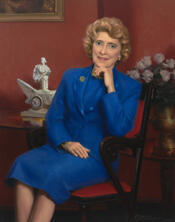
Here you will find contact information for Representative Corinne C. (Lindy) Boggs, including email address, phone number, and mailing address.
| Name | Corinne C. (Lindy) Boggs |
| Position | Representative |
| State | Louisiana |
| District | 2 |
| Party | Democratic |
| Status | Former Representative |
| Term Start | January 3, 1973 |
| Term End | January 3, 1991 |
| Terms Served | 9 |
| Born | March 13, 1916 |
| Gender | Female |
| Bioguide ID | B000592 |
About Representative Corinne C. (Lindy) Boggs
Marie Corinne Morrison Claiborne Boggs (March 13, 1916 – July 27, 2013), commonly known as Lindy Boggs, was an American politician and diplomat who served as a member of the U.S. House of Representatives from Louisiana and later as United States Ambassador to the Holy See. A member of the Democratic Party, she was the first woman elected to Congress from Louisiana and one of three female U.S. Representatives from the state, along with Catherine Small Long and Julia Letlow, each of whom, like Boggs, entered Congress through special elections following the deaths of their husbands. Over nine terms in the House, from 1973 to 1991, she contributed to the legislative process during a significant period in American history, representing the interests of her constituents and participating actively in the democratic process.
Boggs married Thomas Hale Boggs Sr., a rising Democratic politician from Louisiana who would later become Majority Leader of the United States House of Representatives. In 1940, after Hale Boggs won a seat in the House of Representatives, the Boggs family relocated to Washington, D.C. Although he lost his re-election bid in 1942, he returned to Congress in 1947 as the representative of Jefferson Parish, Louisiana, and served continuously until his death. During these years, Lindy Boggs became deeply familiar with congressional life and politics, building relationships and gaining experience that would later inform her own public service.
On October 16, 1972, Representative Hale Boggs’s twin-engine Cessna plane disappeared over Alaska while he was helping fellow Democrat Nicholas Begich, father of future U.S. Senator Mark Begich of Alaska, campaign for reelection. Despite extensive search efforts, the plane was never found. The first bill that the House of Representatives passed in 1973, House Resolution 1, officially recognized Hale Boggs’s death and created the need for a special election in Louisiana’s 2nd congressional district, based in New Orleans. Lindy Boggs ran successfully as a Democrat for her husband’s vacated seat and took office in 1973, beginning what would become an 18-year congressional career.
Corinne Claiborne Boggs was elected to a full term in 1974 with 82 percent of the vote and was re-elected seven times thereafter, serving in the House of Representatives until she vacated her office in January 1991. In most of her contested races she polled more than 80 percent of the vote, reflecting strong support in her district. In 1984, after a federal court order mandated the creation of Louisiana’s first majority–African-American congressional district, her district was redrawn, and she became the only white member of Congress representing a majority–African-American constituency. She continued to win re-election in the reconfigured district, further solidifying her reputation as a respected and effective legislator. During her tenure, she was recognized as a prominent Democratic figure and played a visible role in national party affairs.
Boggs’s prominence within the Democratic Party was underscored by her selection as permanent chairwoman of the 1976 Democratic National Convention, held in New York City to nominate the Carter–Mondale ticket. In that role she became the first woman to preside over a major party national convention, a milestone in the political advancement of women in the United States. Her leadership at the convention and her service in the House highlighted her status as a trailblazer for women in public life and as a key figure in Louisiana and national Democratic politics.
In 1990, Boggs announced her retirement from public office, and she left Congress at the conclusion of her ninth term in January 1991. She was succeeded in the House by William J. Jefferson. That same year, she was awarded the Laetare Medal by the University of Notre Dame, the oldest and most prestigious award for American Catholics, recognizing her contributions to public life and her service to church and country. In 1994, she was inducted into the Louisiana Political Museum and Hall of Fame in Winnfield, one year after her late husband had been among the museum’s original thirteen inductees, further cementing the Boggs family’s legacy in Louisiana political history.
Boggs continued her public service on the international stage when President Bill Clinton appointed her United States Ambassador to the Holy See in 1997, a position she held until 2001. As ambassador to the Vatican, she represented American interests to the Holy See during a period marked by significant global and domestic developments, drawing on both her long experience in Congress and her deep Catholic faith. Her diplomatic tenure added an important chapter to a career already distinguished by legislative and party leadership.
In her later years, Boggs remained an honored public figure. In 2005, her home on Bourbon Street in New Orleans’s French Quarter sustained moderate wind damage from Hurricane Katrina, a storm that devastated much of the city she had long represented. In 2006, she was awarded the Congressional Distinguished Service Award in recognition of her time in the House of Representatives. She was a member of Sigma Gamma Rho, one of the four traditionally African-American sororities in the United States, reflecting her longstanding engagement with diverse civic and community organizations. The Boggs Center for Energy and Biotechnology Building at Tulane University is named in her honor, acknowledging her support for education and research. In 2013, Boggs and her daughter, journalist Cokie Roberts, received the Foremother Award from the National Center for Health Research, recognizing their contributions to public discourse and civic life. Corinne Claiborne Boggs died on July 27, 2013, leaving a legacy as a pioneering congresswoman, party leader, and diplomat.