Senator Cornelius Cole
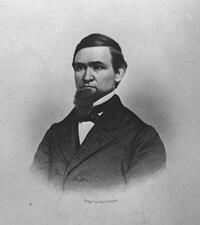
Here you will find contact information for Senator Cornelius Cole, including email address, phone number, and mailing address.
| Name | Cornelius Cole |
| Position | Senator |
| State | California |
| Party | Republican |
| Status | Former Representative |
| Term Start | December 7, 1863 |
| Term End | March 3, 1873 |
| Terms Served | 2 |
| Born | September 17, 1822 |
| Gender | Male |
| Bioguide ID | C000607 |
About Senator Cornelius Cole
Cornelius Cole (September 17, 1822 – November 3, 1924) was an American politician and lawyer who represented California in both houses of the United States Congress during and after the Civil War. A member of the Republican Party, he served a single term in the United States House of Representatives from March 4, 1863, to March 3, 1865, and a single term in the United States Senate from March 4, 1867, to March 3, 1873. Living to the age of 102 years and 47 days, he is recognized as the longest-lived U.S. Senator.
Cole was born in Lodi, Seneca County, New York, on September 17, 1822. He attended local common schools and pursued further studies at Ovid Academy in Ovid, Lima Seminary in Lima, and Hobart College in Geneva, New York. He later enrolled at Wesleyan University in Middletown, Connecticut, from which he graduated in 1847. After college he studied law in the office of William H. Seward, the future governor of New York and U.S. Secretary of State, and was admitted to the bar in 1848.
Drawn by the California Gold Rush, Cole traveled west and spent about a year mining gold before turning permanently to the practice of law. Beginning in 1849 he established himself as an attorney in California, first in San Francisco and later in Sacramento. On January 5, 1853, he married Olive Colegrove of Trumansburg, New York; the couple would have nine children. Cole became active in the emerging Republican Party in his adopted state. On March 8, 1856, he was one of the organizers of the California branch of the Republican Party, serving as secretary and drafting its initial manifesto. He served on the Republican National Committee from 1856 to 1860 and, from August 1856 to January 1857, co-edited the Sacramento Daily Times with James McClatchy. He was nominated on the Republican ticket for clerk of the Sacramento court but was unsuccessful. In 1858 he was elected district attorney of Sacramento County, further establishing his prominence in California public life.
By the early 1860s Cole had moved with his family to Santa Cruz, relocating there in 1862. A strong supporter of the Union during the American Civil War, he helped raise the Santa Cruz Cavalry Troop for the California Militia and was commissioned a captain in 1863 after winning an election to command the unit. He did not actively assume that command, however, because he had been elected to Congress. In 1862 he won election as a Union Republican to the United States House of Representatives from California and served one term from March 4, 1863, to March 3, 1865. His service in the House coincided with some of the most critical years of the Civil War. On November 19, 1863, Cole traveled to Gettysburg, Pennsylvania, with President Abraham Lincoln and was on the speaker’s platform near Lincoln when the president delivered the Gettysburg Address. On April 14, 1865, he spoke with Lincoln only a few hours before the president was assassinated.
In 1865 Cole was elected to the United States Senate from California as a Republican, and he served one term from March 4, 1867, to March 3, 1873. His Senate career unfolded during the turbulent Reconstruction era, and he participated in the legislative process at a time of major constitutional and political change. During his final two years in the Senate he served as chairman of the Committee on Appropriations, playing a significant role in federal spending decisions. He was also among the senators who voted in favor of the impeachment of President Andrew Johnson. Throughout his two terms in Congress—first in the House and then in the Senate—Cole represented California’s interests while aligning with the national Republican program of Union preservation and Reconstruction.
After leaving the Senate in 1873, Cole returned to California and resumed the practice of law, working in both San Francisco and Los Angeles. In 1880 he moved to an area then outside Los Angeles where he founded the settlement of Colegrove on land that had been part of Rancho La Brea. He had acquired this land from Henry Hancock as payment for legal services in helping Hancock confirm title to the rancho. Colegrove was named in honor of his wife, Olive Colegrove Cole, and several of its streets were named for the couple’s children, including Willoughby Avenue, Eleanor Street, and Seward Street. He gradually withdrew from active legal practice and lived in retirement in Colegrove, which was later absorbed into the city of Los Angeles. Cole marked his centennial birthday in 1922.
Cole’s family connections extended into military and legal affairs of the post–Civil War era. His brother, George W. Cole, served as a Union Army officer during the Civil War and attained the rank of brevet major general. After the war, George Cole was tried and acquitted for the murder of L. Harris Hiscock, whom he accused of having an affair with his wife. Cornelius Cole himself reflected on his long public career and California’s development in his memoir, “Memoirs of Cornelius Cole, Ex-Senator of the United States from California,” published in New York by McLoughlin Brothers in 1908.
Cornelius Cole died of pneumonia in Los Angeles, California, on November 3, 1924, at the age of 102. He was buried at Hollywood Forever Cemetery. At 102 years and 47 days, he remains the longest-lived individual to have served in the United States Senate. His life and career, spanning from the era of the early republic through World War I, have been the subject of later historical studies, including Catherine Coffin Phillips’s “Cornelius Cole: California Pioneer” (1929) and Leonard L. Richards’s “The California Gold Rush and the Coming of the Civil War” (2007).