Representative Corrine Brown
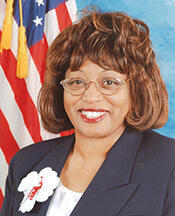
Here you will find contact information for Representative Corrine Brown, including email address, phone number, and mailing address.
| Name | Corrine Brown |
| Position | Representative |
| State | Florida |
| District | 5 |
| Party | Democratic |
| Status | Former Representative |
| Term Start | January 5, 1993 |
| Term End | January 3, 2017 |
| Terms Served | 12 |
| Born | November 11, 1946 |
| Gender | Female |
| Bioguide ID | B000911 |
About Representative Corrine Brown
Corrine Brown (born November 11, 1946) is an American former politician and convicted felon who served as a member of the U.S. House of Representatives from Florida from 1993 to 2017. A member of the Democratic Party, she was one of the first African Americans elected to Congress from Florida since Reconstruction and served twelve consecutive terms in the House. Her long tenure in Congress coincided with a significant period in modern American political history, during which she participated in the legislative process and represented the interests of her constituents in a series of heavily contested and frequently litigated congressional districts.
Brown was born in Jacksonville, Florida, where she was raised and educated in the public schools. She attended Florida A&M University, a historically Black university, earning a Bachelor of Science degree in 1969. She continued her studies at Florida A&M University and received a master’s degree in 1971. Pursuing further training in education, she obtained an educational specialist degree from the University of Florida in 1974. Before entering national politics, Brown worked in fields related to education and public service, drawing on her academic background and her ties to the Jacksonville community.
Brown’s political career began at the state level in Florida. After an unsuccessful bid for the Florida House of Representatives in 1980, she ran again and was elected in 1982 from a newly drawn state House district. She served in the Florida House of Representatives for ten years, building a base of support in North Florida and establishing herself as a prominent Democratic legislator. Her decade in the state legislature helped position her for a run for Congress when new opportunities emerged following the 1990 census and the subsequent redrawing of congressional district lines.
After the 1990 census, the Florida Legislature created a new 3rd congressional district in the northern part of the state, designed to enclose an African-American majority. The district was a horseshoe-shaped configuration encompassing largely African-American neighborhoods in Jacksonville, Gainesville, Orlando, Ocala, and Lake City, and it appeared likely to send Florida’s first African-American representative to Congress since Reconstruction. Brown decided to run for the new seat in 1992. She faced several candidates in the Democratic primary, with her strongest opponent being Andy Johnson, a white talk radio host from Jacksonville. Brown defeated Johnson in both the primary and a subsequent runoff and went on to win the general election in November 1992. She took office on January 3, 1993, beginning a congressional career that would span nearly a quarter century.
Brown’s district soon became the subject of major legal and political controversy. In 1995, the U.S. Supreme Court struck down Florida’s 3rd congressional district as an unconstitutional racial gerrymander. One of the main instigators of the lawsuit that led to the redistricting was her 1992 opponent, Andy Johnson. Brown strongly criticized the change, remarking in an interview with The New Republic that “[t]he Bubba I beat couldn’t win at the ballot box [so] he took it to court.” Although the district was redrawn to be more compact and its Black population was reduced, Brown won reelection in 1996 and continued to hold the seat through subsequent election cycles. Following decennial redistricting in 2012, her district was renumbered as the 5th district, but its basic shape—stretching from Jacksonville to Orlando—remained largely the same and was widely identified as one of the most gerrymandered districts in the country. The League of Women Voters of Florida and the Florida Democratic Party challenged the new redistricting plan in court, arguing that the 5th district was drawn to favor its incumbent and the Republican Party by packing Democratic voters, in violation of Florida’s newly adopted Fair Districts Amendment.
In 2015, the Florida Supreme Court ruled that the congressional redistricting plan was a partisan gerrymander in violation of the Fair Districts Amendment and ordered the 5th district to be substantially redrawn. The new configuration made the district significantly more compact and reoriented it along an east–west axis from downtown Jacksonville to Tallahassee, rather than stretching south toward Orlando. Brown challenged the court-ordered map in federal court, contending that it violated the federal Voting Rights Act, but in April 2016 the court ruled against her. She ran for reelection in 2016 in a district that was more than 62 percent new to her. During that campaign she was indicted by a federal grand jury and faced trial on 22 federal felony criminal counts related to corruption. In the August 2016 Democratic primary she was defeated by former state senator Al Lawson of Tallahassee, who went on to win the general election and succeed her in Congress.
During her twelve terms in the House of Representatives, Brown took positions that generally aligned with the Democratic Party’s liberal wing. She was a reliable supporter of reproductive rights, earning 100 percent ratings from the Florida Alliance of Planned Parenthood Affiliates, NARAL Pro-Choice America, and the National Family Planning & Reproductive Health Association. She also received consistently high ratings from interest groups focused on animal and wildlife issues, senior citizens and Social Security, organized labor, education, and welfare and poverty concerns. By contrast, she received relatively low scores from organizations emphasizing limited government and business interests, including the National Taxpayers Union on tax and spending issues, the American Farm Bureau Federation, and the U.S. Chamber of Commerce, as well as from groups focused on trade, conservative issues, national security, indigenous peoples’ issues, gun rights, immigration, and foreign aid and foreign policy. Her voting record included opposition in 2006 to the Child Custody Protection Act, the Public Expression of Religion Act, the Electronic Surveillance Modernization Act, the Military Commissions Act, and the Private Property Rights Implementation Act of 2006, while she supported the SAFE Port Act. On September 29, 2008, she voted in favor of the Emergency Economic Stabilization Act of 2008, the major financial rescue legislation during the global financial crisis.
Brown’s congressional career was also marked by several ethics inquiries and controversies prior to the criminal case that ultimately ended her tenure. In 1998, she was questioned by the House Ethics Committee about receiving a $10,000 check from Henry Lyons, leader of the National Baptist Convention and a longtime associate. Brown acknowledged receiving the check but maintained that she had converted it into another check made out to Pameron Bus Tours to pay for transportation to a rally she organized in Tallahassee to protest the reorganization of her district lines, insisting that she had not used the money for personal purposes and that she was not required to report it. Around the same time, the Federal Election Commission admonished Brown, and her former campaign treasurer resigned after discovering that his name had been forged on her campaign reports. The staffer alleged to have forged the treasurer’s signature remained on Brown’s staff and by 1998 was serving as her chief of staff. On June 9, 1998, the Congressional Accountability Project voted to conduct a formal inquiry into Brown’s conduct and called on the House Committee on Standards of Official Conduct to determine whether she had violated House ethics rules. Among the issues raised was that Brown’s adult daughter, Shantrel Brown, had received a luxury automobile as a gift from an agent of Foutanga Babani Sissoko, a Malian millionaire and swindler who was a friend of the congresswoman and had been imprisoned in Miami after pleading guilty to bribing a customs officer. Brown had worked to secure Sissoko’s release, pressuring U.S. Attorney General Janet Reno to deport him to Mali as an alternative to continued incarceration. The Project argued that this violated House gift rules, but Brown denied wrongdoing. A congressional subcommittee ultimately found insufficient evidence to issue a Statement of Alleged Violation, though it concluded she had exercised poor judgment in connection with Sissoko.
In addition to her House service, Brown briefly explored higher office. On June 1, 2009, she announced the formation of an exploratory committee to consider seeking the Democratic nomination for the U.S. Senate seat to be vacated by Republican Senator Mel Martinez. Criticizing then-Governor Charlie Crist, she argued that Florida faced severe economic challenges and questioned his record of accomplishment. By October 2009, however, Brown decided not to pursue the Senate race and instead sought and won reelection to her House seat. After leaving Congress following her 2016 defeat and subsequent legal troubles, she returned to electoral politics once more in June 2022, announcing that she would seek the Democratic nomination for a U.S. House seat being vacated by Representative Val Demings, who was running for the U.S. Senate. In that race she finished a distant fourth in a crowded primary field that included the eventual winner, Maxwell Frost, Florida state senator Randolph Bracy, and former U.S. Representative Alan Grayson.
Brown’s post-congressional years were dominated by the federal corruption case arising from her time in office. On December 4, 2017, after being convicted on multiple counts related to fraud and corruption, she was sentenced to five years in prison and ordered to pay restitution. She began serving her sentence in the custody of the Federal Bureau of Prisons. Her conviction was later overturned on appeal, and the court ordered that she be retried on the charges. On May 17, 2022, rather than face a second trial, Brown pleaded guilty to charges related to the case. She was resentenced to the time she had already served—two years, eight months, and nine days in federal custody—and was ordered to pay $62,650.99 in restitution to the Internal Revenue Service.