Representative Craig Hosmer
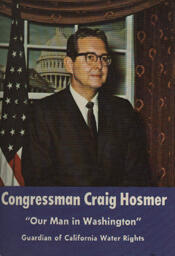
Here you will find contact information for Representative Craig Hosmer, including email address, phone number, and mailing address.
| Name | Craig Hosmer |
| Position | Representative |
| State | California |
| District | 32 |
| Party | Republican |
| Status | Former Representative |
| Term Start | January 3, 1953 |
| Term End | January 3, 1975 |
| Terms Served | 11 |
| Born | May 6, 1915 |
| Gender | Male |
| Bioguide ID | H000802 |
About Representative Craig Hosmer
Chester Craig Hosmer (May 6, 1915 – October 11, 1982) was an American lawyer and Republican politician who served eleven terms as a United States Representative from California from 1953 to 1974. Over more than two decades in the House of Representatives, he contributed to the legislative process during a significant period in American history, representing the interests of his California constituents and participating actively in the democratic process.
Hosmer was born in Brea, Orange County, California, on May 6, 1915. He attended public schools in California and graduated from Long Beach Polytechnic High School. He then enrolled at the University of California, Berkeley, from which he graduated in 1937. Pursuing a legal career, he attended the University of Michigan Law School in 1938 before returning to California to complete his legal education. He received his law degree from the University of Southern California Law School in 1940, was admitted to the bar that same year, and began practicing law in Long Beach, California.
Shortly after entering legal practice, Hosmer enlisted in the United States Navy in July 1940, as the United States moved closer to involvement in World War II. He advanced to the rank of commander during his active service and later attained the rank of rear admiral in the Naval Reserve. His military experience, particularly in a period of global conflict and emerging nuclear technology, helped shape his later professional focus on atomic energy and national security issues.
Following his wartime service, Hosmer combined legal work with specialized roles in the emerging field of nuclear affairs. In 1948 he served as an attorney with the United States Atomic Energy Commission at Los Alamos, New Mexico, a central site of the nation’s nuclear research and weapons development. During the same period, he was special assistant United States District Attorney for New Mexico. After completing this federal service, he returned to Long Beach to resume private legal practice, building a reputation that would support his entry into electoral politics.
Hosmer first sought a seat in Congress as a Republican candidate in 1950, running unsuccessfully for election to the Eighty-second Congress. He was subsequently elected as a Republican to the Eighty-third Congress and to the ten succeeding Congresses, serving from January 3, 1953, until his resignation on December 31, 1974. Over his eleven terms in the House of Representatives, he served during a transformative era marked by the Cold War, the civil rights movement, and major changes in domestic and foreign policy. A member of the Republican Party, Hosmer took part in shaping legislation across a wide range of issues and became particularly identified with matters involving national defense and nuclear energy, reflecting his legal and military background.
During his congressional service, Hosmer took notable positions on civil rights legislation. He voted in favor of the Civil Rights Acts of 1957, 1960, 1964, and 1968, supporting federal efforts to address racial discrimination and protect civil liberties. He also voted in favor of the Twenty-fourth Amendment to the United States Constitution, which prohibited the use of poll taxes in federal elections. He did not vote on the Voting Rights Act of 1965. His record placed him among those Republicans who backed key civil rights measures during a period of intense national debate over equality and voting rights.
Hosmer was also known for his outspoken reaction to the 1967 USS Liberty incident during the Six-Day War, in which Israeli forces attacked a United States Navy intelligence ship. He was one of the few members of Congress to call publicly for a thorough investigation. Expressing anger over the attack, which killed 34 officers and men of the Navy and wounded another 175, he argued that the nature of the vessel and its distinctive “Victory hull” design made mistaken identity implausible. He characterized the incident as “an act of high piracy,” urged that those responsible be court-martialed on charges including murder, and insisted that the Government of Israel pay full reparations to the United States and indemnities to the families of the Americans killed. Hosmer was not a candidate for reelection in 1974 to the Ninety-fourth Congress and concluded his House service at the end of that year.
After leaving Congress, Hosmer remained active in fields related to his long-standing interest in nuclear policy. From 1975 to 1979 he served as president of the American Nuclear Energy Council, a position that allowed him to draw on his experience with the Atomic Energy Commission and his legislative background to influence public and industry discussions on nuclear energy. He resided in Washington, D.C., during his later years, maintaining connections to the federal policy community even after his formal retirement from elective office.
Chester Craig Hosmer died on October 11, 1982, while aboard a cruise ship bound for Mexico. In recognition of his military service and long tenure in public office, he was buried at Arlington National Cemetery in Arlington, Virginia.