Representative Dan Burton
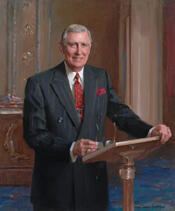
Here you will find contact information for Representative Dan Burton, including email address, phone number, and mailing address.
| Name | Dan Burton |
| Position | Representative |
| State | Indiana |
| District | 5 |
| Party | Republican |
| Status | Former Representative |
| Term Start | January 3, 1983 |
| Term End | January 3, 2013 |
| Terms Served | 15 |
| Born | June 21, 1938 |
| Gender | Male |
| Bioguide ID | B001149 |
About Representative Dan Burton
Danny Lee Burton (born June 21, 1938) is an American politician who served as a Republican member of the United States House of Representatives from Indiana from January 3, 1983, to January 3, 2013. Over fifteen consecutive terms, he represented first Indiana’s 6th congressional district and, following redistricting after the 2000 census, the 5th congressional district. A member of the Republican Party and later a participant in the Tea Party Caucus, Burton was known for his consistently conservative voting record, his leadership roles within conservative House caucuses, and his involvement in high-profile legislative and oversight initiatives.
Burton was born in Indianapolis, Indiana, the son of Bonnie L. (née Hardesty) and Charles W. Burton. His early life was marked by economic hardship and family instability. His father, a former policeman, was abusive toward his mother and struggled to maintain steady employment, leading the family to move frequently among trailer parks, cabins, and motels. After his parents divorced, his mother obtained a restraining order against his father in June 1950. In response, his father kidnapped her, and Burton and his younger brother and sister were briefly placed in the Marion County Children’s Guardian Home. His mother eventually escaped, and his father was sentenced to two years in jail. Following these events, Burton’s mother remarried, and he and his siblings experienced more stable and happier teenage years.
As a teenager, Burton worked as a caddy at a local country club to help make ends meet. This job allowed him to develop strong golf skills, and he went on to win a statewide golf championship in high school. He graduated from Shortridge High School in Indianapolis in 1957. Burton attended Indiana University from 1958 to 1959 and then the Cincinnati Bible Seminary (now Cincinnati Christian University) from 1959 to 1960. He also served in the United States Army from 1956 to 1957, leaving active duty to return to college while remaining in the Army Reserve from 1957 to 1962. After his schooling, Burton entered the private sector as a real estate broker and, in 1968, founded the Dan Burton Insurance Agency, establishing himself as a small businessman before embarking on a full-time political career.
Burton’s political career began in the Indiana General Assembly. He was first elected to the Indiana House of Representatives, serving from 1967 to 1968. He then served in the Indiana State Senate from 1969 to 1970. After a brief interval out of office, he returned to the Indiana House from 1977 to 1980 and again to the Indiana State Senate from 1981 to 1982. During this period, Burton also sought federal office. He first ran for Congress in 1970, challenging Democratic incumbent Andy Jacobs in Indiana’s 11th congressional district, but was unsuccessful. He tried again in 1972, running in the Republican primary, where he lost to William Hudnut. These early campaigns, however, helped build his name recognition and political base in central Indiana.
Following the 1980 census, the Republican-controlled Indiana legislature significantly reconfigured the state’s 6th congressional district, shifting it to the northern suburbs of Indianapolis and making it a heavily Republican seat. The four-term Democratic incumbent, David W. Evans, chose to run against Andy Jacobs in the Democratic primary rather than seek reelection in the newly drawn district. While still in his second stint in the Indiana State Senate, Burton entered the 1982 Republican primary for the open 6th District seat and won a five-way contest with 37 percent of the vote. In the general election, he defeated Democrat George Grabianowski by a margin of 65 percent to 35 percent. Burton took office in the U.S. House of Representatives on January 3, 1983, and was reelected fourteen times, never receiving less than 62 percent of the vote in a general election. After the 2000 census, his district was renumbered as the 5th District, but it remained centered on the Republican-leaning northern suburbs of Indianapolis.
During his three decades in Congress, Burton developed a reputation as a staunch conservative. He consistently supported anti-abortion legislation and, in the 109th Congress, received a 100 percent rating from the National Right to Life Committee. He was a strong advocate of gun rights, earning an “A” rating from the Gun Owners of America. His voting record and advocacy on behalf of business interests and social conservatism garnered him numerous awards from conservative and pro-business organizations, including a Friend of the Farm Bureau Award in 2004 from the American Farm Bureau Federation, a True Blue Award in 2006 from the Family Research Council, eight Guardian of Small Business Awards from the National Federation of Independent Business, and twenty-two Spirit of Enterprise Awards from the U.S. Chamber of Commerce. Within the House Republican Conference, Burton was active in organized conservative groups. He served as chairman of the Republican Study Committee during the 101st Congress. After Speaker Newt Gingrich withdrew official funding for the group in 1995, Burton joined Representatives John Doolittle of California, Ernest Istook of Oklahoma, and Sam Johnson of Texas in refounding it as the Conservative Action Team (CAT), with the three men sharing the chairmanship from 1994 to 1999. In 2001, the group reclaimed its original name, the Republican Study Committee. Burton was also a member of the Tea Party Caucus in the later years of his congressional service.
Burton’s legislative work included both high-profile foreign policy initiatives and efforts to reshape federal management practices. In 1995, he authored legislation targeting foreign companies that did business with Cuba, aiming to penalize those that acquired property confiscated from Americans by the Cuban government of Fidel Castro. This initiative became part of the Helms–Burton Act, which allowed foreign companies to be sued in American courts if they acquired assets formerly owned by U.S. citizens in Cuba. After Cuban forces shot down two small Brothers to the Rescue planes piloted by anti-Castro Cuban Americans in February 1996, President Bill Clinton, as part of a broader response to the incident, signed the Helms–Burton Act into law. Domestically, Burton was the primary sponsor of H.R. 2883, the “Government Performance and Results Act Amendments” of 1998. This measure, opposed by the Clinton administration, sought to require federal agencies to engage in more rigorous strategic planning, establish clearer accountability metrics, and provide more detailed reporting on their performance. Although the bill was not enacted into law, it reflected Burton’s interest in government efficiency and oversight.
Burton’s role in congressional oversight was particularly visible during his tenure as chairman of the House Committee on Government Reform (later Government Reform and Oversight). In that capacity, he led a three-year investigation into corruption within the Federal Bureau of Investigation related to the notorious Winter Hill Gang in Boston. The committee’s work helped expose FBI misconduct that had contributed to the wrongful convictions of Joseph Salvati, Peter Limone, Henry Tameleo, and Louis Greco for the 1965 murder of Edward “Teddy” Deegan. The revelations from this investigation ultimately contributed to the exoneration of the four men, who were later awarded $102 million in damages by Judge Nancy Gertner of the U.S. District Court for the District of Massachusetts. Burton’s oversight activities, including this inquiry, underscored his willingness to challenge federal law enforcement agencies and highlighted his broader focus on accountability within the executive branch.
In his later congressional years, Burton continued to face electoral challenges within his own party as the political landscape in Indiana evolved. In 2008, he encountered his first well-funded Republican primary challenger since his initial election to Congress, when former Marion County Coroner John McGoff mounted a serious campaign. Burton prevailed by a narrower margin than in previous races, defeating McGoff 52 percent to 45 percent in what became the closest Republican primary of his career. In 2010, amid growing intra-party competition, Burton faced six challengers in the Republican primary. He won the nomination with a 30 percent plurality, defeating State Representative Luke Messer (28 percent), McGoff (19 percent), State Representative Mike Murphy (9 percent), Brose McVey (8 percent), Andy Lyons (4 percent), and Ann Adcock (3 percent), carrying a majority in only one county, Huntington County, where he received 55 percent of the vote. By the 2012 election cycle, the reconfigured 5th District remained a Republican stronghold but was considered slightly more competitive for Democrats than its predecessor. Burton was poised to face a crowded Republican primary field that included McGoff, former U.S. Attorney Susan Brooks, former U.S. Representative David McIntosh, and attorney Jack Lugar, while State Representative Scott Reske and labor activist Tony Long entered the race on the Democratic side. On January 31, 2012, citing “personal problems with family health,” Burton abruptly announced that he would retire at the end of his term and not seek reelection. Susan Brooks went on to win the seat in the general election. Burton left Congress on January 3, 2013, concluding a thirty-year tenure marked by staunch conservatism, active participation in party caucuses, and a prominent role in legislative and oversight activities during a significant period in late twentieth- and early twenty-first-century American political history.