Representative Daniel Angelus Driscoll
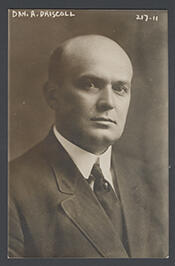
Here you will find contact information for Representative Daniel Angelus Driscoll, including email address, phone number, and mailing address.
| Name | Daniel Angelus Driscoll |
| Position | Representative |
| State | New York |
| District | 42 |
| Party | Democratic |
| Status | Former Representative |
| Term Start | March 15, 1909 |
| Term End | March 3, 1917 |
| Terms Served | 4 |
| Born | March 6, 1875 |
| Gender | Male |
| Bioguide ID | D000500 |
About Representative Daniel Angelus Driscoll
Daniel Angelus Driscoll (March 6, 1875 – June 5, 1955) was an American businessman, civic leader, and Democratic politician from Buffalo, New York, who served four terms as a United States Representative from 1909 to 1917 and later as postmaster of Buffalo from 1934 to 1947. Over the course of his public career, he represented the interests of his constituents in Congress during a significant period in American history and played a prominent role in the commercial and civic life of Buffalo.
Driscoll was born in Buffalo, New York, on March 6, 1875, the son of Timothy Driscoll and Catherine Blanche Driscoll. He attended the city’s public schools, completing his elementary education at School 35 in 1891, and subsequently graduated from Central High School. Raised in a Catholic family, he became active at an early age in parish affairs and charitable work, laying the foundation for a lifelong involvement in religious, fraternal, and community organizations that paralleled his business and political pursuits.
After completing his education, Driscoll entered the funeral business founded by his father, Timothy Driscoll & Sons. The firm, later operated by Driscoll and his brothers as Timothy Driscoll’s Sons, became a well-known family-owned funeral home in Buffalo. In addition to his work in the funeral business, Driscoll expanded his interests into other commercial ventures, including the organization and later presidency of Buffalo’s Phoenix Brewery. His growing prominence in business was matched by active participation in civic and fraternal life. He held leadership roles in the Ancient Order of Hibernians and took part in many Catholic church activities, frequently serving on charity committees. He was also a member of organizations such as the Elks, Moose, Buffalo Club, Buffalo Athletic Club, Park Club, Erie Downs Country Club, and the Knights of Columbus.
Driscoll became active in Democratic Party politics at a young age. In June 1898, he was elected secretary of a local Democratic meeting that selected delegates to the state party convention, marking his emergence as a party organizer. In September 1899, he sought the Democratic nomination for the New York State Assembly from Erie County’s 4th district. Although unsuccessful, he remained a visible figure in local politics. In November 1900, he helped organize the Jefferson Club of Erie County, a Democratic organization formed to promote party principles while avoiding the factional disputes then roiling the party. By 1903, his supporters had created the Daniel A. Driscoll Association to advance his political prospects. They again pressed for his nomination to the State Assembly in 1904, an effort that ended when Driscoll publicly disclaimed any interest in the race.
In 1906, Driscoll was a candidate for the Democratic nomination to represent New York’s 35th congressional district, but he withdrew in favor of the incumbent, William H. Ryan, who went on to win reelection. Two years later, in August 1908, Driscoll again sought the Democratic nomination for the U.S. House of Representatives. When it became evident at the district convention that he had secured enough votes to win, Ryan withdrew from the race. In the November 1908 general election for the U.S. House of Representatives from New York’s 35th congressional district, Driscoll, the Democratic nominee, received 25,866 votes, defeating Republican L. Bradley Dorr, who received 20,093 votes, as well as Samuel F. Leary (Socialist, 626 votes), Charles Reinagel (Independence League, 133 votes), and Joseph A. Dixon (Prohibition, 108 votes). He succeeded Ryan on March 4, 1909.
Driscoll served in the United States House of Representatives from March 4, 1909, to March 3, 1917, completing four consecutive terms during a period of significant national change, including the Progressive Era and the lead-up to American involvement in World War I. A member of the Democratic Party, he represented first New York’s 35th congressional district and, following redistricting, New York’s 42nd congressional district. He was reelected in 1910, 1912, and 1914. In the 1910 election for the 35th district, he ran as the Democratic and Independence League candidate, receiving 21,727 votes to Republican Patrick J. Keeler’s 14,605, with Samuel F. Leary (Socialist) receiving 1,713 votes and Joseph A. Dixon (Prohibition) 128 votes. In 1912, running in the 42nd congressional district, Driscoll, as the Democratic nominee, received 14,851 votes, defeating Willard H. Ticknor (Republican, 8,613 votes), L. Bradley Dorr (National Progressive, 7,161 votes), Samuel Leary (Socialist, 1,613 votes), and Vernon M. Stone (Prohibition, 259 votes). In 1914, he again prevailed in the 42nd district with 13,081 votes, narrowly defeating Ticknor (Republican, 12,633 votes), John J. Smith (Progressive, 1,265 votes), and Adam Sebenck (Socialist, 688 votes). In 1916, he was an unsuccessful candidate for reelection, losing to William F. Waldow, the Republican and National Progressive nominee, who received 16,623 votes to Driscoll’s 15,411, with Samuel Fawkes (Socialist) receiving 580 votes and 4,484 ballots recorded as blank, scattering, or void. During his tenure in the House, Driscoll served on the Rivers and Harbors Committee, where he worked to secure federal funding for improvements to New York’s ports and waterways, including the expansion and maintenance of the Port of Buffalo and the deepening of shipping channels in the Hudson River and Lake Champlain. Through this committee work, he contributed to infrastructure projects that supported commerce and transportation in his state and district.
After leaving Congress in March 1917, Driscoll returned to Buffalo and resumed his role in the Driscoll family funeral business. At the same time, he continued to pursue other business interests, notably in the brewing industry, where he helped organize and served as president of Phoenix Brewery, reflecting his ongoing engagement with the city’s commercial development. Remaining active in civic affairs, he maintained memberships in numerous professional and fraternal organizations and was associated with the National Association of Postmasters later in his career.
In 1934, Driscoll was appointed postmaster of Buffalo, a federal position that placed him in charge of the city’s postal operations during the later years of the Great Depression, World War II, and the immediate postwar period. He served in this capacity until his retirement in 1947, overseeing significant growth and modernization in postal services and maintaining close ties to the community through his public responsibilities. After retiring, he continued to reside in Buffalo, remaining involved in local social and religious circles. A lifelong bachelor, Driscoll never married and had no children. He died in Buffalo on June 5, 1955, and was buried at Holy Cross Cemetery in Lackawanna, New York.