Representative Daniel J. Flood
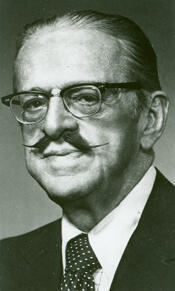
Here you will find contact information for Representative Daniel J. Flood, including email address, phone number, and mailing address.
| Name | Daniel J. Flood |
| Position | Representative |
| State | Pennsylvania |
| District | 11 |
| Party | Democratic |
| Status | Former Representative |
| Term Start | January 3, 1945 |
| Term End | January 3, 1981 |
| Terms Served | 16 |
| Born | November 26, 1903 |
| Gender | Male |
| Bioguide ID | F000209 |
About Representative Daniel J. Flood
Daniel John Flood (November 26, 1903 – May 28, 1994) was an American attorney and politician, a flamboyant and long‑serving Democratic United States Representative from Pennsylvania. Nicknamed “Dapper Dan” for what Time magazine called his “villainous‑looking” waxed mustache and eccentric clothes, he served as a Representative from Pennsylvania in the United States Congress from 1945 to 1981, holding office for 16 terms. First elected to the U.S. House in 1944, he served continuously from 1955 to 1980 and became a powerful member of the House Appropriations Committee. Flood was credited with leading the effort to help the Wilkes‑Barre area recover after the devastating flooding caused by Hurricane Agnes in 1972 and played a key role in establishing national programs such as Medicare, economic development initiatives for Appalachia, and the Federal Coal Mine Health and Safety Act of 1969.
Flood was born into an ethnic Irish family in Hazleton, in northeastern Pennsylvania, the son of Sarah (McCarthy) and Patrick Flood. He attended public schools in Wilkes‑Barre, Pennsylvania, and St. Augustine, Florida. From an early age he studied acting, a skill he fancied and later used to dramatic effect in his congressional career. He graduated from Syracuse University in 1924, then attended Harvard Law School before completing his legal education at Dickinson School of Law in Carlisle, Pennsylvania, from which he graduated in 1929. His theatrical interests continued alongside his studies; he developed the signature waxed mustache and taste for white suits that became hallmarks of his public persona, and his style, dress, and speech were often compared to that of a Shakespearean actor.
Admitted to the bar in 1930, Flood opened a law practice in Wilkes‑Barre. During the Great Depression he served as an attorney for the federal Home Owners’ Loan Corporation in 1934 and 1935, work that deepened his commitment to New Deal–style economic intervention and inspired him to join the Democratic Party under the influence of President Franklin D. Roosevelt. His legal and administrative abilities led to a series of state appointments. From 1935 to 1939 he was deputy attorney general for the Commonwealth of Pennsylvania and counsel for the Pennsylvania Liquor Control Board. In 1941 he was appointed director of the State Bureau of Public Assistance Disbursements by State Treasurer G. Harold Wagner and served as executive assistant to the state treasurer from 1941 to 1944, gaining experience in public finance and social welfare administration that would later inform his work on federal appropriations.
Flood’s first bid for elective office came in 1942, when he was the Democratic candidate in a special election to replace Congressman J. Harold Flannery in what was then Pennsylvania’s 12th congressional district, based in Wilkes‑Barre. He narrowly lost to Republican Thomas B. Miller, and later that year lost to Miller again by a wider margin in the general election. In 1944, running in a district renumbered as the 11th, he defeated Miller and entered the U.S. House of Representatives, beginning his long association with Congress. He was defeated for reelection in 1946 amid a nationwide Republican landslide, regained his seat in 1948, and was reelected in 1950. In 1952 he again lost his seat, this time to Republican Edward J. Bonin in former General Dwight D. Eisenhower’s presidential landslide. Flood returned to Congress in 1954 in a rematch against Bonin and, after a close reelection contest in 1956, went on to win 11 additional terms without serious opposition. Over these years he participated actively in the legislative process and represented the interests of his northeastern Pennsylvania constituents during a significant period in American history.
As his seniority increased, Flood became a key member of the House Appropriations Committee, where his knowledge of the legislative process and control over spending bills gave him substantial influence. He used this position to contribute strongly to the passage of Medicare, to promote economic development initiatives in the Appalachian region, and to help secure enactment of the Federal Coal Mine Health and Safety Act of 1969, which improved working conditions and health protections for miners. He also promoted the strength of U.S. military forces and supported the proliferation of nuclear arms during the Cold War, reflecting his strong national defense views. Within his district, whose economy had been devastated by the decline of the anthracite coal industry, he used his influence in Congress to sponsor measures such as the Area Redevelopment Act of 1961 and to channel federal contracts and development projects intended to transition the local economy. He persuaded Senator John F. Kennedy of Massachusetts to campaign in his home district and strongly supported Kennedy’s presidential campaign and administration. In the 1972 presidential election, however, he supported Republican President Richard M. Nixon over Democratic nominee George McGovern and refused to accompany McGovern during the latter’s visit to Wilkes‑Barre after the 1972 flood.
Flood’s most celebrated work on behalf of his district came after the remnants of Hurricane Agnes overwhelmed the Susquehanna River watershed in June 1972, causing catastrophic flooding in Wilkes‑Barre’s business and residential areas and throughout the river valley. As a subcommittee chairman on the Appropriations Committee with years of accumulated clout, he was widely credited with cutting through federal red tape to speed disaster relief and reconstruction in what was then the most damaging hurricane in U.S. history. He helped muster air and boat rescue operations, brought President Nixon to the region to survey the damage, and organized a broad federal response. The slogan “It took a Flood to tame a flood” became associated with his efforts. His intense focus on Wilkes‑Barre sometimes drew criticism from neighboring Scranton, which lay outside his 11th District; he was occasionally accused of favoring Wilkes‑Barre and is often cited as a driving force behind placing “Wilkes‑Barre” first in the name of the Wilkes‑Barre/Scranton International Airport. He was reputed to have quipped that “no self‑respecting man from Wilkes‑Barre would ever date the best looking blonde from Scranton,” a remark that underscored his fierce local pride.
Over time, Flood’s aggressive use of political influence drew increasing scrutiny. He was investigated by at least eight separate U.S. Attorney’s offices, with some 175 possible cases reportedly pending against him. In February 1978 The Washington Post reported that he was accused of helping steer federal grant money to the B’nai Torah Institute, a community service organization in New York, from which he received campaign contributions totaling nearly $1,000 plus an undisclosed honorarium. His former aide Stephen Elko testified that Flood was a “muscler” who used his influence to direct federal contracts to individuals and corporations in exchange for cash kickbacks. One widely cited example was the so‑called “Flood–Medico–Bufalino Triangle,” in which Medico Industries of Plains Township, with Flood’s assistance, obtained a $3,900,000 Department of Defense contract to produce 600,000 warheads for use in the Vietnam War. Mafia crime boss Russell Bufalino, an associate of Medico executives William “Billy” Medico and Philip Medico—the latter known as a caporegime in the Bufalino crime family—frequented Medico offices, and the FBI discovered that Flood often traveled on the company’s jet. As a result of Elko’s testimony, the Department of Justice and the House Committee on Standards of Official Conduct (now the House Committee on Ethics) opened formal investigations in early 1978. On September 5, 1978, a federal grand jury indicted Flood on three counts of perjury, charging that he had lied about payoffs. A trial on bribery charges, alleging that he had accepted more than $50,000 in payoffs, ended with a hung jury. A retrial was repeatedly delayed because of treatment for several ailments; federal prosecutors suggested that some treatments were being postponed as a stalling measure.
During the 96th Congress, the House moved to discipline Flood. In 1979 he was censured for bribery, and the ethical and legal controversies effectively ended his congressional career. In February 1980 he pleaded guilty to a single count related to payoffs and was placed on probation for one year. He resigned from the House of Representatives on January 31, 1980, bringing to a close more than three decades of intermittent but ultimately long‑tenured service. His career thus combined substantial legislative achievements—particularly in social welfare, regional economic development, and mine safety—with a dramatic and controversial denouement that placed him among the federal officials censured and later listed in discussions of American political scandals.
Flood’s personal life and public image were closely tied to his love of the theater. He studied acting in his school days and maintained close ties to local theater in Wilkes‑Barre. He persuaded his friend James Karen to begin an acting career by recruiting him into a production at the Little Theatre of Wilkes‑Barre, and he met his wife, Catherine Swank, when both were cast in a production there. His oratorical style on the House floor and in public appearances was often described as theatrical, and his weekly televised messages from Washington became a staple of Sunday morning television in northeastern Pennsylvania. He was known for attending virtually any public event in his district, reinforcing his reputation as a hands‑on, highly visible representative. Within the region he came to be regarded as a folk hero for his relentless pursuit of federal resources and his advocacy for miners and working‑class communities.
Daniel John Flood died in Wilkes‑Barre on May 28, 1994. His funeral was held on May 30 at St. John’s Church in Wilkes‑Barre, where then‑Governor Bob Casey and Representatives Paul Kanjorski and Joseph McDade delivered eulogies. He was interred in the family plot at St. Mary’s Cemetery in Hanover Township, Pennsylvania. His legacy in northeastern Pennsylvania is reflected in numerous commemorations, including Daniel J. Flood Elementary School in the Wilkes‑Barre Area School District and other local landmarks bearing his name. On October 2, 2010, the Pennsylvania Historical and Museum Commission honored him with a state historical marker on Wilkes‑Barre’s Public Square, recognizing his service as U.S. Congressman from Pennsylvania’s 11th District from 1944 to 1980 and his key role in national programs such as Medicare, Appalachian urban economic development, and coal mine health and safety, as well as his advocacy of a strong U.S. military during the Cold War and his resignation amid controversy.