Representative Daniel Webster Mills
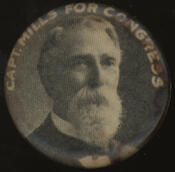
Here you will find contact information for Representative Daniel Webster Mills, including email address, phone number, and mailing address.
| Name | Daniel Webster Mills |
| Position | Representative |
| State | Illinois |
| District | 4 |
| Party | Republican |
| Status | Former Representative |
| Term Start | March 15, 1897 |
| Term End | March 3, 1899 |
| Terms Served | 1 |
| Born | February 25, 1838 |
| Gender | Male |
| Bioguide ID | M000773 |
About Representative Daniel Webster Mills
Daniel Webster Mills (February 25, 1838 – December 16, 1904) was a U.S. Representative from Illinois and a Chicago businessman and local official whose career spanned commerce, military service, municipal administration, and national politics. He was born near Waynesville, Warren County, Ohio, on February 25, 1838, into a rural community in southwestern Ohio that was then developing as an agricultural and trading area. Mills attended the common schools of nearby Rayesville and continued his studies at Waynesville High School, receiving the basic education typical of mid-nineteenth-century Midwestern youth and preparing him for a career in business.
In 1859 Mills moved to Corwin, Ohio, a small community in Warren County, where he entered private enterprise at a young age. There he engaged in mercantile pursuits, grain shipping, and pork-packing, activities that reflected the region’s role as a hub for agricultural production and trade. Through these ventures he gained experience in commerce, transportation, and commodity markets, building the practical business background that would later support his work in larger urban and political settings.
During the American Civil War, Mills entered the Union Army, reflecting the strong Unionist sentiment of southern Ohio. He served as captain of Company D in the 180th Regiment, Ohio Volunteer Infantry, holding that commission until the close of the war. His regiment, organized in the later stages of the conflict, was assigned to duty in the Western Theater, and his service as a company commander placed him in a position of direct responsibility for the discipline, welfare, and combat readiness of his men. This period of military leadership contributed to his public standing and provided him with administrative and organizational experience that he would later apply in civilian roles.
After the war, Mills relocated to Chicago, Illinois, which was emerging as a major commercial and transportation center in the postwar period. From 1866 to 1869 he engaged in lake shipping, participating in the movement of goods on the Great Lakes at a time when waterborne commerce was vital to the city’s rapid growth. Following his work in shipping, he turned to the real estate business in Chicago, a field that expanded significantly as the city rebuilt and developed after the Civil War and, later, after the Great Chicago Fire of 1871. His involvement in real estate placed him at the intersection of urban expansion, investment, and municipal development.
Mills also held important local administrative positions in Cook County and the city of Chicago. He served as warden of Cook County Hospital from 1877 to 1881, overseeing one of the principal public medical institutions in the region. In that capacity he was responsible for the management of hospital operations, including care for indigent and immigrant populations in a rapidly growing metropolis. Later, he entered elective municipal office and served as an alderman on the Chicago City Council from 1889 to 1893. As an alderman he participated in city governance during a period marked by industrialization, labor unrest, and significant infrastructure and public health challenges, contributing to the legislative and oversight functions of the council.
Building on his local prominence and Republican Party affiliation, Mills was elected as a Republican to the Fifty-fifth Congress, representing Illinois from March 4, 1897, to March 3, 1899. In Congress he served during the administration of President William McKinley and the opening of the Spanish–American War, a time of growing national involvement in international affairs and debates over economic policy, tariffs, and currency. Although specific committee assignments and legislative initiatives are not extensively documented, his single term placed him among the Midwestern Republican legislators who supported the party’s national program in the late nineteenth century.
Mills sought to continue his service in the national legislature but was an unsuccessful candidate for reelection in 1898 to the Fifty-sixth Congress. After leaving Congress in March 1899, he returned to Chicago and resumed his activities in the real estate business, remaining engaged in the city’s commercial life. He continued to reside in Chicago until his death there on December 16, 1904. Daniel Webster Mills was interred in Graceland Cemetery in Chicago, a burial place for many of the city’s prominent political, business, and civic leaders, reflecting the public stature he had attained through his military service, municipal leadership, and term in the U.S. House of Representatives.