Representative Dante B. Fascell
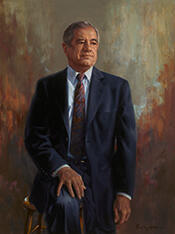
Here you will find contact information for Representative Dante B. Fascell, including email address, phone number, and mailing address.
| Name | Dante B. Fascell |
| Position | Representative |
| State | Florida |
| District | 19 |
| Party | Democratic |
| Status | Former Representative |
| Term Start | January 5, 1955 |
| Term End | January 3, 1993 |
| Terms Served | 19 |
| Born | March 9, 1917 |
| Gender | Male |
| Bioguide ID | F000041 |
About Representative Dante B. Fascell
Dante Bruno Fascell (March 9, 1917 – November 28, 1998) was an American politician and attorney who represented Florida as a Democratic member of the United States House of Representatives from 1955 to 1993. Over the course of 19 consecutive terms in Congress, he became one of the chamber’s most influential voices on foreign affairs, ultimately serving for nine years as chairman of the House Committee on Foreign Affairs. His long tenure in the House coincided with a significant period in American history, during which he participated actively in the legislative process and represented the interests of his South Florida constituents.
Fascell was born in Bridgehampton, Suffolk County, New York, on March 9, 1917. In 1925, his family moved to Florida, where he would spend the remainder of his life and build his political career. He attended local schools and went on to study at the University of Miami, where he pursued legal training. While a student at the University of Miami School of Law, he became a member of the Phi Mu Alpha Sinfonia music fraternity and the Kappa Sigma fraternity, and he was inducted into the Iron Arrow Honor Society, the university’s highest honor. He graduated from the University of Miami School of Law in 1938, was admitted to the bar, and began practicing law in the Miami area.
With the onset of World War II, Fascell entered military service. He joined the Florida National Guard in 1941 and, as the United States mobilized for war, he was commissioned a second lieutenant in 1942. During the war he served in the African, Sicilian, and Italian campaigns, rising to the rank of captain. His wartime experience in multiple theaters of combat helped shape his later interest in international affairs and national security policy, which would become central themes of his congressional career.
After returning to Florida and resuming his legal practice, Fascell entered elective politics. He was elected to the Florida House of Representatives in 1950, representing Dade County at the state level. In 1954, he successfully ran for the United States House of Representatives as a Democrat from a district centered on Dade County, Florida, beginning his federal legislative service on January 3, 1955. As a member of the House of Representatives, he participated in the democratic process over nearly four decades, contributing to legislation on domestic policy, civil rights, and foreign affairs, and steadily building seniority and influence within the Democratic Party and the institution.
Fascell’s congressional service was marked by a complex but ultimately supportive record on civil rights. In 1956, he was the sole Democratic representative from the state of Florida—and one of only seven members of the Florida delegation overall—to refuse to sign the Southern Manifesto, a document opposing the Supreme Court’s decision in Brown v. Board of Education. He later voted in favor of the Civil Rights Acts of 1960 and 1968, the 24th Amendment to the U.S. Constitution prohibiting poll taxes in federal elections, and the Voting Rights Act of 1965. He did not, however, support the Civil Rights Acts of 1957 or 1964, though he agreed to the Anderson–Aiken amendment to the 1957 legislation. In his home district, he worked on issues of local and regional importance, including championing the creation of Biscayne National Park, south of Miami; the park was established and signed into law by President Lyndon B. Johnson in 1968, and its visitor center was later named in Fascell’s honor. A public park in South Miami also bears his name, reflecting his long-standing service to the community.
Foreign policy and international relations became the central focus of Fascell’s work in Congress. Initially a supporter of U.S. involvement in the Vietnam War, he soon became a critic of the conflict as it escalated, and he emerged as an advocate for greater congressional oversight of the executive branch in matters of war and peace. He co-sponsored the War Powers Act of 1973, designed to limit the president’s ability to commit U.S. forces to armed conflict without congressional authorization. Fascell was deeply engaged in issues relating to the Cold War, international organizations, and human rights, and he played a leading role in the work of the Commission on Security and Cooperation in Europe, particularly in connection with the implementation of the Helsinki Accords. Over the years he authored or co-authored numerous reports and studies on topics such as arms control, United Nations financing, international terrorism, international communications policy, and U.S.–Soviet relations, including works like “Basket III, Implementation of the Helsinki Accords,” “Congress and Arms Control,” and “International News: Freedom Under Attack.”
As his seniority grew, Fascell became a central figure in the House’s foreign policy establishment. He served as chairman of the House Committee on Foreign Affairs from 1984 to 1993, a period that encompassed the final phase of the Cold War, the collapse of the Soviet Union, and the emergence of new international challenges. In that capacity, he oversaw hearings and legislation on U.S. relations with allies and adversaries, arms control, international development, and global human rights. He worked to repeal the Clark Amendment, thereby allowing the U.S. government to send aid to UNITA rebels in Angola, an effort associated with his role as a partner in the lobbying firm Black, Manafort, Stone and Kelly. Fascell was also a prominent voice on Western Hemisphere issues, particularly U.S.–Cuban relations, and he secured federal aid for Cuban-Americans who had settled in his South Florida district. His interest in Latin America and the Caribbean was reflected in special study missions, reports on the Alliance for Progress, and his co-sponsorship of legislation such as the establishment of the Caribbean Organization.
Fascell’s legislative and intellectual engagement extended beyond committee hearings to a wide range of published congressional reports, hearings, and policy analyses. He was involved in studies on the financing of United Nations peacekeeping operations and the Article 19 controversy, on the activities of the International Cooperation Year, on the work of the Canada–United States Interparliamentary Group, and on the Federal Reserve System’s check clearance float and Government Accountability Office bid protest procedures. He contributed to examinations of international terrorism, the role of Congress in arms control, and the future of international communications policy, including delivering the Third David M. Abshire Endowed Lecture at Georgetown University’s Center for Strategic and International Studies. His reflections on U.S.–Soviet relations and his visit to the Kremlin were published by the University of Miami’s Institute for Soviet and East European Studies, and his long engagement with Cuban issues was later collected in “Fascell on Cuba: Selected Speeches and Statements on the Cuban Revolution, Fidel Castro and U.S.–Cuban Relations.”
After nearly four decades in the House, Fascell retired from Congress when his 19th term ended in January 1993. As he prepared to leave office, his colleagues honored his service, including with a formal ceremony unveiling his portrait as chairman of the House Committee on Foreign Affairs. When President Bill Clinton took office in 1993, he proposed to nominate Fascell as United States Ambassador to Italy, a post that would have reflected both Fascell’s heritage and his foreign policy expertise. Fascell declined the nomination for family reasons and because he had developed colorectal cancer. Even in retirement, his influence persisted through institutions he helped create, notably the Dante B. Fascell North-South Center at the University of Miami, established by the Dante B. Fascell North-South Center Act of 1991 as a prestigious think tank devoted to Western Hemisphere affairs.
In the final years of his life, Fascell continued to receive recognition for his decades of public service. On October 29, 1998, President Clinton presented him with the Presidential Medal of Freedom, the nation’s highest civilian honor, acknowledging his leadership in Congress and his contributions to U.S. foreign policy and democratic governance. Dante Bruno Fascell died the following month, on November 28, 1998, from colorectal cancer at the age of 81. His papers, covering his congressional career from 1955 to 1993, are preserved in the Special Collections Division of the University of Miami Libraries, providing a detailed record of his role in shaping American domestic and foreign policy during the second half of the twentieth century.