Senator David Rice Atchison
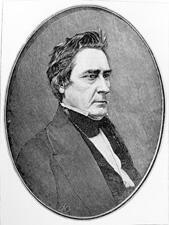
Here you will find contact information for Senator David Rice Atchison, including email address, phone number, and mailing address.
| Name | David Rice Atchison |
| Position | Senator |
| State | Missouri |
| Party | Democratic |
| Status | Former Representative |
| Term Start | December 4, 1843 |
| Term End | March 3, 1855 |
| Terms Served | 2 |
| Born | August 11, 1807 |
| Gender | Male |
| Bioguide ID | A000322 |
About Senator David Rice Atchison
David Rice Atchison (August 11, 1807 – January 26, 1886) was a mid-19th-century Democratic United States Senator from Missouri who served in the Senate from 1843 to 1855 and held the post of president pro tempore of the United States Senate for six years. A prominent pro-slavery advocate and influential figure in the politics of territorial expansion, he played a central role in the events leading to “Bleeding Kansas” and in the repeal of the Missouri Compromise. Atchison also had a notable military career in Missouri, serving as a major general in the Missouri State Militia during the 1838 Mormon War and later as a Confederate brigadier general in the Missouri Home Guard under Major General Sterling Price during the American Civil War.
Atchison was born near Lexington, Kentucky, on August 11, 1807. He was raised in a slaveholding society that shaped his later political views and commitments. After receiving his early education in Kentucky, he studied law and was admitted to the bar. Seeking opportunity on the expanding western frontier, he moved to Missouri, where he established a legal practice and quickly entered public life. His legal and political work in Missouri, combined with his connections among the state’s Democratic leaders and slaveholding planter class, positioned him for higher office.
In Missouri, Atchison’s early prominence was reinforced by his military service. In 1838 he served as a major general in the Missouri State Militia during the conflict commonly known as Missouri’s Mormon War, a confrontation between Latter-day Saint settlers and non-Mormon Missourians that resulted in the expulsion of the Mormons from the state. His role in this episode reflected both his influence in state affairs and his alignment with the dominant pro-slavery, anti-Mormon sentiment of much of Missouri’s political establishment. By the early 1840s, Atchison had become a leading Democrat in western Missouri and a recognized figure in state politics.
In October 1843, Atchison was appointed to the United States Senate to fill the vacancy caused by the death of Senator Lewis F. Linn. He was the first senator from western Missouri to serve in this position, and at age 36 he was the youngest senator from Missouri up to that time. A member of the Democratic Party, he contributed to the legislative process during two terms in office and represented the interests of his Missouri constituents during a significant period in American history. Atchison was re-elected to a full term in 1849. Within the Senate, he quickly gained popularity among his fellow Democrats. When Democrats took control of the Senate in December 1845, they chose him as president pro tempore, placing him second in the line of succession to the presidency and entrusting him with presiding over the Senate in the absence of the vice president. That elevation, coming when he was only 38 and had served just two years, underscored his standing within the party.
Atchison’s tenure as president pro tempore was lengthy and influential. He first held the office beginning in December 1845 and continued until 1849, when he stepped down in favor of Senator William R. King of Alabama. After King was elected Vice President of the United States, he relinquished the Senate post, and Atchison again assumed the role of president pro tempore in December 1852. Atchison continued in that capacity until December 1854, giving him an aggregate of six years in the position. During this period, some of his associates later claimed that, for 24 hours—from Sunday, March 4, 1849, through noon on Monday, March 5—he may have been acting president of the United States, because President James K. Polk’s term had expired at noon on March 3 and President-elect Zachary Taylor delayed his inauguration until Monday. Atchison himself treated the matter humorously, recalling that he had been awakened at 3 a.m. by a colleague joking that, as “President,” he should appoint him secretary of state. Most scholars dismiss the notion that Atchison was ever legally president, but the episode became a persistent part of his legend.
As a senator, Atchison was a fervent advocate of slavery and territorial expansion. He strongly supported the annexation of Texas and backed the United States in the Mexican–American War, viewing territorial growth as an opportunity to extend slaveholding interests. His stance brought him into sharp conflict with Missouri’s other Democratic senator, Thomas Hart Benton. Although both men were Democrats, Benton increasingly opposed the extension of slavery and by 1849 publicly declared himself against it. Their rivalry deepened into open enmity, and in 1851 Atchison allied with Whig legislators in Missouri to defeat Benton’s bid for re-election to the Senate. This intra-party struggle reflected the broader sectional tensions that were fracturing national politics in the decade before the Civil War.
Atchison played a pivotal role in the sectional crisis over the organization of the territories west of Missouri. Senator Benton, intending to challenge Atchison in 1854, began to agitate for the territorial organization of the region that would become Kansas and Nebraska so that it could be opened to settlement. To counter Benton and to protect and expand slavery, Atchison proposed that the area be organized with the explicit repeal of the Missouri Compromise’s prohibition of slavery north of latitude 36°30′, substituting the doctrine of popular sovereignty, under which settlers in each territory would vote on whether to allow slavery. At Atchison’s request, Senator Stephen A. Douglas of Illinois introduced the Kansas–Nebraska Act in November 1853, embodying this principle. The act passed and became law in May 1854, creating the Territories of Kansas and Nebraska and effectively overturning the Missouri Compromise. Atchison’s role in this legislation made him a central architect of the policy that helped precipitate violent conflict in the territories and hastened the nation’s march toward civil war.
Following passage of the Kansas–Nebraska Act, Atchison became one of the most visible leaders of the pro-slavery cause in the Kansas Territory. A substantial slaveholder and plantation owner, he was a prominent pro-slavery activist and “border ruffian” leader, deeply involved in organizing and encouraging armed Missourians to cross into Kansas to influence elections and intimidate or attack abolitionists and other free-state settlers. His activities contributed directly to the period of violence known as “Bleeding Kansas,” which preceded Kansas’s eventual admission to the Union as a free state. Atchison’s aggressive pro-slavery leadership in the territory further polarized national opinion and diminished his standing among moderates, even as it solidified his reputation among pro-slavery partisans.
Atchison’s Senate career ended in 1855 when he failed to secure re-election amid the shifting political landscape and rising sectional tensions. He returned to Missouri, where he remained a figure of influence among pro-slavery Democrats. With the outbreak of the American Civil War, he aligned with the Confederacy. He served as a Confederate brigadier general in the Missouri Home Guard under Major General Sterling Price, participating in efforts to bring Missouri fully into the Confederate camp and to resist Union control in the state. Although Missouri remained officially in the Union, Atchison’s service reflected his continued commitment to the Confederate and pro-slavery cause.
In his later years, Atchison lived quietly in northwestern Missouri, on his property near Gower. He remained a symbol of the antebellum pro-slavery political order and of the controversies surrounding the Kansas–Nebraska Act and the “President for a Day” legend. David Rice Atchison died at his home near Gower, Missouri, on January 26, 1886, at the age of 78. He was buried in Greenlawn Cemetery in Plattsburg, Missouri. His grave marker, reflecting the enduring popular fascination with the 1849 succession anomaly, bears the inscription “President of the United States for One Day.”