Representative David Johnson Foster
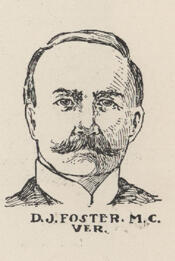
Here you will find contact information for Representative David Johnson Foster, including email address, phone number, and mailing address.
| Name | David Johnson Foster |
| Position | Representative |
| State | Vermont |
| District | 1 |
| Party | Republican |
| Status | Former Representative |
| Term Start | December 2, 1901 |
| Term End | March 21, 1912 |
| Terms Served | 6 |
| Born | June 27, 1857 |
| Gender | Male |
| Bioguide ID | F000300 |
About Representative David Johnson Foster
David Johnson Foster (June 27, 1857 – March 21, 1912) was an American lawyer and Republican politician who served as a U.S. Representative from Vermont from 1901 until his death in 1912. Over six consecutive terms in the United States House of Representatives, he contributed to the legislative process during a significant period in American history, representing the interests of his Vermont constituents and holding several important committee chairmanships.
Foster was born in Barnet, Caledonia County, Vermont, on June 27, 1857, the son of Jacob Prentiss Foster and Matilda (Cahoon) Foster. He attended the public schools in Barnet and pursued further studies at St. Johnsbury Academy, from which he graduated in 1876. He then enrolled at Dartmouth College in Hanover, New Hampshire, and completed his collegiate education there in 1880, laying the academic foundation for his subsequent legal and political career.
After graduating from Dartmouth, Foster studied law and prepared for admission to the bar. He was admitted to the bar in 1883 and began the practice of law in Burlington, Vermont. That same year he married Mabel M. Allen; the couple had three children, Mabel Foster, Mathilde Foster, and Mildred Foster. Establishing himself as a practicing attorney in Burlington, he quickly became active in public affairs and Republican Party politics at the local and state levels.
Foster’s early public career included service as Chittenden County State’s Attorney from 1886 until 1890, a role in which he was responsible for prosecuting criminal cases and representing the state in legal matters within the county. He advanced to statewide office as a member of the Vermont State Senate, serving from 1892 until 1894. In 1894 he was chosen as the first president of the Young Men’s Republican Club of Vermont, reflecting his prominence in party organization and his role in cultivating younger Republican leadership. That same year he was appointed Vermont state tax commissioner, a position he held from 1894 until 1898, overseeing matters of state taxation and revenue.
From 1898 until 1900, Foster served as chairman of the Vermont board of railroad commissioners, where he dealt with issues of regulation, transportation policy, and the oversight of railroad operations within the state. His growing reputation as an able administrator and public servant led to his election to national office. A member of the Republican Party, Foster was elected as a Republican candidate to the Fifty-seventh Congress and to the five succeeding Congresses, serving as a Representative from Vermont in the United States Congress from March 4, 1901, until his death on March 21, 1912. During these six terms in office, he participated actively in the democratic process and in shaping national legislation at a time marked by industrial expansion, regulatory reform, and increasing American engagement in international affairs.
In the House of Representatives, Foster held several key committee assignments that underscored his influence in Congress. He served as chairman of the Committee on Expenditures in the Department of Commerce and Labor during the Fifty-ninth, Sixtieth, and Sixty-first Congresses, where he was involved in overseeing federal spending and administrative efficiency in a department central to the nation’s commercial and labor policies. He also served as chairman of the Committee on Foreign Affairs in the Sixty-first Congress, placing him at the forefront of congressional consideration of the United States’ growing role in world affairs. In addition to his domestic legislative responsibilities, he was appointed chairman of the commission representing the United States at the first Centennial of the Independence of Mexico, held in Mexico City in 1910, and he served as chairman of the United States delegation to the general assembly of the International Institute of Agriculture at Rome in May 1911, reflecting his engagement with international diplomacy and agricultural cooperation.
Foster remained in office until his death in Washington, D.C., on March 21, 1912, becoming one of the members of the United States Congress who died in office in the early twentieth century. His passing brought to a close more than a decade of continuous congressional service and a longer record of public life in Vermont. He was interred in Lakeview Cemetery in Burlington, Vermont, where he had long made his home and built his legal and political career.