Representative David Sjodahl King
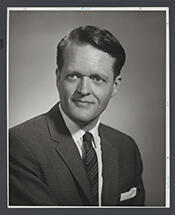
Here you will find contact information for Representative David Sjodahl King, including email address, phone number, and mailing address.
| Name | David Sjodahl King |
| Position | Representative |
| State | Utah |
| District | 2 |
| Party | Democratic |
| Status | Former Representative |
| Term Start | January 7, 1959 |
| Term End | January 3, 1967 |
| Terms Served | 3 |
| Born | June 20, 1917 |
| Gender | Male |
| Bioguide ID | K000199 |
About Representative David Sjodahl King
David Sjodahl King (June 20, 1917 – May 5, 2009) was an American attorney, diplomat, and public servant who represented Utah in the United States House of Representatives for three terms between 1959 and 1967. A member of the Democratic Party, he served in Congress during a significant period in American history, participating in the legislative process and representing the interests of his Utah constituents. Over the course of his career, he combined legal practice, public office, and extensive service in the Church of Jesus Christ of Latter-day Saints (LDS Church).
King was born on June 20, 1917, in Salt Lake City, Utah, into a family with a strong tradition of public service and religious commitment. His father, William H. King, served as a United States Senator from Utah, and his maternal grandfather was Janne M. Sjödahl, a noted LDS scholar and writer. King was also a direct patrilineal descendant of Edmund Rice, an English immigrant to the Massachusetts Bay Colony, through a line that included Samuel Rice (1634–1684) and Edmund Rice (1594–1663). He grew up in an environment that emphasized education, civic duty, and church activity, influences that shaped his later professional and religious life.
King pursued higher education at the University of Utah, from which he graduated in 1937. Shortly after completing his undergraduate studies, he served as a missionary for the LDS Church in Great Britain from 1937 to 1939. Following his mission, he enrolled at Georgetown University Law School in Washington, D.C., where he completed his legal education. In 1943 he served as a law clerk to Justice Howard M. Stephens of the United States Court of Appeals for the District of Columbia Circuit, gaining experience in federal appellate practice before returning to Utah to begin his own legal and academic career.
Upon his return to Utah, King entered both public service and private legal practice. He served as counsel to the Utah Tax Commission from 1944 to 1946, advising on state tax matters during the closing years of World War II and the immediate postwar period. Beginning in 1945, he engaged in private law practice, and from 1946 to 1958 he taught commercial law at Intermountain Business College, contributing to the training of business and legal professionals in the region. From 1948 to 1958, he also served as second assistant to Elbert R. Curtis, the ninth General Superintendent of the LDS Church’s Young Men’s Mutual Improvement Association, reflecting his growing leadership role in church youth programs.
King entered national politics as a Democrat and was elected to the 86th and 87th Congresses, serving in the U.S. House of Representatives from January 3, 1959, to January 3, 1963. During these first two terms, he participated in the democratic process at a time marked by the early civil rights movement, Cold War tensions, and domestic economic change, working to represent the interests of his Utah constituents. In 1962 he chose not to seek renomination to the House, instead running for a seat in the United States Senate; his senatorial campaign was unsuccessful. He returned to the House after being elected to the 89th Congress in 1964, serving from January 3, 1965, to January 3, 1967. His third term concluded when he was defeated in his bid for reelection in 1966, ending eight years of intermittent congressional service between 1959 and 1967.
Following his congressional career, King continued his public service in the diplomatic corps. In January 1967 he was appointed United States Ambassador to Madagascar, and in May 1968 he received a concurrent appointment as U.S. Ambassador to Mauritius. He served in both posts simultaneously until August 1969, representing American interests in the Indian Ocean region during a period of post-colonial transition and evolving U.S. foreign policy. After completing his diplomatic assignments, King resumed legal work and international service. During the 1970s and 1980s, he practiced law in Washington, D.C., and served as an alternate director at the World Bank, participating in the governance of an institution central to international development finance. He retired from professional practice in 1986 to devote his time more fully to service in the LDS Church.
In retirement, King undertook several major ecclesiastical assignments. From July 1986 to June 1989, he served as president of the LDS Church’s Haiti Port-au-Prince Mission, overseeing missionary work and church administration in a challenging environment. From September 1990 to 1993, he presided over the Washington D.C. Temple in Kensington, Maryland, directing the operations of one of the church’s prominent temples. In 1994, he was called as patriarch of the Washington D.C. Stake and of the church’s district for the District of Columbia, providing spiritual blessings and counsel to members in the area. He also authored a work on temple worship, “Come to the House of the Lord,” published in 2000 by Horizon Publishers & Distributors Inc.
King made his home in Kensington, Maryland, where he lived with his wife of 61 years, Rosalie King. The couple were the parents of eight children, among them Josephine “Jody” Olsen, who later became Director of the Peace Corps in 2018. He was preceded in death by two of his sons, David King Jr. and Elliott West King. David Sjodahl King died on May 5, 2009, closing a life that encompassed legal practice, legislative and diplomatic service, and extensive leadership in his church. Materials relating to his life and career are preserved in the L. Tom Perry Special Collections at the Harold B. Lee Library, Brigham Young University, and his public career has been documented in reference works such as the Utah History Encyclopedia.